
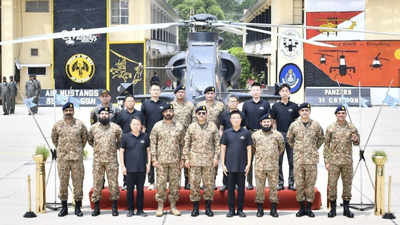
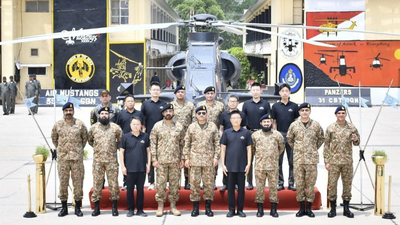
Pakistan’s reported procurement of 30 Chinese-made Z-10ME attack helicopters has brought renewed attention to the modernisation of its Army Aviation Corps, which has been looking to replace its ageing American-built Bell AH-1F Cobra fleet. The reported contract, details of which emerged through an image circulated on Chinese media, would mark a major addition to Pakistan’s attack helicopter inventory. However, neither Islamabad nor Beijing has officially confirmed the reported order or the number of helicopters involved. The report comes as India expands its own fleet of Light Combat Helicopters (LCH) Prachand, built for mountain warfare.The report comes from an image on Chinese social media, shared by a military blogger known as Sashoujian. It claims that China National Aero-Technology Import and Export Corporation (CATIC) signed a contract with Pakistan’s defence ministry for 30 Z-10ME helicopters, with associated equipment and services. The image does not give the year and has not been independently verified, and neither Islamabad nor Beijing has confirmed the order. Pakistan did formally induct the helicopter on August 2, 2025, at Multan Garrison, in a ceremony led by Army chief Field Marshal Asim Munir, though it did not disclose how many were inducted.The Z-10ME is an export variant of China’s Z-10, built by Changhe Aircraft Industries Corporation (CAIC). It carries extra armour, missile approach warning sensors, radar warning systems, countermeasures and a millimetre-wave radar above the main rotor. Its armament includes anti-tank guided missiles, air-to-air missiles, rocket pods and a cannon.
Why Pakistan turned to China
The Army Aviation Corps has been trying to replace its ageing American-built Bell AH-1F Cobra helicopters since 1985. In April 2015, the US State Department approved a possible sale of 15 AH-1Z Viper helicopters worth an estimated $952 million, but the planned deliveries did not take place after Washington froze military aid to Pakistan in 2018. Islamabad then signed a $1.5 billion contract in 2018 with Turkey for 30 T129 ATAK helicopters. That deal stalled because the US withheld export licences for the engines made by the Light Helicopter Turbine Engine Company (LHTEC), and Pakistan eventually abandoned it and turned to the Z-10.
India’s high-altitude answer
India’s Prachand is designed for mountain operations and, according to the Ministry of Defence (MoD), can take off and land at 5,000 metres with adequate fuel and payload. The Indian Air Force (IAF) inducted its first helicopters in October 2022 as part of 15 limited-series production helicopters, 10 for the IAF and five for the Army. On March 28, 2025, the MoD signed two contracts worth Rs 62,700 crore with Hindustan Aeronautics Limited (HAL) for 156 helicopters, 90 for the Army and 66 for the IAF. Deliveries are due to begin in the third year of the contract and run over the next five years, with more than 65% indigenous content and over 250 domestic firms involved.The Prachand carries a 20mm turret gun, 70mm rocket pods and air-to-air missiles, and is powered by two Shakti turboshaft engines, with a service ceiling of 6,500 metres. The weaponised version of the ALH Dhruv, the Rudra is the most numerous armed helicopter in the country, this chopper in service with both the army and IAF. The Rudra is equipped to carry a 20mm cannon and 70mm rockets. This helicopter, along with the Prachand, will get the Helina and the Dhruvastra missile soon.The Indian attack helicopter fleet also consists of 28 Boeing AH-64E Apache, which functions as the heavy, network-centric element. It is armed with AGM-114 Hellfire missiles and Longbow radar. The IAF operates 22 of these advanced choppers, while the army operates the remaining six. India also operates the Russian-origin Mil Mi-35 attack helicopters, which will be retired from service in the coming years.
How India and Pakistan’s attack choppers compare
Placing the two helicopters side by side shows how differently they were designed. The Z-10ME is a medium-weight platform with a maximum take-off weight of around 7,000-7,200 kg, powered by two WZ-9G engines that reportedly produce about 1,500 shaft horsepower each. Its top speed is around 300 kmph, and its range is reported at about 800 km, though published figures vary. The Prachand is lighter, at 5,800 kg, with two Shakti engines, developed by HAL with Safran, of about 1,400 shaft horsepower each. It has a cruise speed of 270 kmph, a range of 580 km and an endurance of around four hours.The biggest difference is the ability to operate at the higher altitudes of the Himalayas. The Prachand has a service ceiling of 6,500 metres and can take off and land at 5,000 metres with adequate fuel and payload, which matters in eastern Ladakh, Siachen and other high areas along both the Line of Actual Control as well as the Line of Control. The Z-10ME has had engine and airframe upgrades, but public information does not show an equivalent demonstrated capability with a substantial combat load. A service ceiling should not be confused with the ability to operate from high-altitude helipads carrying weapons and fuel.The Z-10ME carries a 23mm cannon and has four external weapon stations, with missiles reportedly drawn from China’s KD-9, KD-10 and HJ-10 families, which gives it a more extensively documented anti-armour package. The Prachand has a 20mm turret gun, 70mm rocket pods and air-to-air missiles, with the indigenous Dhruvastra anti-tank missile being integrated. The Z-10ME’s millimetre-wave radar above its rotor lets it scan for targets from behind ridgelines, and HAL lists no comparable radar for the Prachand.The Prachand has the advantage in publicly demonstrated high-altitude performance, and the Z-10ME in a better-documented radar and anti-armour fit. A definitive comparison of combat effectiveness is hard to make, because independently verified data on the Chinese helicopter, particularly its high-altitude payload and sensors, is not available.