
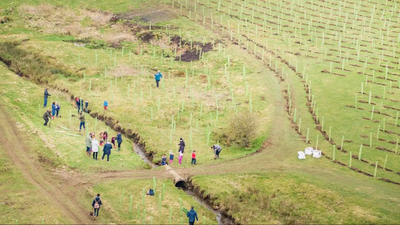
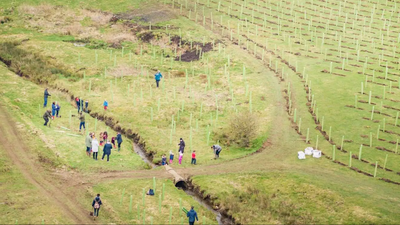
Four years after moving 2,500 acres of North Yorkshire farmland away from intensive farming, conservation teams at Broughton Sanctuary have recorded more than 1,700 species and planted 330,000 trees across the estate. According to the Broughton Sanctuary State of Nature Recovery Report, published in December 2025, 80 per cent of the 1,030-hectare historic site near Skipton is now managed through rewilding and nature-friendly farming methods. The land was previously mainly used as monoculture pasture. Supported by the White Rose Forest through the UK Government’s Trees for Climate programme, tree cover across the estate rose from less than 5 per cent in 2020 to more than 35 per cent by the end of 2025.
Woodland expansion and species counts
The estate’s tree-planting programme has added 19 native broadleaf species across 400 hectares. These young woodland corridors link areas of broken-up habitat, helping wildlife move between them while also supporting carbon capture and natural flood management. Surveys included in the report have recorded more than 1,700 species across the restored land. Reduced intensive grazing allowed longer grasses to grow, leading to an increase in small mammals and attracting more birds of prey. All five native British owl species now live at the sanctuary: Barn, Tawny, Little, Long-eared and Short-eared owls. Field observations suggest Short-eared Owls are almost certainly breeding on the estate for the first time in decades. Other birds of prey recorded include Peregrine Falcons, Merlins, Hen Harriers, Red Kites and Sparrowhawks. To help birds of prey nest, conservationists installed 13 Barn Owl boxes and 13 Kestrel boxes supplied by specialist Colin Shawyer. Monitoring carried out with Stephen Downing of the Northern England Raptor Forum recorded 33 Barn Owl chicks and 13 Kestrel chicks ringed in 2024. A long spring drought in 2025 reduced vole numbers and delayed nesting, but late-summer broods recovered, leading to six more Barn Owl chicks being ringed. Alongside broadleaf planting, the estate worked with Benedict Pollard of Mighty Fine Oaks to plant 76 specimen oaks in the registered parkland. The trees were grown from acorns collected from historic British trees. The project aims to protect genetic diversity and create a supply of veteran trees for future generations.
Habitat engineering through livestock
Natural changes across the estate are also being driven by carefully managed livestock grazing. The sanctuary currently has 57 Riggit Galloway cattle, three Iron Age pigs, three Dales ponies and 15 Roe Deer. The Riggit Galloway cattle are managed with local farmer Neil Heseltine of Hill Top Farm in Malham and remain outdoors throughout the year. They graze without chemical treatments, regular medication or silage, helping stop aggressive plant species from taking over open grassland. The three Iron Age pigs were introduced in August 2024 and act as natural soil engineers. Their rooting breaks up compacted ground, exposing old seedbeds and creating patches of bare soil. Botanical monitoring found new plants growing in these disturbed areas, including Common Eyebright, Sneezewort, Creeping Cinquefoil, Bird’s-foot Trefoil and Mouse-ear Hawkweed. Self-seeded birch, oak and cherry saplings were also recorded. Thistles growing in the disturbed areas provided nectar for pollinators late in the season and attracted groups of Goldfinches feeding on their seed heads. In wet areas, a family of beavers made up of two adults and one kit continues to change local watercourses. Their dams hold water across the landscape, create wetland areas and slow the flow of streams during storms.
Infrastructure changes and future targets
Physical barriers across the sanctuary have also been changed to help animals move more freely. Teams removed 17 kilometres of fencing, creating connected routes through pasture, woodland and moorland. Water management work included creating seven wetland scrapes and ponds to hold water on floodplains. A 30-kilometre trail network, called the Odyssey Nature Trail, was opened to give the public access to selected nature recovery areas. Figures in the report show that 200 local volunteers helped with habitat management during 2025. Educational programmes brought 7,331 children to the site for school visits, while general public activities reached 1,500 people during the year. The number of staff working on nature recovery also increased from two full-time positions to seven. The report’s 10-year plan sets out further goals for the period from 2026 to 2036. Planned work includes expanding wetlands created by beavers, developing self-sustaining herds of rare-breed livestock and restoring floodplains by reversing old drainage ditches. Estate managers also plan to bring back native species that are missing from the area, starting with the Harvest Mouse in 2026. Other work will focus on restoring moorland, planting gullies and gradually removing non-native plants such as Rhododendron and Laurel from existing forests.