
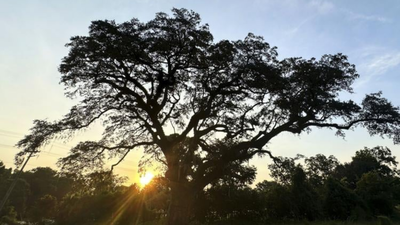
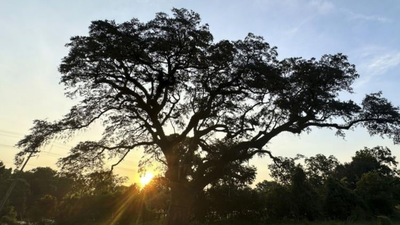
Specialist arborists have begun careful restoration work in South Carolina to save a 300-year-old southern live oak that stood near one of the final major battles of the American Revolutionary War. The huge tree stands at the historic Eutaw Springs battlefield in Orangeburg County. It survived musket fire, artillery attacks and centuries of harsh weather. But support systems added decades ago to hold its split trunk together have now become a danger. Heavy iron chains and steel cables wrapped around the branches have grown into the bark, putting pressure on the tree and blocking the movement of water and nutrients through its living tissue. Crews from SavATree, a specialist tree care company, are carrying out a multi-stage restoration project. The work includes removing the metal, improving the soil around the tree and adding modern, flexible support systems to help extend its life.
Old metal supports are now harming the tree
The oak’s current problems began after a powerful lightning strike more than 50 years ago damaged its canopy and split its large trunk. To stop the heavy tree from collapsing, landowners installed thick steel cables and iron chains around its main branches. The supports held the damaged limbs together for decades. But as the oak continued to grow, its trunk and branches slowly grew around the metal. The steel has now become tightly embedded in the tree, creating a serious problem. It is putting pressure on the cambium layer, the part of the tree that carries nutrients and other materials between the roots and leaves. “Those cables and chains that saved the tree’s life are now unfortunately slowly killing the tree,” said Aron Landsaw, a certified arborist with SavATree who is leading the work. “It’s basically choking out the bark so it can’t pull up nutrients.” Arborists are carefully removing metal links that can still be reached. They are also cutting tight cables and other supports to reduce pressure on the branches. “Once we remove the cables, the tree should be able to start pulling up some of those nutrients,” Landsaw explained. “And it should thrive.” The restoration is expected to take at least a year of intensive treatment. After that, scientists will assess the tree’s structure and the health and density of its leaves.
Oak stands as a witness to the Eutaw Springs battle
The historic tree stands near the centre of the Eutaw Springs battlefield, where American and British forces fought a major battle on 8 September 1781. American troops under General Nathanael Greene launched a surprise morning attack on British forces led by Lieutenant Colonel Alexander Stewart. Continental soldiers initially pushed through the British camp. British troops later regrouped behind the thick brick walls of a nearby farmhouse, stopping the American advance. Although Stewart’s forces held the area by nightfall, heavy British casualties forced them to retreat towards Charleston. The withdrawal effectively ended British control over much of the South Carolina interior just weeks before the siege of Yorktown. “We’re really standing at the central point of the Eutaw Springs Battlefield,” said Catherine Noyes, Liberty Trail Program director and deputy director of land preservation for the American Battlefield Trust. “The British camp was on this property … all around this tree right behind us.” Historical researchers say the oak also provided shade and shelter to soldiers and their horses during the battle and the hot late-summer campaign. “It is a witness tree. It witnessed this battle,” said Garrison Marcoux, a historian with the South Carolina Battleground Preservation Trust. “It provided shade to the men and their horses in the intense South Carolina September sun.” Marcoux said it is unusual for trees this old to survive in the region, especially after facing severe weather and other environmental pressures over many decades. “It’s a living relic,” Marcoux said. “It’s unbelievable to think about.”
Restoration begins ahead of 250th anniversary
The survival of the Eutaw Springs oak is especially significant in South Carolina, where many old trees have been lost to major storms and other natural disasters. Former South Carolina State Parks Director Phil Gaines said extreme weather, including Hurricane Hugo in 1989, destroyed much of the region’s historic tree canopy. That has made surviving 300-year-old trees particularly rare. The initial $20,000 restoration project is being funded equally by the American Battlefield Trust and the South Carolina 250 Commission. The work comes as South Carolina prepares events marking the 250th anniversary of the founding of the United States. Removing the old metal is only part of the restoration. Tree care crews are also improving the soil around the oak. They are using deep-root aeration, organic treatments and low-pressure liquid fertiliser around the tree’s drip line. These measures are intended to reduce soil compaction caused by visitors, machinery and years of use around the battlefield. Specialists are also installing a modern lightning protection system. Copper conductors will run down the trunk to help protect the canopy if the tree is struck again. Restoration teams will check soil moisture and the density of the leaf canopy every three months. The monitoring will help determine whether the oak is recovering and rebuilding its natural system for moving water and nutrients after the damaging metal supports are removed.