
In an increasingly volatile geopolitical environment, the government has doubled down on the idea that defence preparedness and indigenisation are no longer optional extras but core strategic necessities, with the stated ambition shifting from the familiar Make in India slogan to something more ambitious still, Owned by India. India’s defence establishment has spent the past year pushing an ambitious agenda of self-reliance. The numbers and policy shifts released by the defence ministry tell a fairly comprehensive story of just how far this transformation has gone.
Policy changes to accelerate modernisation
At the policy level, several major reforms have reshaped how India buys and builds its weapons. A review of the Defence Acquisition Procedure (DAP), first introduced in 2020, got underway in 2025, with the draft DAP 2026 focused on strengthening realistic self-reliance, easing business processes and enabling faster acquisition of rapidly evolving technology through what is being called spiral acquisition, essentially procuring in phases rather than waiting for a finished, static product.
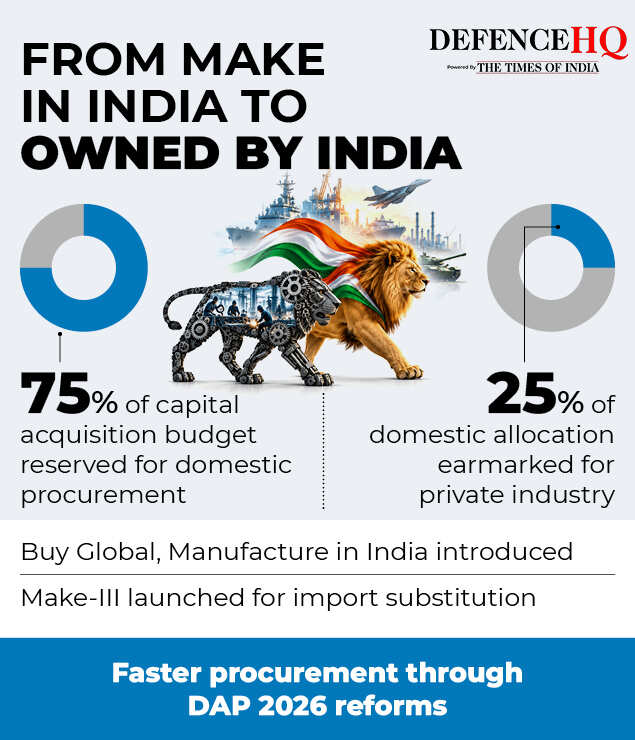
The government is investing in domestic industry through procurement of indigenous equipment.
It is good to note that the government has earnestly pivoted to Atmanirbharta in defence aquisition and procurement. It is carrying out targeted spending to enlarge India’s defence Industrial Base. The results are also visible. However all these efforts are tactical in nature with short term outcomes. If one looks ahead, there is a requirement to put in place such policies and structures which will enhance capabilities in a balanced manner. It should also come up with a plan to plug gaping holes in our long range over the horizon fighting capabilities – both manned and unmanned. Presently it appears that our politico military leadership has not been able to come to terms with the realities of modern day wars. Alarmingly our adversaries have been active and seem to have taken a lead in this sphere.
Lt Gen PR Shankar (retd), Professor, Aerospace Dept IIT Madras and former DG Artillery
Perhaps the most consequential of these reforms is the mandatory allocation for domestic capital procurement. To guarantee Indian manufacturers a predictable share of the defence market, the government has progressively raised the portion of the capital acquisition budget reserved exclusively for domestic procurement from 58% to 75%, with a dedicated quarter of that domestic allocation specifically carved out for private industry rather than public sector firms alone. The government has also carried out a full review of capital procurement timelines, shortening them through greater delegation of decision-making authority, removal of duplicate steps and increased automation.This is complemented by a new ‘Buy Global, Manufacture in India’ category, which nudges foreign original equipment manufacturers to set up subsidiaries and manufacturing facilities within India itself, ensuring that even critical spares and components get indigenised over time rather than remaining permanently import-dependent.
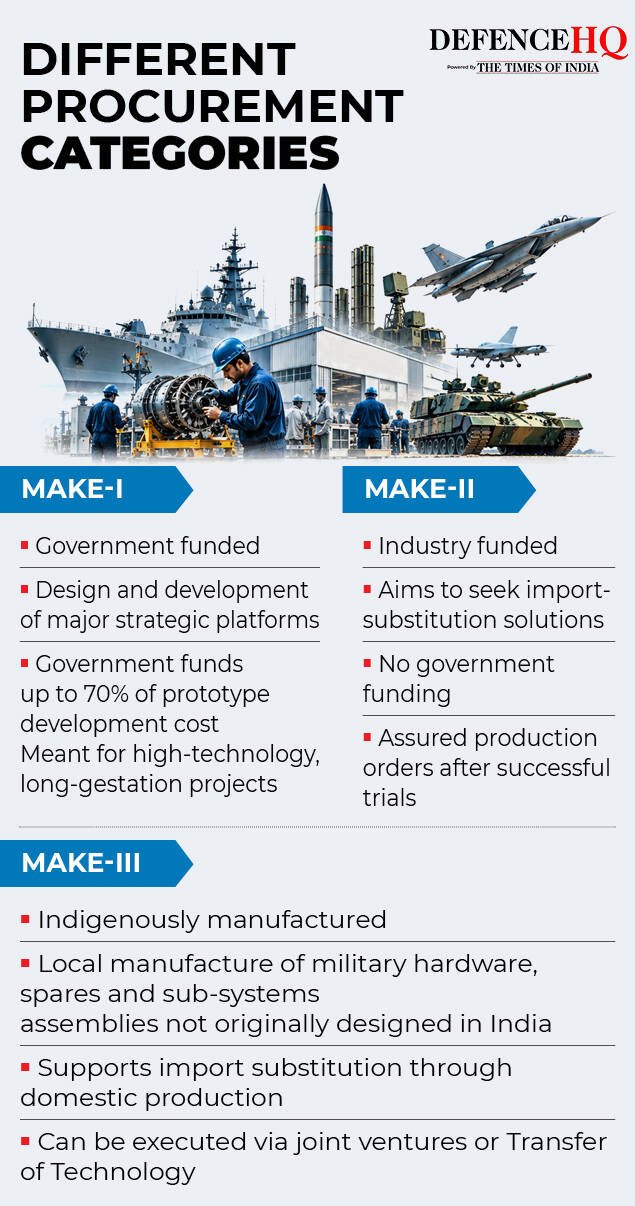
The defence ministry has created different categories through which indigenisation can be increased.
A new Make-III category has also been introduced specifically for import substitution, targeting components and sub-systems that were not designed in India but can be manufactured locally, offering domestic firms a faster procurement route and cutting the lifecycle costs of maintaining existing military equipment. Capital acquisition cases valued up to Rs 100 crore are now exclusively reserved for MSMEs, provided at least two eligible MSMEs participate, this threshold can stretch to Rs 150 crore.The government has also tied its innovation schemes far more directly into actual procurement. The iDEX and Technology Development Fund schemes, once seen mainly as research initiatives, now feed directly into fast-tracked Acceptance of Necessity (AoN) approvals, meaning successful startup prototypes can move straight into procurement, with participating startups guaranteed up to five years of assured orders once their technology is validated.The Make-I category, which governs indigenous prototype development, has similarly been simplified, with the government now funding 70% of prototype development costs and opening up previously restricted testing facilities to private industry, removing much of the financial risk that once discouraged companies from investing in defence R&D without any guarantee of an eventual contract.
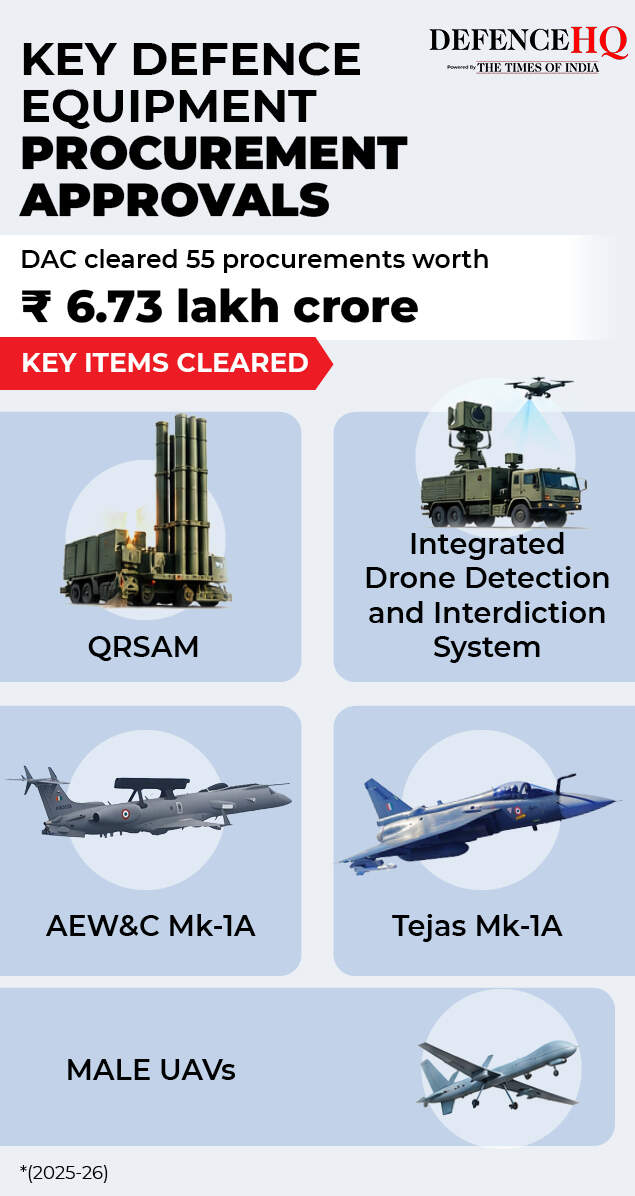
In the last fiscal, the defence ministry cleared deals worth Rs 6.73 lakh crore for the armed forces.
Over the course of 2025-26, the defence minister chaired defence acquisition council cleared 55 capital acquisition proposals worth roughly Rs 6.73 lakh crore. Among the key approvals were the indigenous QRSAM air defence system, an upgraded integrated drone detection and interdiction system and an advanced AEW&C Mk-1A variant of the existing Netra airborne early warning aircraft. Th body also cleared major projects such as Medium Altitude Long Endurance drones for all three services, contracts for 97 more Tejas Mk-1A fighters and a significant agreement to procure Rafale Marine fighters for the Navy.
Forces charting own path
The Army’s own modernisation push has been shaped heavily by the operational lessons of the past year, with new technology areas like artificial intelligence, autonomous systems, hypersonic weapons, drones and directed energy weapons all identified as likely disruptors of warfare over the next two decades. Several structural changes have followed. An Independent Armoured Brigade and a Mountain Brigade are being reorganised into what’s being called a Rudra All Arms Brigade, designed to converge combat power across different arms for greater synergy, with orders issued in July 2025.
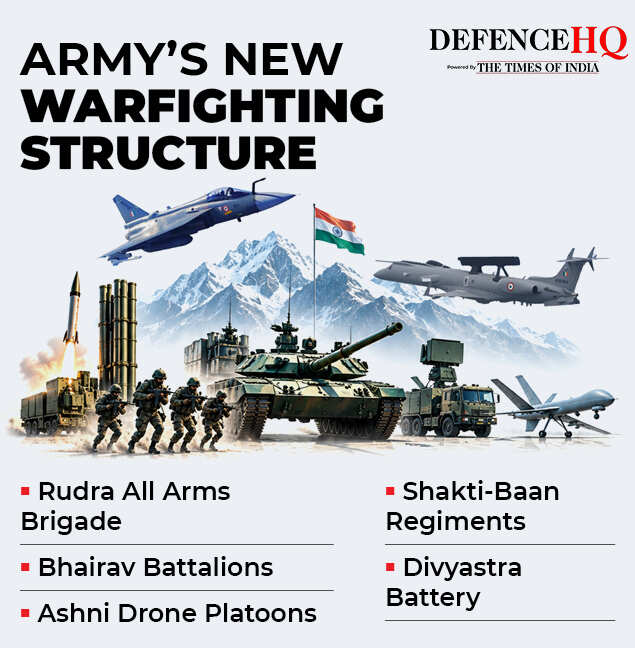
The army is tinkering with its structure to make the force more combat effective.
The Army has also begun raised Bhairav light commando battalions, each roughly 264 personnel strong, purpose-built for hybrid warfare and high-tempo operations, alongside new Shakti-Baan artillery regiments and Divyastra batteries formed by reorganising existing medium artillery regiments. To boost drone surveillance at the battalion level, every infantry battalion is set to raise its own Ashni drone platoon, built by reinforcing existing reconnaissance elements rather than creating entirely new units from scratch.The Army has also moved decisively on unmanned systems following gaps exposed during Operation Sindoor, where domestic industry struggled to supply niche products in the UAS, counter-UAS and loitering munitions space. In response, a dedicated Core Committee now oversees all decisions on UAS and counter-UAS induction, a Special Purpose Vehicle is being planned to fast-track related R&D and procurement with special financial powers and nine Fast Track Development Projects have been endorsed under the ADITI and iDEX schemes to close these capability gaps quickly. On the manufacturing side, the Army’s own drone production has scaled up significantly.In the same time frame the navy notched up a series of major indigenous commissionings through this time frame. Since April 2025, the Indian Navy has steadily inducted new indigenous warships, starting with INS Arnala, followed soon after by INS Nistar. Come August, a landmark moment arrived with INS Udaygiri and INS Himgiri commissioned together, the first simultaneous commissioning of frontline warships from two different shipyards. INS Androth followed in the months after, then INS Ikshak and INS Mahe.The pace carried into 2026. INS Anjadip was commissioned early in the year, followed by a significant double induction, INS Aridhaman, India’s nuclear ballistic missile submarine, alongside the frigate INS Taragiri. Not long after came the Navy’s biggest single-day induction yet, with INS Dunagiri, INS Sanshodhak and INS Agray commissioned together at Kolkata. Most recently, INS Nipun joined the fleetThe navy too had deployed for Operation Sindoor. Frontline ships including the Carrier Battle Group and submarines were forward deployed into the North Arabian Sea in an offensive posture, maintaining persistent maritime domain awareness through a networked combination of surface, air, space and shore-based assets. This forward presence, denying operational space to any adversary at sea, is credited with playing a significant role in Pakistan’s request for an urgent ceasefire on May 10, 2025, with Navy Special Forces also taking part in precision strikes on terror infrastructure on May 7.For the Air Force too, Operation Sindoor stands as the defining episode of the year. The IAF carried out precision strikes on terror targets deep inside Pakistan using long-range precision-guided weapons. When Pakistan escalated with drone and missile attacks on India, the IAF’s Integrated Air Command and Control System coordinated a layered defence successfully neutralised multiple Pakistani aircraft and thus denied Pakistan operational freedom. As Pakistan widened its targeting to civilian infrastructure, the IAF responded by striking Pakistani air defence radars, command centres and military infrastructure. Perhaps the most striking single achievement came when an S-400 unit destroyed a Pakistani special mission aircraft from 314 kilometres away, the longest surface-to-air kill of its kind. 219 Presidential Gallantry Awards were conferred on IAF personnel in recognition of their role in the operation.