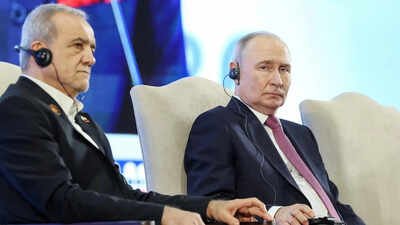
A non-public Russian government document shows Moscow was working to build a broad economic and strategic partnership with Iran, including alternative financial channels that could help the two countries reduce their exposure to Western sanctions.The 44-page Russian-language document, titled “Plan for Cooperation Between the Russian Federation and the Islamic Republic of Iran for 2024-2026,” was approved by Russia on September 2, 2024. Marked “For official use,” it assigns Russian ministries, agencies and state companies specific responsibilities and deadlines for projects running through the end of 2026, according to a Fox News Digital report.The plan also covers alternative payment systems, nuclear cooperation, oil and gas projects, aircraft-component production in Iran, new rail and shipping links, technology cooperation and coordination through international organizations such as Brics.The roadmap was drawn up more than a year before the current war involving Iran and the United States. It therefore does not show which projects remain active or how the conflict changed Moscow’s plans. However, a review of the document and later public reporting shows that several initiatives included in the plan subsequently moved forward.“The roadmap is not revelatory: people paying close attention to the relationship between Russia and Iran will see many collaborations between the two countries that have been public for years,” Fox News Digital quoted Keti Korkiya, a research analyst with the Foundation for Defense of Democracies’ Russia program, saying.“What is more revealing is the architecture of the relationship Moscow is trying to build,” she said, pointing to financial mechanisms, transportation routes, energy investment and aviation cooperation as different ways of reducing vulnerabilities created by sanctions and Western economic pressure.
Building financial system outside the West
Some of the most significant provisions deal with how Russia and Iran planned to move money between the two countries.The roadmap sought to increase the share of bilateral trade conducted in Russian and Iranian national currencies from 68% in 2024 to 71% by 2026. It also called for expanding correspondent banking accounts denominated in national currencies.The plan went further, directing the Bank of Russia and the Central Bank of Iran to develop the use of central bank digital currencies for cross-border payments.Another provision called for “ensuring the use of independent systems for transmitting financial messages,” including connections between financial institutions using independent channels to exchange financial information.The document does not specifically name SWIFT or explicitly say that the systems were intended to bypass US financial controls. Instead, it calls for greater use of national currencies, independent financial infrastructure and measures against what Moscow calls “unilateral restrictive measures.”A European intelligence source who reviewed the document told Fox News Digital that the plan covers areas including nuclear programs, energy and financial transactions that “aim to evade the US sanctions.”In February 2025, Russian deputy PM Alexei Overchuk said Russia and Iran had “practically completely” shifted bilateral settlements into national currencies using their own financial and banking messaging systems.Iran’s ambassador to Russia said around the same time that the two countries no longer needed SWIFT for their bilateral banking relationship and were using confidential systems of their own. He also said the first phase of connecting Iran’s Shetab payment network with Russia’s Mir system had begun the previous year.Korkiya described the strategy as an effort to create redundancy in the relationship.“Individually, none of these initiatives is transformative,” she wrote. “Collectively, however, they amount to an attempt to remove single points of vulnerability and build redundancy into the Russia-Iran economic relationship.”
Nuclear cooperation at Bushehr
Russia’s state nuclear company Rosatom was assigned responsibility for continued cooperation at Iran’s Bushehr nuclear power plant, including fuel and maintenance support for Unit 1 and construction work involving Units 2 and 3.Some of that cooperation existed before the roadmap. The document incorporated the Bushehr projects into its wider framework rather than creating them from scratch.The cooperation has continued.On Sept 2, 2026, Rosatom said Russian specialists had begun returning to Bushehr. The company said Unit 1 was preparing for scheduled maintenance and partial fuel replacement and that nuclear fuel had already been delivered to the facility.Rosatom also said work was continuing at the plant and that additional Russian specialists were expected to arrive.
Russian aircraft parts could be produced in Iran
The document calls for Russia to help establish production in Iran of individual parts and assemblies for Russian aircraft.Russian authorities were instructed to identify aircraft parts that could be repaired or manufactured in Iran, find Iranian companies capable of producing them and have selected facilities certified by Russia’s aviation regulator, Rosaviatsiya.The roadmap set March 31, 2026, as a deadline for an agreement on localized production and Dec. 31, 2026, as the target for beginning prototype production.There is public evidence that aviation cooperation between the countries expanded, although the more ambitious aircraft-parts provision has not been independently confirmed as implemented.In February 2025, Rosaviatsiya’s chief said three Iranian companies had been approved to perform maintenance and airworthiness work on Russian-operated aircraft. The move followed maintenance of an Aeroflot Airbus A330 in Tehran.Russian officials also discussed broader aviation cooperation with Iran, including aircraft manufacturing and joint work on passenger-aircraft engines.
Oil, gas and hidden financing
The roadmap names three Iranian oil and gas projects where Russia sought a role: Shadegan, Kish and North Pars.Russia’s Energy Ministry and unspecified Russian companies were assigned responsibility for advancing the projects.In several cases, the document lists financing as “confidential.”At least one of the projects later showed signs of progress. Interfax reported in February 2026 that Russian state-owned ZN-Vostok was developing Iran’s Shadegan oil field. Iranian officials also said Tehran wanted to expand Russian investment in additional oil and gas projects.The document set deadlines for work on Shadegan through 2025, while projects involving Kish and North Pars extended into 2026.
A new trade route to the Persian Gulf
Russia and Iran also planned to expand their transportation links.The document calls for work on a proposed railway using Russia’s 1,520-millimeter track gauge that would run from Iran’s border with Azerbaijan toward ports on the Persian Gulf.Another major project is the Rasht-Astara railway, a roughly 162-kilometer missing section of the International North-South Transport Corridor.Russia and Iran launched engineering surveys for that railway in May 2025, according to Russia’s Transport Ministry.The project had not reached full construction by late summer 2026, with the two governments still working on implementation and construction arrangements.The roadmap also called for Iranian investment in port infrastructure in Astrakhan, Russia, including a terminal, warehouses, a logistics park and facilities for grain and vegetable oil.
Cooperation extends to media and technology
The plan reaches beyond finance, energy and transportation.It calls for Russian and Iranian media organizations to exchange content, train journalists and produce joint media projects.The document also seeks Russian technology contracts in Iran covering information and communications technology, “information security,” telecommunications and the video-game industry.The two countries were also expected to coordinate through Brics and other international institutions in opposition to what Moscow describes as “unilateral trade restrictions.”Korkiya said the strategy was not limited to finding ways around sanctions.“Especially interesting is that the roadmap also goes beyond practical sanctions workarounds and includes an effort to build an intellectual and diplomatic campaign against sanctions themselves,” she wrote, citing plans for expert communities, discussion platforms and an international forum focused on unilateral restrictions.The document itself does not establish that every project was completed or remains active. But its detailed assignments, deadlines and financial provisions show that Moscow was seeking to make its relationship with Tehran broader and more resilient well before the current US-Iran war.