
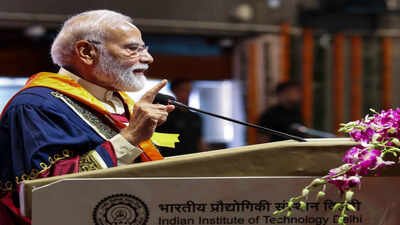
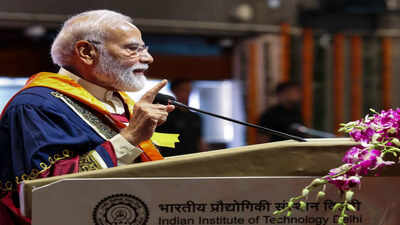
“Wish there were more daughters among the medalists.” Prime Minister Narendra Modi’s remark at the IIT Delhi convocation speech. Prime Minister Narendra Modi on Saturday expressed his desire to see more women among the medal winners and award recipients at IIT Delhi’s convocation. It again touched a wound at the very structure of the academics that has long been addressed but never solved.It carries a question that transcends the ceremony itself: Where are the women when India’s most prestigious engineering institutions celebrate academic excellence?At a convocation, medals are supposed to represent the culmination of years of hard work, competition and perseverance. Yet the absence of enough women among those receiving them points towards a problem that begins much earlier than the final stage of an IIT education.The issue is not simply that fewer women are standing on the convocation stage. The more uncomfortable question is why, despite years of policy interventions, expanded seats and repeated calls for gender diversity, women continue to account for only about one-fifth of IIT undergraduate engineering admissions.And the numbers suggest that India may have reached a point where adding more seats for women alone is no longer enough.
The numbers have moved, but the needle has barely shifted
According to data from the Joint Implementation Committee (JIC), women accounted for 20.15 percent of total BTech admissions in IITs in 2025.On the surface, that appears to be an improvement. Dig it deeper, and reality hits on the face.Compare it with 2020, when women constituted 19.90 per cent of total BTech admissions. Five years. A difference of just 0.25 percentage points.The absolute number of female students admitted did rise, from 3,185 in 2020 to 3,664 in 2025. But the total number of seats filled also expanded substantially, from 16,061 to 18,188.In other words, more women entered IITs, but their share of the overall student population remained almost frozen.
| Year | Total seats filled | Female candidates admitted | Female share |
| 2020 | 16,061 | 3,185 | 19.90% |
| 2025 | 18,188 | 3,664 | 20.15% |
That statistic deserves more scrutiny than a simple headline celebrating an increase in female admissions.Because if the proportion has barely changed in five years, is the system actually becoming more gender-diverse, or are we merely becoming better at increasing the absolute number of women without changing the underlying equation?
The 20 percent intervention worked, until it stopped moving the needle
The education system did not brush the problem under the carpet. The Supernumerary Seats Scheme (SSS), introduced in 2018, was specifically designed to increase female participation in IIT BTech programmes. Under the scheme, additional seats were created for female candidates with the broader objective of taking women’s representation to around 20 per cent.The early results were significant.Female representation, which stood at just 8 per cent in 2016, rose to nearly 20 per cent by 2020. That was an important breakthrough.But the subsequent numbers tell another story.By 2025, 3,633 female-only seats, including supernumerary seats, were allotted. Another 31 women secured admission through the gender-neutral pool, suggesting that more female candidates are also competing successfully on the common merit route.Yet the overall female share remained around 20 percent. This is where the conversation needs to move beyond quotas and reserved capacity.A policy can open a door. It cannot necessarily persuade a young woman to walk through it.
The real IIT gender gap may begin long before JEE
An IIT seat is not won on the day of admission.For many students, the journey begins years earlier, with mathematics in school, exposure to science, parental expectations, access to coaching, confidence in solving difficult problems, and, eventually, the decision to prepare for the JEE.For girls, each of those stages can carry an additional layer of social calculation. IIT preparation often involves two years of intense coaching. In many cases, that means moving away from home and living in coaching hubs.For a boy, such relocation may be treated as an investment in his future. For a girl, families can still worry about safety, accommodation, distance from home, and the social environment.That difference in calculation can become an ordeal for female aspirants long before the examination hall.The question, therefore, is not merely how many girls qualify for IITs?It is also: How many girls are encouraged to attempt the journey in the first place?
Money is another invisible filter
Competitive engineering preparation is expensive. Coaching fees, accommodation, travel, study material and the opportunity cost of spending two years preparing for an extremely competitive examination can create a formidable barrier.Students from financially secure families may have access to specialised coaching, personalized guidance, and extensive preparatory material.Others may not. And when resources are limited, family priorities can influence who gets the larger educational investment.This is where gender stereotypes creep in and become consequential. If a family subconsciously views engineering as a more natural career for a son while expecting a daughter to choose a career closer to home, the inequality may never appear in an admission statistic.By the time the IIT admission list is released, the decision has already been made.
What happens to the girls who do make it?
There is another question that deserves attention.What are the choices of high-ranking female candidates after they qualify? The source data points to a troubling possibility: some top-ranking female candidates may choose institutions closer to home or universities offering academic environments they perceive as more flexible.That raises a fundamental issue. If a young woman has the academic ability to enter an IIT but chooses another institution, should the conversation still be limited to increasing IIT seats for women?Perhaps not. The question then becomes whether India’s social structure is knitted in a way that it is sufficiently accommodating to women in the first place.Concerns around campus climate, branch allocation, and the perceived culture of engineering disciplines can influence those choices.An admission system can make a seat available. The institution still has to make the student want to stay.
The confidence gap starts before the coaching centre
The gender divide in engineering cannot be explained entirely by what happens after Class 10 or during JEE preparation.It often begins much earlier. Mathematics and physics can become psychologically coded as “boys’ subjects” through seemingly ordinary experiences: Who is encouraged to participate in problem-solving, who is told they are naturally good at numbers, who gets additional academic support, and whose mistakes are treated as evidence that a subject is “not meant for them.”Experts cited in the source material point to insufficient early exposure to STEM, uneven parental encouragement, and a lack of sustained institutional support as contributing factors.This is perhaps the most difficult part of the problem because confidence cannot be created through a notification.A girl who spends years being subtly told that engineering is difficult, unsafe, male-dominated or unsuitable for her may never seriously consider IIT as her destination.And that means the gender gap begins before the entrance examination even begins.
A medal is not just a medal
This brings us back to the Prime Minister’s remark at IIT Delhi. “Wish there were more daughters among the medallists.”The statement can be read as a call for greater participation. But it should also prompt a harder conversation about what happens before a student reaches the convocation stage.A medal is the final visible outcome of a very long chain of decisions.Who was encouraged to study mathematics?Who was allowed to move to another city for coaching?Who could afford the preparation?Who had access to quality teachers?Who was told that an IIT degree was worth the risk?Who was made to believe that a demanding engineering career was compatible with being a woman?And, finally, who felt that an IIT campus was a place where she belonged?If the answers to those questions continue to differ by gender, the problem cannot be solved simply by adding seats.
IITs need to ask a more uncomfortable question
The 20 per cent mark was a meaningful milestone when India was trying to correct an extraordinarily skewed gender balance.But a ceiling can eventually become a warning sign.If female representation rose sharply from 8 percent in 2016 to nearly 20 percent by 2020, and then remained around 20 percent through 2025, policymakers should ask why the momentum disappeared.Was the intervention successful but incomplete?Are the remaining barriers largely social rather than institutional?Are enough girls even entering the JEE pipeline?Are IITs losing qualified women to other institutions?And are engineering departments doing enough to make women feel that they are not merely admitted students but equal stakeholders in the institution?These are not questions that a reservation formula can answer.
From quotas to culture: The next reform must start much earlier
The next phase of gender reform in engineering needs to move beyond admission statistics. Schools need stronger exposure to STEM careers. Parents need to be encouraged to view engineering as equally viable for daughters. Students from smaller towns need access to high-quality preparation without necessarily having to relocate. Mentorship needs to begin before the JEE years rather than after admission.IITs, meanwhile, need to examine campus culture, academic flexibility, mentorship, accommodation and the everyday experiences of women students.The objective should not be to produce a statistic that looks better. It should be to create a system in which a talented girl from any part of India can look at an IIT and think: That place is for me.
The bigger test for India
India cannot aspire to become a technology powerhouse while allowing half its population to remain underrepresented in the institutions producing its engineers, researchers, and technology leaders.The IITs are not merely colleges. They are pipelines into some of the country’s most influential scientific, technological, and corporate careers.That makes the gender gap more than an education issue.It is an economic issue. A social issue. A talent issue. And, ultimately, an issue of national capacity.The Prime Minister’s wish for more daughters among IIT medallists should therefore not end with applause at a convocation.It should begin a much larger reckoning. Because the real question is not why aren’t there enough women holding medals?The real question is much more uncomfortable:How many girls with the ability to win those medals never got the chance to reach the starting line?