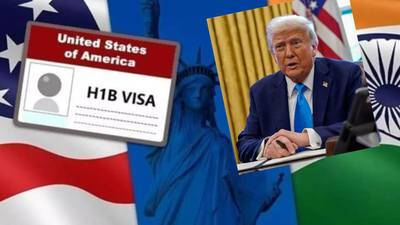
The H-1B visa has long been a debate about who gets access to the American labour market, how much employers should pay for foreign talent, and how far a president can go in altering immigration policy without Congress.The same debate returned to the spotlight this week after a federal judge in Massachusetts struck down President Donald Trump‘s $100,000 fee on certain new H-1B visa petitions, ruling that the administration lacked the legal authority to impose what amounted to a tax on employers hiring highly skilled foreign workers.For Indian professionals, who account for nearly 70% of H-1B beneficiaries, the decision removes a major obstacle that had threatened to make new sponsorships significantly more expensive and potentially less attractive for employers.The ruling, delivered by US District Judge Leo Sorokin on Monday, marks one of the most consequential judicial setbacks so far to Trump’s efforts to restrict legal immigration through executive action.“The substance and application of the $100,000 payment reveal that it is a tax, regardless of what the payment is called,” Sorokin wrote, concluding that Congress, not the president, holds the authority to impose such a levy.
Why was the fee introduced?
The Trump administration announced the measure through a presidential proclamation in September 2025. Under the policy, employers seeking certain new H-1B workers from abroad would have been required to pay $100,000 per petition.Before the change, employers generally paid between $2,000 and $5,000 in government filing fees depending on the petition category.The administration argued that the higher fee would discourage misuse of the programme and help protect American workers from foreign competition. Federal officials maintained in court filings that the payment was a regulatory fee permitted under the Immigration and Nationality Act.But critics saw it differently.A coalition of 20 Democratic state attorneys general challenged the policy, arguing that the president had effectively created a new tax without congressional approval. The states also warned that the fee would discourage employers from hiring highly skilled workers and damage industries that rely heavily on global talent.
Why does the ruling matter to Indian professionals?
At one level, the decision is straightforward. A major cost barrier attached to new H-1B petitions has been removed.But the significance extends beyond the fee itself.The H-1B programme remains one of the primary pathways through which Indian technology professionals, engineers, researchers, academics and other skilled workers enter the United States workforce. Any measure that increases the cost of sponsorship can affect employer willingness to recruit talent from abroad.The concern was especially acute because of the scale of the increase. A process that previously involved a few thousand dollars in filing fees suddenly carried a six-figure charge.For large technology companies, the fee represented an additional expense. For smaller employers, startups, hospitals and universities, it risked becoming a hiring barrier.As Joshua Wildes, an immigration attorney at Wildes & Weinberg, told Higher Ed Dive last year, “The smaller ones that don’t have the funds, they simply cannot afford it. The bigger ones that do have the funds, they don’t want to do it, because it’s a lot of money.”The numbers suggest employers largely stayed away.According to court filings cited by TNN, US Citizenship and Immigration Services had received only 85 payments under the policy by mid-February, a tiny figure compared with the scale of the H-1B system.
What happened to universities?
The fee triggered concern well beyond the technology sector. American universities depend heavily on the H-1B programme to recruit international faculty, researchers and scholars. Institutions such as Stanford University, the University of Michigan and the University of Florida each recorded more than 100 H-1B approvals during fiscal year 2026.Higher education groups warned that the fee could make recruitment more difficult and weaken research capacity at institutions that depend on global talent.The issue became particularly contentious after some states adopted restrictive positions following Trump’s proclamation. Florida’s public university system paused new H-1B hiring through January 2027, while Texas imposed a similar pause at public colleges through May 2027.For Indian academics and researchers seeking opportunities in American universities, the court’s ruling removes one source of uncertainty, although broader policy restrictions remain in place.
Is the legal fight over?
Not yet.The Massachusetts ruling does not necessarily mark the end of the dispute.In a separate lawsuit filed by the Association of American Universities and the US Chamber of Commerce, a federal judge in Washington previously upheld the fee, concluding that Trump possessed broad authority under immigration law to restrict the entry of foreign nationals. That decision is currently under appeal.Another lawsuit brought by labour and industry groups remains active as well.The White House has already indicated that it intends to continue fighting.“President Trump has clear legal authority to restrict entry of any class of aliens he determines is not in America’s best interests, and that is exactly what he did,” White House spokesperson Taylor Rogers said. “The Administration is confident this order will be reversed on appeal.”The administration can now appeal Sorokin’s decision to the US Court of Appeals for the First Circuit and seek to keep the policy alive while litigation continues.
What happens next for Indian professionals?
For now, employers seeking to sponsor foreign workers are no longer required to pay the $100,000 fee, removing what had become one of the most significant barriers attached to new H-1B petitions.But the larger lesson may be that the fight over skilled immigration in the United States is increasingly moving from immigration offices to courtrooms.The ruling does not expand H-1B quotas. It does not guarantee visa approvals. Nor does it settle the broader political argument over employment-based immigration.What it does do is limit one of the most aggressive attempts to use cost as a tool for reducing participation in the programme.For Indian professionals planning careers in the United States, the pathway remains competitive and politically contested. But for the moment, one of its largest financial hurdles has been removed, not by an immigration agency, but by a federal court that concluded the president had gone beyond the powers granted to him by Congress.