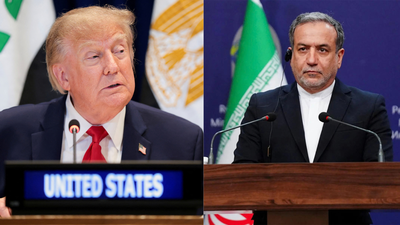
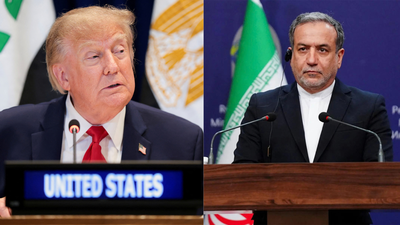
US President Donald Trump said US and Iranian officials held an unexpected meeting on Tuesday, even as he warned in his address to the UN General Assembly that he could “annihilate” Iran if a deal is not reached soon to end the nearly seven-month war.Trump said his chief envoys, Steve Witkoff and Jared Kushner, held talks with Iranian officials for about three hours on the sidelines of the annual gathering of world leaders.Trump described the meeting as positive, saying, “It was a very good meeting.” He later added that the Iranian officials were “not the highest level, but it’s something.”What happened in the meetingUS Middle East envoy Steve Witkoff said in a post on X that the talks were conducted through mediators who shuttled between the US and Iranian teams. He said he felt “very good” about the meeting and was hopeful the effort “will prove constructive and promising.”Iranian officials confirmed that foreign minister Abbas Araghchi took part in the talks, which were mediated by Qatari diplomats.Iran conveyed several conditions during the talks, including an end to the war on all fronts and a halt to what Tehran described as US “acts of aggression,” Iranian Foreign Ministry spokesperson Esmail Baghaei told state news agency IRNA.Baghaei said Tehran also called for an end to the naval blockade and economic warfare, along with the release of Iranian assets, IRNA reported.A senior Iranian official separately said Tehran was prepared to reopen the Strait of Hormuz within a week if Washington took reciprocal steps to ease military and economic pressure on Iran, as cited by the Guardian.The official said the position had been approved by Iran’s Supreme Leader Mojtaba Khamenei and the Supreme National Security Council.Earlier, the Islamic Revolutionary Guards Corps (IRGC) said there was no contradiction between pursuing negotiations and continuing the war. The position was also echoed by Iran’s chief negotiator Mohammad Ghalibaf in recent remarks to the Iranian parliament.The Iranian official said Tehran was looking for signs that Washington was prepared to resume negotiations, lift its military blockade of Iranian ports and halt operations linked to the Strait of Hormuz. If the US took those steps, Iran was prepared to reopen the strategic waterway within seven days and return to the negotiating table, the official said.However, some Iranian media outlets close to the IRGC denied that any new position had been adopted, highlighting differences within Tehran.Trump warns Iran of ‘annihilation’In his address to the General Assembly, Trump defended his decision to launch the war with Iran, saying he had shown resolve while other leaders had hesitated.At the same time, he suggested the conflict could be approaching a turning point, calling on Iran to fully reopen the Strait of Hormuz and return to negotiations to reach a settlement.“I have a big decision to make,” Trump said. “Will a deal be made with Iran that lets them rebuild and create a far greater country than it ever was before, maybe one of the greatest in the Middle East or even the world. Or do I annihilate the Islamic Republic and do it quickly, never giving them a chance to kill and destroy people and countries again?”“The terrorist regime is behaving badly, not because they are strong and confident, but because they are weak and desperate,” Trump added.Most members of Iran’s delegation walked out of the chamber as Trump criticised the Islamic Republic in his address.War continues to pressure energy marketsThe conflict has grown more complicated despite US and Israeli strikes that have killed much of Iran’s top leadership and damaged its air force and navy, while a US blockade on Iranian oil has further strained Tehran’s economy.The war has also kept energy markets on edge, with oil prices remaining elevated. Earlier this month, Saudi Arabia shut a key pipeline that had served as an alternative route for oil stranded in the Gulf after it came under attack by Iran-backed militants in Iraq.Meanwhile, territorial advances by Yemen-based Houthi rebels, another Iran-backed group, near the Bab al-Mandab Strait have made the Red Sea shipping route increasingly hazardous for oil carriers.