
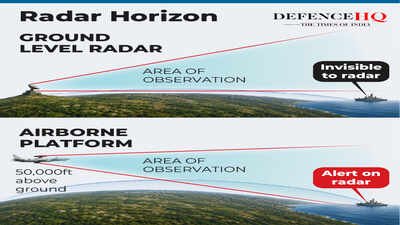
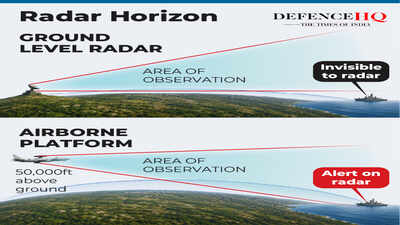
Recent conflicts in West Asia, Eastern Europe and the Indian subcontinent have demonstrated the effectiveness of air power. Pakistan, Ukraine and various countries in the Gulf have experienced the debilitating effects of aerial firepower. As nations across the board improve their air defences, a key priority is enhancing their ability to build a clearer air picture. “You can’t shoot what you can’t see,” as the old adage goes. One of the biggest challenges faced by military planners is reducing the reaction time available to defending forces against threats travelling at hundreds, or even thousands, of kilometres per hour. This becomes especially important when those threats fly close to the ground to avoid radar detection.Radars, much like human eyesight, work on the principle of line of sight, as radar waves travel in straight lines. With the radar horizon at a little under five kilometres for a ground-based system, a terrain-hugging aircraft or cruise missile will only become visible very late, sharply reducing the defenders’ reaction time. The area hidden below the Earth’s curvature is known as the radar shadow. The best way to compensate for this limitation is to increase the height at which the observer — or, in this case, the radar — is located, thereby extending the radar horizon and reducing the radar shadow.The most effective way to improve the radar picture is to elevate the radar itself, best achieved by mounting it on an aircraft. While an aircraft flying at high altitude can be detected hundreds of kilometres away by modern radars, the same aircraft flying at low level may remain invisible until it is very close. Attack aircraft around the world have long been designed to fly at low altitudes to shield themselves from the gaze of enemy radars and the deadly weapons they guide. The objective is simple: reduce the defender’s available reaction time.
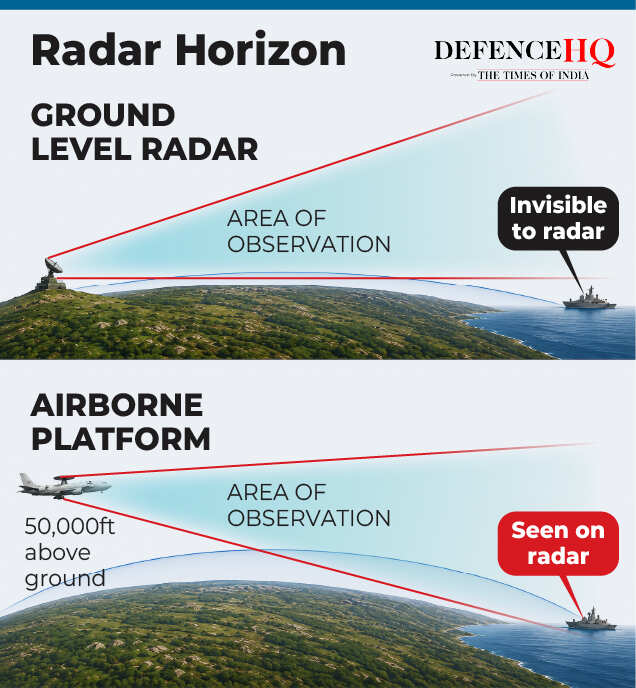
The Phalcon Airborne Early Warning & Control System (AEW&C) of the IAF, for example, has a service ceiling of around 50,000 feet. From that altitude, the horizon—and consequently the radar horizon—extends to roughly 500 km. This ability to scan and monitor vast stretches of airspace provides defenders with additional reaction time, allowing local air defences to be readied or friendly fighters to be scrambled to intercept incoming threats. In the age of low-flying drones, cruise missiles and fighters, the ability to detect threats at long range has become even more critical.
AEW&C platforms are critical enablers of modern air combat that provide surveillance, and command and control in the aerial domain. They provide the much needed real time aerial situational awareness with the vertical domain envelopment over land and sea for national security.
Air Marshal Diptendu Choudhury, former Commandant, Tactics and Combat Development Establishment
Sensors in Modern Conflict
In the age of artificial intelligence, smarter computing, increasingly capable sensors and autonomous systems, the nature of warfare is changing. The ability to detect, track and classify targets at extended ranges is becoming increasingly important.Airborne sensors, in particular, are redefining the battlespace by providing commanders with real-time situational awareness, enabling faster decision-making and more coordinated responses. In this context, AEW&C platforms function as flying command centres that knit together disparate elements into a cohesive network. Their importance is magnified in contested environments, where stealth aircraft, cruise missiles and drones seek to exploit gaps in ground-based radar coverage. These aircraft effectively remove the proverbial fog of war, ensuring commanders can clearly see the evolving battlespace.
Why AEW&C Matters for India
They play a vital role in controlling friendly offensive air operations deep inside enemy territory. They also play a vital role in Air Defence operations in detecting enemy air threats and directing our own AD fighters to engage them at the maximum possible ranges. Their need will keep increasing in the foreseeable future as they provide vital visibility and control of sovereign air spaces, and areas of national interest over land and sea.
Air Marshal Diptendu Choudhury, former Commandant, National Defence College
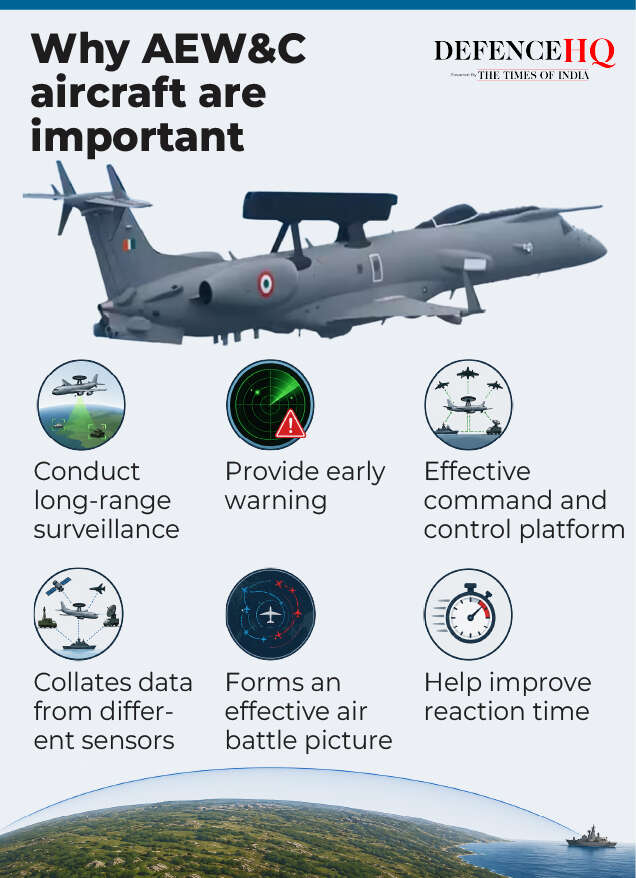
India’s geography imposes unique demands on its air defence network. With a land border stretching over 15,000 km and a coastline exceeding 11,000 km, maintaining continuous surveillance across such vast frontiers is a formidable challenge. Compounding this is the prospect of a two-front conflict with Pakistan and China, a concern that has long shaped India’s strategic calculus. In such a scenario, the ability to detect threats early and coordinate responses across multiple theatres becomes even more critical. AEW&C platforms extend radar coverage far beyond the limits of ground-based sensors, can track hundreds of aerial targets simultaneously and serve as airborne command posts. These systems are therefore regarded as force multipliers, enhancing the combat capability of the existing force. With the IAF already down to 29 fighter squadrons against a sanctioned strength of 42, maximising the effectiveness of the available fleet becomes paramount.
Current Fleet and Status
India’s airborne surveillance capability today rests on a modest fleet of six platforms. The indigenous Netra Mk-1 AEW&C system, mounted on Embraer ERJ-145 aircraft, comprises three operational platforms optimised for border surveillance, fighter control and tracking low-flying targets. Netra achieved Final Operational Clearance in June 2026, marking its transition from development to full operational service. Complementing Netra are three Israeli Phalcon AWACS mounted on Russian Il-76 aircraft. These heavier platforms provide full 360° radar coverage and serve as strategic assets capable of overseeing entire theatres of operation. Together, the six aircraft provide India with a basic airborne warning capability, but defence planners have consistently argued that the fleet remains too small to sustain round-the-clock coverage across multiple theatres. The gap becomes evident when compared with regional rivals: China operates more than 30 AWACS, while Pakistan fields around 10 AEW&C aircraft.
Expanding the Fleet
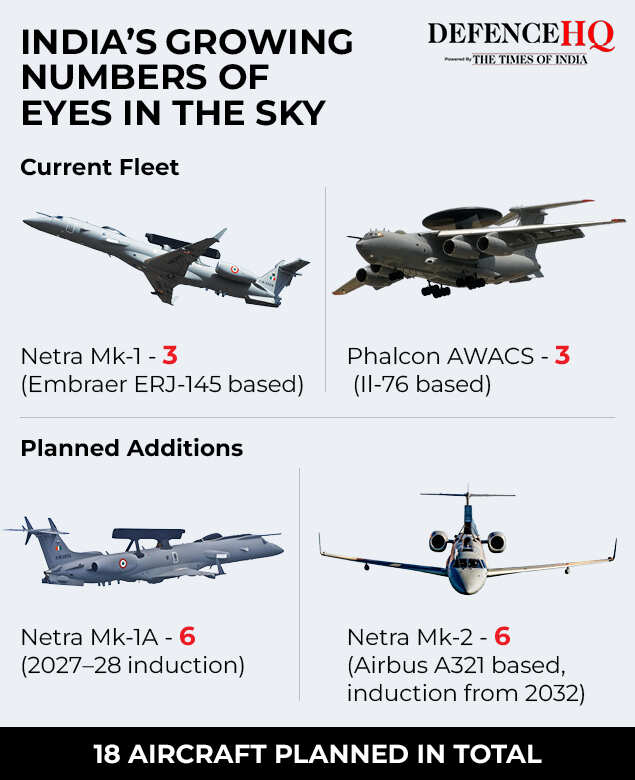
Recognising this shortfall, India has embarked on a major expansion of its airborne surveillance capability. The first step is the induction of six Netra Mk-1A aircraft, which will triple the size of the indigenous fleet. These upgraded platforms will feature Gallium Nitride AESA radar modules capable of extending detection ranges to as much as 450 km. They will also incorporate more powerful electronic warfare suites, improved stealth detection capabilities and enhanced resistance to jamming. Deliveries are expected between 2027 and 2028.In parallel, the Netra Mk-2 programme has been launched to develop a heavier indigenous AWACS capability. Six Airbus A321 airframes are being converted into advanced surveillance platforms, with AI Engineering Services Limited handling airframe conversion and Adani Defence Systems & Technologies serving as the Development-cum-Production Partner (DCPP) for the mission systems. The Mk-2 will feature full 360° radar coverage, greater endurance and more advanced command-and-control capabilities. Flight trials are expected by 2029–30, with induction planned from 2032 onwards. Together, these programmes will expand India’s fleet from six to eighteen aircraft: three Netra Mk-1, six Netra Mk-1A, six Netra Mk-2 and three Phalcon AWACS.
Completing the Aerial Battlespace Picture
AEW&C platforms do not operate in isolation. They form part of a broader surveillance ecosystem that includes ground-based radars, satellites and electronic intelligence assets. India is also investing in long-range surveillance radars along its borders, coastal radar chains to monitor maritime traffic and space-based sensors that provide strategic warning. Integrating these assets with airborne platforms creates a layered surveillance network with overlapping coverage, providing both greater reach and redundancy.The information gathered is transmitted via datalinks to fighter aircraft, ensuring combat elements share a common operating picture of the battlespace. The Defence Research and Development Organisation (DRDO) has also pursued indigenous electronic warfare systems that improve the resilience of this network against enemy jamming and cyber attacks. The result is a progressively integrated battlespace where information flows seamlessly across platforms, enhancing the armed forces’ ability to fight as a unified, networked force.India’s airborne surveillance roadmap follows a three-tiered approach: Netra Mk-1 for tactical coverage, Netra Mk-1A for extended-range detection and Netra Mk-2 for full-spectrum airborne surveillance. Together with the Phalcon AWACS, these platforms are expected to provide comprehensive battlespace awareness by the early 2030s. The planned expansion of this crucial fleet from six to eighteen aircraft marks a decisive shift in capability, significantly enhancing the IAF’s ability to manage a potential two-front threat. More importantly, it will accelerate the transformation of the air force into a truly networked force capable of detecting threats earlier, responding faster and coordinating operations more effectively.