
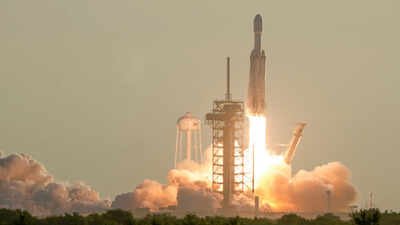
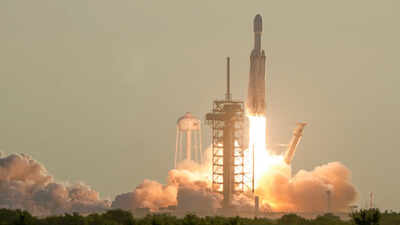
Elon Musk‘s SpaceX launched NASA‘s $4.3 billion Roman Space Telescope. This mission will send the observatory on a three-month journey to a point in space where it will hunt for planets around distant stars, probe the hidden forces of dark energy and survey the cosmos at a pace no NASA telescope has managed before. Minutes after liftoff, as the rocket’s boosters landed safely and the telescope separated cleanly from its upper stage, NASA science mission director Nicky Fox was in tears watching the action unfold. “It’s such a good day!” she said.The telescope lifted off shortly after daybreak aboard a Falcon Heavy rocket, SpaceX’s triple-core launch vehicle, from Kennedy Space Center. Roman is headed to an observation point roughly 1 million miles (1.6 million kilometres) from Earth, the same neighbourhood already occupied by the Webb Space Telescope, one of NASA’s other major orbiting instruments.The bus-sized telescope is named after Nancy Grace Roman, NASA’s first chief astronomer, who died in 2018. Once it reaches its destination, NASA expects it to cast the widest gaze yet on parts of the universe that have remained hidden from view.“It’s going to find thousands of supernovae, tens of thousands of planets, billions of galaxies and tens of billions of stars,” Fox said. “It’s going to be able to do things that we’ve never been able to do before with its massive field of view.”
A launch that ended with a call from the US President Donald Trump
Several minutes after liftoff, the rocket’s two reusable side boosters descended tail-first back to Cape Canaveral, producing sonic booms as they landed. Soon after, the telescope separated from the rocket’s upper stage, prompting applause from ground controllers.A couple of hours later, NASA Administrator Jared Isaacman was midway through a news conference, telling reporters he expected the Roman Space Telescope to become a household name, when his cellphone rang. US President Donald Trump was calling to offer congratulations.“Boy, it looked beautiful on television,” Trump said, fresh off a visit Friday to Houston’s Johnson Space Center to honour the Artemis II moon crew. “You’re the hottest in space.”
A field of view 100 times wider than Hubble telescope
Roman’s field of view is more than 100 times wider than that of the Hubble Space Telescope, which has been producing images from orbit for 36 years. Webb, which joined the fleet several years ago, carries a narrower but more precise instrument that can zoom in on objects nearly as old as the Big Bang itself.The three telescopes are expected to work in tandem, along with the European Space Agency’s Euclid spacecraft and the National Science Foundation’s Vera C. Rubin Observatory in Chile, to answer some of astronomy’s biggest open questions.Among the targets are stars with planets orbiting them. Once Roman spots a candidate, Webb, which is more sensitive and more precise, will follow up to fill in the details.“Roman’s vast reach will allow us to find the weird, the rare and the unusual,” senior project scientist Julie McEnery said on the eve of launch. “We’ll redefine what it means to find a needle in a haystack.”Astronomers are also counting on Roman to shed light on dark matter and dark energy, the unseen forces believed to make up most of the universe. By cataloguing galaxies across vast stretches of sky, Roman is expected to help scientists calculate how quickly the universe is expanding under their influence.
Why speed is Roman’s defining feature
Roman’s central advantage over its predecessors is how fast it can work. According to McEnery, a month of Milky Way observations by Roman would take Hubble a century to complete. The telescope is also expected to scan the galactic bulge at the center of the Milky Way far faster than any previous instrument, offering the deepest look yet into the heart of the galaxy.Roman carries a wide-field infrared camera that matches Hubble’s sensitivity but operates 1,000 times faster. It also holds a coronagraph, an experimental instrument designed to block out starlight so that planets orbiting a masked star can be imaged directly, however faint they may be.Roman was not built to search for signs of life. But Fox said it will lay the groundwork for future telescopes to tackle what NASA considers its biggest question: “Are we alone? Is there another Earth 2.0 looking back at me?”The telescope is designed to be refuelled in orbit, which means its working life could be extended if a robotic tanker becomes available sometime in the next decade.
A mirror with an unlikely past
Roman launched nearly a year ahead of schedule and within its budget, and it is the first NASA space telescope named after a woman.Retired NASA scientist Ed Weiler, who was hired by Roman in 1978, said the honour was overdue. He coined the phrase “Mother of Hubble” for her, crediting her insistence, after joining the newly formed NASA in 1959, that observatories placed above Earth’s atmosphere could see farther and more clearly than anything on the ground. She died in 2018 at age 93.“This is very, very fitting. I think Nancy would be very proud” that the telescope bearing her name will take on questions about dark energy and other unresolved mysteries of the universe, Weiler said.Hubble launched in 1990 with a flawed mirror that later required a dramatic spacewalking repair. Roman’s primary mirror is the same size as Hubble’s, at nearly 8 feet (2.4 meters) in diameter, but its origin is different: it is surplus hardware from a spy satellite.The National Reconnaissance Office donated two leftover mirrors to NASA more than a decade ago for repurposing. The second one remains in storage.