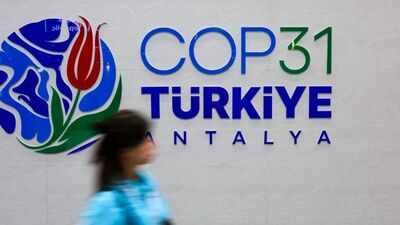
Small island nations are stepping up pressure on major economies at the United Nations climate negotiations, urging the international community to take urgent action against global warming, which threatens their very survival.The annual climate conference has entered its second and final week in Turkey’s resort city of Antalya. This year’s discussions come after months of climate-related disasters, geopolitical disruptions and an intensifying El Nino phenomenon, all of which have increased the vulnerability of some of the world’s smallest nations.“We don’t need more studies. We don’t need more negotiations. We just need more action,” Tonga prime minister Fatafehi Fakafanua told the associated press.Tonga, one of the world’s major ocean nations, has a vast maritime territory compared with its relatively small land area. Like several other island countries, it faces serious threats from climate change. Record ocean temperatures endanger marine ecosystems that support local livelihoods, while melting glaciers contribute to rising sea levels, increasing the risks of coastal erosion and flooding.Tonga and other small island developing States (SIDS) have emerged as vocal advocates for climate action, urging larger and more industrialised countries to reduce greenhouse gas emissions before the consequences become irreversible.These island nations are also calling on wealthier countries, which contribute significantly to global pollution, to provide financial assistance for climate adaptation, damage mitigation and recovery from climate-related disasters.Individually, small island economies have limited influence in international negotiations. However, their collective voice carries greater weight, said Ilana Seid, chair of the Alliance of Small Island States and Palau’s ambassador to the United Nations.“On our own, individual SIDS are small economies. We have little leverage, but when you put us together and we speak with one voice, we can speak pretty loudly and pretty strongly,” Seid said.Many commitments emerging from the annual climate negotiations remain voluntary and legally nonbinding. Countries have also failed to reach a comprehensive agreement on moving away from fossil fuels, the primary source of greenhouse gas emissions. These shortcomings have fuelled criticism of the conference of the parties (COP) process.Against this backdrop, political leaders, negotiators and environmental activists say COP31 must restore confidence in international climate negotiations and demonstrate that these meetings can translate commitments into meaningful action.“I feel that my future and the future of generations after me are on the line,” said Atiterentaai Rinimarawa, a 24-year-old youth representative from Kiribati.“We are not asking for sympathy, but we are calling for climate justice, stronger commitment and real action,” she added.
- Island nations seek greater influence in climate talks
Turkey and Australia are jointly hosting COP31 this year. Pacific island representatives said their participation and influence have increased, particularly through Australia’s involvement and Fiji’s hosting of a preparatory climate meeting in October.“I absolutely think that our voice has been elevated,” Fakafanua said, adding that it reflected years of efforts by island nations to secure greater recognition in international climate discussions.He said it had taken until COP31 for these countries to occupy a more prominent position in the negotiations.The Alliance of small island states comprises 39 countries, which Seid described as a powerful negotiating bloc. Despite their geographical differences, island nations across the Pacific, Caribbean and Africa face similar climate vulnerabilities.“Our vulnerabilities are so consistent, regardless of if you’re from the Pacific, or the Caribbean, or the African region,” Seid said, adding that the international spotlight on these countries had become brighter this year.Global climate targets, however, remain significantly off track. The United Nations has warned that the world is unlikely to achieve its goal of limiting global warming to 1.5 degrees Celsius (2.7 degrees Fahrenheit) above pre-industrial levels.Small island nations are urging governments to preserve this target, arguing that exceeding it could have devastating consequences for their populations.“For us, it’s really not a temperature threshold, it’s a survival threshold,” said Adelle Thomas, senior director at the Natural Resources Defense Council and a native of the Bahamas.She said the key question was whether political leaders would match their commitments with the realities already confronting vulnerable communities.
- Climate action needs to move faster
Although the world could exceed the 1.5-degree warming threshold, international climate negotiations have helped prevent temperatures from rising even further, Thomas said. This demonstrates that the COP process has delivered results, although its pace has failed to match the speed of climate change.Thomas, who also serves as vice-chair of a working group of the Intergovernmental panel on climate change, said countries should not abandon the negotiations despite their limitations.“It is a long-term game, which unfortunately doesn’t align with the level of impacts that we’re seeing, but I don’t think that we should give up on COP,” she said.The absence of the United States, the world’s largest economy and one of its major greenhouse gas emitters, has added another challenge to this year’s discussions. Washington has stayed away from the negotiations for the second consecutive year.Fakafanua acknowledged that the process could be frustrating but maintained that international climate cooperation remained necessary.“We’ve definitely made progress and we’re better with COP than without,” he said.The Alliance of Small Island States is also seeking concrete financial commitments at COP31. It wants to secure $500 million for climate resilience programmes and another $200 million to strengthen early-warning systems for natural disasters.Fakafanua argued that countries suffering the consequences of climate change should receive financial support from those primarily responsible for causing it.“It’s only fair that those who are suffering from the effects of climate change are assisted by those who were at fault,” he said.This year has brought additional challenges for island nations. Global ocean temperatures reached record highs in August, while an exceptionally strong El Nino continues to intensify. Geopolitical developments, including the war involving Iran, have also pushed up energy prices, adding to economic pressures.Thomas said climate change was no longer a distant international concern, as communities across the world were already experiencing its effects.“Average citizens around the world are experiencing climate impacts in their homes and in their communities and that directly links to what’s going on in these international negotiations,” she said.She stressed that citizens and local communities also had a responsibility to hold their governments accountable and ensure that leaders prioritised climate action.COP31 is taking place amid competition for international attention, with other major global summits beginning in China and the Philippines.Qiyun Woo, a young environmental activist from Singapore, said the climate negotiations needed to rebuild confidence among younger generations and demonstrate that world leaders were committed to securing a sustainable future.“These climate talks need to renew faith,” Woo said, adding that young people needed to believe in international processes and the ability of global leaders to protect future generations.