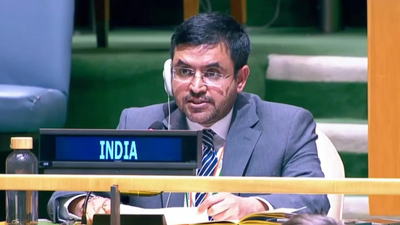
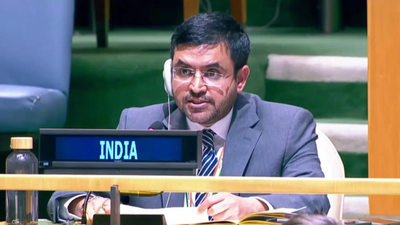
NEW DELHI: India used the UN stage to turn Pakistan’s own words against it, arguing that the terror networks Islamabad once nurtured have now come back to haunt their own backyard, a reality, New Delhi said, that even Pakistan’s leaders have begun to acknowledge. India also urged the international community to take stronger action against states accused of sponsoring terrorism.Speaking at the UN General Assembly’s Sixth Committee, which deals with legal affairs, India’s first secretary Raghoo Puri said Pakistan had long portrayed itself as both a victim and a frontline state in the fight against terrorism.“Pakistan has presented itself as a frontline state in combating terrorism and as a victim, while masking the fact that the Frankenstein’s (monster) the Pakistani state has created and lost control over have moved from wreaking havoc in neighbouring countries to doing the same in Pakistan,” Puri said on Wednesday.“This was exposed recently by a provincial chief minister of Pakistan, and may I jog the memory of colleagues to an interview in 2018 by her father and former prime minister of Pakistan, exposing this dark secret,” he said.“You cannot run with the hares and hunt with the hounds,” Puri warned. “Reality never works like that”.Puri was responding to remarks by Pakistan’s deputy Permanent Representative Usman Jadoon, who had launched an attack on India during the committee proceedings.
Pakistan’s own leaders expose terror threat
Puri pointed to recent remarks by Punjab chief minister Maryam Nawaz, who said her province faced a bigger threat from neighbouring Pakistani provinces than from neighbouring countries.Maryam Nawaz, who leads Pakistan’s Punjab province, said last month in Lahore: “Unfortunately, the threat Punjab, a province of 130 million, faces comes less from my neighbouring countries and more from my neighbouring provinces.”Earlier this month, she also questioned the idea of distinguishing between different forms of extremist violence, saying anyone involved in terrorism should be treated as a terrorist regardless of their political motives.Puri also referred to an interview given by Maryam Nawaz’s father, former Pakistan prime minister Nawaz Sharif, to Dawn in 2018. Sharif had spoken about militant groups operating from Pakistan and questioned whether they should be allowed to cross the border and carry out attacks in India.“Militant organisations are active. Call them non-state actors; should we allow them to cross the border and kill 150 people in Mumbai?” he had said.Puri did not name either Maryam Nawaz or Nawaz Sharif while making his remarks.
‘Bombed-out airfields’ are not victory
Puri also hit back at Pakistan’s claims about the outcome of Operation Sindoor, India’s counterterror military action to the Pahalgam attack.“If bombed-out airfields and cratered runways look like victory to Pakistan, they are, of course, welcome to enjoy it,” he said.He accused Pakistan of continuing to spread false claims about the operation and said its approach was part of a wider campaign of disinformation.Puri said the “Pakistani representative’s desperation to falsely tout the Pakistani military’s narrative on the outcome of Operation Sindoor” was consistent with Pakistan’s long-running use of state-backed misinformation and psychological warfare.
‘Circular economy of words’
Puri also took a swipe at Pakistan after its delegation made a second intervention, repeating what he described as old arguments.“Pakistan believes in the circular economy of words and narratives,” Puri said.“If this much effort had actually been made in countering terrorism rather than narrative building, misinformation, and disinformation, the world would have been a better place,” he said.“But nothing more can be expected from a Form 47 government,” he added, referring to Pakistan’s political system and alleged manipulation of the electoral process.Puri also challenged Pakistan’s claims on minority rights and accused Islamabad of allowing religious extremism to flourish.
‘The victims in Pahalgam were not asked about their political orientation’
“The victims in Pahalgam were not asked about their political orientation; they were asked about their religion,” Puri said.“It is therefore deeply ironic that Pakistan speaks of combating religious hatred while allowing the conditions that enable it to persist and thrive, especially by fomenting cross-border terrorism,” he added.Puri referred to the Pahalgam terror attack, in which terrorists targeted tourists after asking about their religion.He said the attack showed the consequences of allowing extremist groups and crossborder terrorism to continue.
India raises Masood Azhar issue
Puri also questioned Pakistan’s claims that it was taking action against Jaish-e-Mohammed chief Masood Azhar, who is listed by the UN as a terrorist.Pakistan had increased the reward for information leading to Azhar’s arrest from Pakistani rupees 50 lakh to 70 lakh.“Pakistan glosses over its state support for terrorism by announcing enhanced rewards for apprehending UN-listed head of Jaish-e-Mohammed, terrorist and mastermind of several attacks against my country,” Puri said.“When the media can reach Masood Azhar and get confirmation from him about the success of Operation Sindoor, surely the Pakistani state knows his whereabouts,” he said.Azhar had earlier appeared in a video in which he claimed that his family infrastructure had been destroyed during India’s strikes on Bahawalpur as part of Operation Sindoor.Puri also recalled Pakistan’s earlier claims that Jaish-e-Mohammed was no longer active.“Just a few months ago, Pakistani representatives used this forum to call the Jaish-e-Mohammed a defunct organisation,” Puri said. “The world has seen the script play earlier, and we are clear-eyed that this time also it is going to be no different.”
India invokes 9/11, 26/11 and Pahalgam
Puri warned that allowing terrorist groups to operate with political protection could undermine international efforts against terrorism.“When terrorist groups are allowed to operate under state political power, international commitments become meaningless, and when perpetrators are provided safe havens, the victims of terrorism are denied justice,” he said.He also cited the example of al-Qaeda leader Osama bin Laden, who was found in Abbottabad, Pakistan, years after the 9/11 attacks.“The world has not forgotten 9/11, and where its perpetrators, including Osama bin Laden, were caught,” Puri said.
Share your thoughts in the comments
Be respectful · TOI community guidelines
He then pointed to the 2008 Mumbai attacks.“The world has not forgotten 26/11,” when Pakistani terrorists killed 166 people in Mumbai, he said. “The world has not forgotten Pahalgam.”Puri also referred to Pakistan’s record on terror financing and the upcoming meeting of the Financial Action Task Force (FATF).“The world is aware of Pakistan’s financial support to terrorism, as also, the FATF plenary meeting coming up soon,” he said.The FATF, the global body that monitors terror financing and money laundering, is scheduled to hold its next plenary meeting in Paris from October 26 to 30.