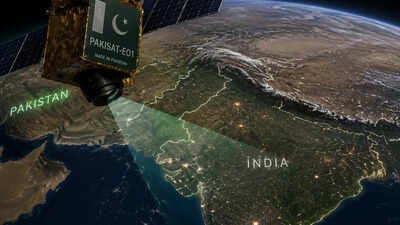
NEW DELHI: Pakistan has boosted its space surveillance power manifold by launching a series of six earth observation (EO) satellites in the last one and a half years. These EO or spy satellites can be used by Pakistan to keep an eye on India’s borders, troop deployment and military assets.Pak launched 6 satellites in a year; may be used to spy on India, warns expertThough the Space and Upper Atmosphere Research Commission (SUPARCO) was set up in 1961, Pakistan launched its first satellite only in 1990. Even the payloads launched in the last several decades with the help of foreign launchers were less than a dozen. However between Jan 2025 and April 2026, Pakistan surprisingly launched six EO satellites, mostly with the help of Chinese rockets.The six EO satellites launched are Pakistan Air University PAUSAT-1 on Jan 14, 2025 by SpaceX-Falcon 9; Pakistan Remote Sensing Satellite-Earth Observation 1 (PRSC-EO1) launched on Jan 17, 2025 by China’s Long March-2D rocket; PRSS-2 EO on July 31, 2025 by a Chinese rocket; Hyperspectral satellite HS-1 on Oct 19, 2025 by China’s Long March; PRSC-EO2 lifted off on Feb 12, 2026 by China’s Smart Dragon-3; and PRSC-EO3 on April 25 this year by Chinese Long March-6.Group Captain Ajay Ahlawat (retd), now a defence analyst, told TOI, “There is no secret about these satellites as all payload launches are recorded with ITU (International Telecommunication Union). We (India) too did not miss it. These EO satellites have been designed to see things in greater detail and have improved Pakistan’s visibility on Indian territory, at least for 3-4 years. On the contrary, India has not been able to launch a single surveillance satellite in the last one year. Our payloads are ready. But the rocketry system is not. After so many recent failures, Isro is worried and not sure of successful launches.”“Our NavIC system has also crippled as only three navigation satellites are in space against the requirement of minimum four, forcing our strategic forces to rely on foreign navigation systems like GPS and Glonass for missile navigation,”the defence expert said. Group Capt Ahlawat (Retd) suggested that India should get their payloads that are critical for key space missions launched from friendly space agencies like Europe’s Spaceport at French Guiana or Russia’s Baikonur Cosmodrome till the time Isro fixes its rocket problems.Rear Admiral Sudhir Pillai (Retd), also a defence analyst, said in his blog recently, “When EO-3 satellite is passing over South Asia in daylight, PRSC-S1 is passing over the same geography in darkness, and vice versa. Since the optical satellite needs daylight and the SAR satellite does not, the two satellites together provide what neither achieves alone, compressed revisit cycles approaching persistence in operational terms of the South Asian theatre across the full 24-hour cycle.”Writing about India’s satellite plans, Pillai further wrote, “India’s space-based Surveillance Phase-III programme — SBS-3 — approved in Oct 2024 and accelerated after Operation Sindoor, envisages a constellation of 52 surveillance satellites to be deployed over the second half of this decade. The intent is sound, but the sequencing problem is acute: the overhead ISR threat from China’s already dense military satellite network and from this China-enabled Pakistani constellation is operational now, while SBS-3’s first launches are only expected to begin around 2026 and full deployment is generally not projected before 2029.”