
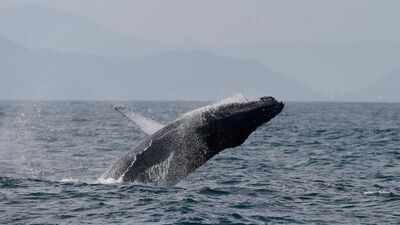
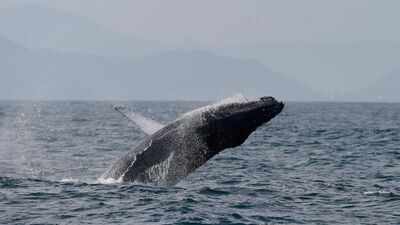
Humpback whales are returning in large numbers to Brazil’s coast after being pushed close to extinction by commercial whaling. Their population in the South Atlantic has risen from about 2,000 to around 35,000 in roughly 40 years, bringing the species close to its population levels before large-scale whaling.According to Science X, the recovery is now clearly visible along Brazil’s coast, including around Rio de Janeiro’s Guanabara Bay where thousands of humpback whales pass through Brazilian waters every year during their migration. Their return has also increased interest in whale-watching trips.The warm waters off Brazil are an important breeding ground for Southern Atlantic humpbacks. Between June and November, the whales travel about 4,000 kilometres from feeding grounds in the Southern Ocean to breeding and calving areas off northeastern Brazil. Many gather around the Abrolhos Bank, a coral reef region along the coasts of Bahia and Espirito Santo.Not long ago, humpback whales were rarely seen in Brazilian waters. According to Enrico Marcovaldi, co-founder of the Humpback Whale Project and founder of the Humpback Whale Institute, four decades ago, people did not even know there were whales in Brazil.“The first time he saw one, he mistook it for a rock. They were legends. We had never seen one,” Marcovaldi said, as quoted by AFP.
Whaling ban helped
A major reason for the recovery was the reduction and eventual end of commercial whaling. In 1982, the International Whaling Commission decided that commercial whaling should be paused for all whale species and populations from the 1985/1986 season onwards. Brazil then banned commercial whaling by law in 1987.Brazil also protected the Abrolhos breeding grounds. These measures gave humpback whales greater protection during an important part of their life cycle. The species was removed from Brazil’s list of threatened species in 2014, and its population has continued to grow.Louise Raulais, who runs the Rio Ocean Club with her partner Theo Andrade, said their company began offering sailboat trips this year for groups of five to 10 people to watch humpback whales.A biologist travels on every trip and explains the whales and the ocean to visitors. Raulais said the experience can encourage people to care more about marine life.“These animals are so iconic and charismatic that they have the power to transform people, to change the way they see the world,” she said.
Tracking whales through skin, photographs
The growing whale population is giving researchers more opportunities to study the animals. They travel to areas such as the Abrolhos archipelago to record the whales, study their behaviour and health, and understand their movements.Biologist Fabio Fontes collects skin and blubber samples from whales using an arrow. He follows groups of male humpbacks competing to mate with a female and takes samples from individual animals.These samples can help establish family relationships between whales. Such information is useful because humpback whales are among the mammals known for travelling very long distances.Researchers previously found that a humpback born in the Abrolhos area was related to another whale seen near South Georgia, about 4,000 kilometres to the south. The discovery helped understand the migration route of these animals.Adult humpback whales can grow up to 16 metres long and weigh as much as six elephants. They feed on krill and small fish during the warmer months and move to tropical waters to breed during winter.Researchers also identify individual whales by studying the markings on their tails. The black-and-white pattern on each whale’s tail is unique, much like a fingerprint.Earlier, comparing photographs to identify whales required researchers to spend hours looking through images. Now, an artificial intelligence platform called Happy Whale can make the comparison within seconds.The platform has already identified 8,300 Brazilian humpback whales. It also helped researchers identify a whale in Brazil that had previously been spotted more than 15,000 kilometres away off Australia’s east coast. The finding was reported in research published in May.“We are seeing that populations in the Southern Hemisphere are much more interconnected than we imagined,” said Milton Marcondes, research coordinator at the Humpback Whale Institute.The return of the whales does not mean the species is free from danger. Researchers say humpback whales still face threats from maritime traffic and fishing nets. Warming seas linked to climate change are another concern because changes in ocean conditions can affect the krill on which the whales depend.