
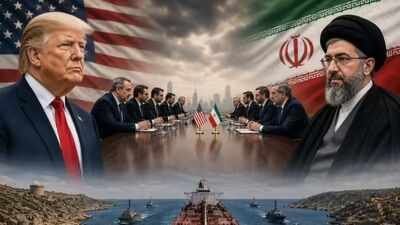
Iran has argued that it has “no choice” but to develop a nuclear weapon to guarantee its security, despite Tehran’s recent commitment under a preliminary agreement with the United States not to pursue nuclear arms, according to a media report linked to the Islamic Revolutionary Guard Corps (IRGC).The article, titled “No choice but to build the atomic bomb,” was published by Iran’s state-affiliated Fars news agency on Sunday and asserted that Tehran must negotiate with its adversaries from a position of strength and strategic deterrence.“To achieve the peace and calm that Iran needs, it must absolutely reach nuclear deterrence to ensure that the rest of the issues can be resolved through negotiation,” the article said, drawing comparisons between Iran’s current standoff with the United States and China’s strategic position during the 1970s.Drawing a comparison with China’s relations with the United States in the 1970s, the piece argued that Beijing was able to negotiate with Washington only after developing nuclear weapons.“America threatened China with nuclear attack twice, similar to Trump’s recent nuclear threats against Iran — but when did Kissinger secretly meet with the Chinese and then negotiate? It was when China built the atomic bomb,” the article stated.It further argued that nuclear weapons would help establish a strategic balance with countries possessing nuclear arsenals.“Nuclear deterrence means that you can reach a balance of power against America and Israel, who possess atomic bombs — not so that war does not happen, but so that the scope of conflict remains controllable,” it said.The comments come despite the memorandum of understanding signed between Washington and Tehran earlier this month, under which Iran agreed to allow inspectors from the International Atomic Energy Agency (IAEA) to regain access to its nuclear facilities after oversight had been suspended last year.As part of the agreement, Iran also pledged not to develop nuclear weapons, while the United States called on Tehran to suspend all uranium enrichment activities for 20 years.The article’s publication comes as IAEA Director General Rafael Grossi renewed calls for unrestricted access to Iran’s nuclear facilities. “The government of Iran has affirmed quite clearly that [developing nuclear weapons] is not their intention, but of course, intentions are not enough,” Grossi told reporters on Friday.“In order to have certainty, we need to have a very strong system of verification as soon as practicable,” he added.Although Iran has agreed to allow IAEA inspectors to return in September, it has not yet granted access to nuclear sites damaged during US strikes ordered by President Donald Trump in 2025. The whereabouts of Iran’s stockpile of enriched uranium also remain unclear.Iranian officials have continued to defend the country’s military capabilities as essential for national security. “Iran’s military capabilities ensure the Iranian people’s inherent right to legitimate self-defence in the face of aggression and crimes, while at the same time guaranteeing peace and stability in the region,” Foreign ministry spokesperson Esmaeil Baghaei said in a post on X on Friday.Baghaei also criticised Gulf countries, accusing them of “engaging in aggression against their Muslim neighbour” while “remaining silent regarding the Israeli nuclear arsenal.”