A former Nintendo of America employee who rescued an original Donkey Kong painting from discarded office materials in the late 1980s has seen the forgotten artwork sell for $329,400 at auction. Donna Darbous, who worked as an advertising executive at the gaming company, saved several original illustrations during an office expansion with her supervisor’s permission. Among them was a 1981 promotional painting by illustrator Leslie Cabarga, featuring Donkey Kong, Pauline and Jumpman, the character who later became known as Mario. Darbous kept the rescued pieces in the flat drawers of a coffee table for decades before rediscovering them while sorting through her belongings. The artwork was eventually sold at Landry Pop Auctions on October 28, 2026, more than doubling its highest pre-sale estimate of $150,000.
How a Nintendo employee rescued the artwork from being discarded
The unusual story began in the late 1980s, when Nintendo of America was expanding its office space. During the process, advertising executive Donna Darbous noticed several original illustrations among materials marked for disposal.Recognising their significance, she sought permission from her supervisor to take some of the pieces home rather than allow them to be thrown away.Among the rescued materials was the original 1981 Donkey Kong promotional artwork created by illustrator Leslie Cabarga. The illustration had been commissioned for Nintendo’s North American arcade promotional flyer and was subsequently used as the basis for posters distributed across the country.Darbous had been involved in Nintendo’s advertising, collateral and packaging initiatives during a period when the company was expanding rapidly in the American market. Her work included campaigns associated with Super Mario Bros., Zelda, Tetris, the Nintendo Entertainment System (NES), Super NES and Game Boy.
Painting remained forgotten inside a coffee table for decades
After bringing the rescued artwork home, Darbous stored the pieces in the flat drawers of a coffee table, alongside prewar lithographs she had collected during her travels in the Czech Republic.The Nintendo material remained there for decades, largely out of sight. Nearly 40 years after her time at the company, Darbous began sorting through her belongings and revisiting her collection of Nintendo memorabilia.During this process, she remembered the rescued illustrations and eventually discovered them inside the coffee table that she still owned.The rediscovery brought back memories of her time at Nintendo and a period when video games and emerging technology were transforming the entertainment industry. Realising the historical significance of the material, she eventually contacted Landry Pop Auctions founder Travis Landry to arrange its sale.
Artwork features Mario’s earliest incarnation as Jumpman
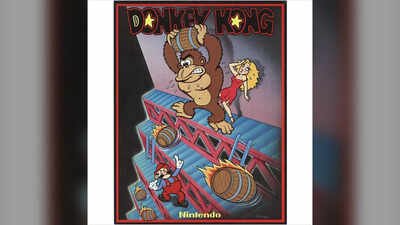
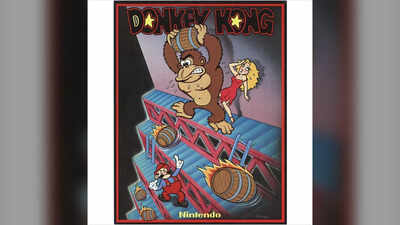
The painting was created in 1981 by American illustrator Leslie Cabarga for Nintendo’s North American Donkey Kong arcade promotional flyer.One of its most significant features is the appearance of Mario in his earliest public incarnation, when the character was known as Jumpman.The illustration depicts Donkey Kong holding a barrel above his head, while Jumpman climbs towards Pauline, who is trapped above him. The scene reflects the central gameplay of the original arcade title, in which players had to navigate obstacles and avoid barrels thrown by the giant ape to rescue Pauline.At the time, Mario had not yet become the globally recognised character associated with Nintendo’s video game franchise. He was introduced as Jumpman in Donkey Kong before being renamed Mario, reportedly after Mario Segale, the landlord of Nintendo of America’s warehouse in Washington state.The name became firmly established with the release of Donkey Kong Jr. in 1982. Mario later became the central character in Mario Bros. in 1983 and Super Mario Bros. in 1985.
How the original Donkey Kong painting was created
The artwork is made using a layered technique involving acrylic paint on transparent acetate placed over an ink and airbrush illustration on cardstock.The characters and objects, including Donkey Kong, Jumpman, Pauline and the barrels, were painted on the transparent acetate layer, while the background was created separately on the cardstock board. The technique resembles the layered artwork used in traditional animation production.According to the auction catalogue, the original measures 19⅞ inches in height and 16⅜ inches in width, approximately 50 by 42 centimetres.Despite being more than four decades old, the artwork was described by the auction house as being in great condition, with vibrant colours. The condition report noted minor wear along the edges of the cardstock, some faint rubbing, small tears and minor losses of airbrush on the underlying board.The auction house also noted that some of the damage was not visible beneath the painted acetate overlay.
Donkey Kong painting sells for $329,400 at auction
The original artwork was offered as Lot 102 at Landry Pop Auctions on October 28, 2026, as part of a sale titled ‘Jumpman: The Beginning of an Icon, Important Original Art and Artifacts from Nintendo History’.The painting carried a pre-sale estimate of $100,000 to $150,000 but eventually fetched $329,400, more than twice its highest estimate.The auction house described the illustration as representing the first public appearance of Mario, making it a significant piece of early video game history.The sale also established a new reported auction benchmark for original video game artwork, surpassing the previous notable record of $63,000 paid for Robert Florczak’s original Prince of Persia box artwork at Heritage Auctions in January 2023.The Donkey Kong painting’s final price was more than five times that earlier figure.
Other Nintendo collectibles were also part of the auction
The Donkey Kong illustration was among 49 pieces from Darbous’ personal collection offered during the auction.The collection included original promotional artwork, gaming memorabilia and other material connected to Nintendo’s early years in the American market.Some of the other notable items included original Mickey Mouse Game & Watch artwork from 1981, Mickey & Donald Game & Watch promotional artwork from 1982, Super Mario Bros. production artwork featuring Mario and Luigi, and an original 1985 Super Mario Bros. NES cartridge.The Super Mario Bros. production artwork featuring Mario and Luigi sold for $17,080, while the graded 1985 NES cartridge fetched $34,160. The Mickey Mouse and Mickey & Donald artwork sold for $7,320 and $10,980, respectively.The auction brought together material from a period when Nintendo was developing the characters, games and visual identity that would eventually become recognised around the world.
How the original Donkey Kong game changed Nintendo’s fortunes
The painting’s historical significance is closely connected to the success of the original Donkey Kong arcade game, released in 1981.Before its launch, Nintendo of America had struggled with the commercial performance of Radar Scope, a space-themed arcade game that left the company with approximately 2,000 unsold cabinets.Nintendo president Hiroshi Yamauchi turned to a young designer, Shigeru Miyamoto, to develop a new game using the existing hardware. The result was Donkey Kong, which introduced players to a character-driven arcade experience centred on rescuing Pauline from the giant ape.The game became a major commercial success in the American market, helping Nintendo establish itself as a significant player in the arcade industry.It also introduced characters that would go on to become central to Nintendo’s identity, particularly Mario, who evolved from Jumpman into one of the most recognisable figures in video game history.The rescued 1981 painting now offers a surviving example of the original promotional artwork used to introduce those characters to American audiences.