
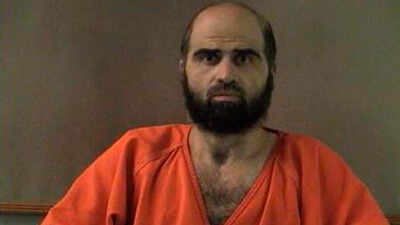
Fort Hood shooter Nidal Hasan has asked a federal court to delay his scheduled execution, saying he intends to argue that he was defending the Taliban from an unlawful US military attack.In a court filing signed by Hasan on Tuesday, he said he intended to demonstrate that the military court’s judgment and his death sentence had been obtained and were being maintained in violation of his federal constitutional and statutory rights.The filing could delay the Trump administration’s plans to execute Hasan on December 3. A hearing has been scheduled for Wednesday morning.Hasan, who is representing himself with assistance from lawyers at the American Civil Liberties Union’s Capital Punishment Project, said he intended to continue representing himself in the legal fight.
Hasan wants to revive defence barred at trial
One of Hasan’s central arguments is that he was prevented from presenting a defence that his actions were legally justified because he was trying to protect the Afghan Taliban from what he described as an unlawful attack by the US Army.Hasan had argued that he was acting in “defense of others”, according to court documents. However, the military judge barred him from presenting that argument during his 2013 trial.After dismissing his lawyers and choosing to represent himself, Hasan largely remained silent during the three-week trial. While the military called nearly 90 witnesses, Hasan called none in his defence and made no closing argument.A military jury found him guilty of multiple counts of murder and attempted murder for the shooting, which left 13 people dead and 32 wounded.The case has been assigned to US district judge Tony Mattivi in Kansas, where Hasan is being held at the military prison at Fort Leavenworth. Mattivi was nominated by president Donald Trump and confirmed by the Senate in June.
What happened in the Fort Hood attack?
On November 5, 2009, Hasan walked into the Soldier Readiness Processing Center at Fort Hood, Texas, where soldiers were waiting for medical tests and preparing for deployment.He opened fire with a handgun fitted with laser sights, killing 13 people and wounding more than 30 others.Hasan was shot by law enforcement officers during the attack, leaving him paralysed from the waist down and confined to a wheelchair.He was convicted by a military jury in 2013 of 13 counts of premeditated murder and 32 counts of attempted premeditated murder. The jury sentenced him to death.
Execution controversy and survivors’ objections
Trump authorised Hasan’s execution on the recommendation of defence secretary Pete Hegseth. The execution, scheduled for December 3 at Fort Hood, would be the first US military execution by firing squad since World War II and the first military execution since 1961.The plan drew controversy after Hegseth announced that the execution would be public and the Pentagon confirmed it would be livestreamed. Critics from both parties raised concerns that broadcasting the execution could fuel radicalisation and turn it into a spectacle.Trump later said the execution would not be livestreamed, but that immediate family members of the victims could witness it in person if they chose.The latest court filing comes amid further dispute over who will be allowed to attend. Military officials have denied requests from three survivors of the 2009 shooting to witness the execution, citing regulations, security and space constraints.The survivors argued that the military should recognise them as victims under a broader definition that includes direct physical, emotional or financial harm. The Army rejected their appeal, saying regulations specify who may attend a military execution.