
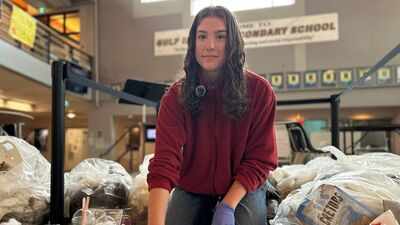
At 17, Canadian student Melody Silva has found ways to bring environmental concerns beyond the classroom and into her wider community. From producing a documentary about fish farming and its effects on British Columbia’s wild salmon to speaking about climate injustice through live performances, she has used creative work to encourage people to pay attention to environmental issues. Her efforts also include working with Indigenous elders, supporting school recycling initiatives and helping other students find practical ways to take action against climate change.
Melody Silva used a documentary to highlight threats to wild salmon
Silva’s interest in environmental protection is closely connected to the natural surroundings in which she grew up. Living in an environment where nature was part of everyday life made it difficult for her to ignore the damage being done to it. She has described climate change as a particularly heavy concern for younger generations, who are left to deal with problems created before their time.According to the National Youth Climate Activism Awards Association, Silva restarted her high school Earth Club 3 years ago. The initiative gave her an opportunity to turn environmental concerns into activities that other students could participate in.One of her most significant projects came in the spring of 2024, when she directed and produced a documentary examining the harmful effects of fish farming on British Columbia’s wild salmon population. The film also explored the wider consequences for the coastal ecosystem, recognising that the health of salmon populations is connected to the natural environment around them.Rather than relying on research alone, Silva sought perspectives from people with direct knowledge of the issue. She interviewed two Kwak’waka’wakw elders and Dan Lewis, executive director of the environmental non-profit Clayoquot Action.The documentary was produced with help from Clayoquot Action and filmmaker Jérémy Mathieu. Silva subsequently presented it at her school to introduce fellow students to the concerns surrounding fish farming and wild salmon.
How did she bring climate concerns to a wider audience through art
She has also used performing arts to reach people who might not otherwise engage with climate issues.Her profile on the National Youth Climate Activism Awards Association website explains that she competed in the national finals of the Canadian Improv Games. During the competition, she used the stage to speak about climate injustice, bringing environmental concerns into a creative setting.The performance reached an audience beyond those attending in person. It was staged at the National Arts Centre and livestreamed, allowing viewers across Canada to watch. This gave Silva another opportunity to communicate her concerns and show how art could become a useful platform for discussing environmental problems.
School activities became another part of her environmental work
Silva’s involvement in climate action has also extended into everyday school life. Her work with the Earth Club has included organising activities that encourage students to reconsider how they consume, reuse and dispose of everyday items.According to her 2026 youth climate activism profile, she has spent 4 years volunteering with Transition Salt Spring, a local environmental non-profit. The experience influenced how she approached her responsibilities as an Earth Club leader.She introduced several eco-events, including clothing swaps, gift swaps and repair cafés. These activities offer students alternatives to throwing away items that remain useful. Clothing and gifts can find new owners, while damaged belongings can be repaired instead of being immediately discarded.
She also encouraged other students to take part in climate action
Her youth climate activism profile describes a Youth Climate Advocacy Training Programme that she was spearheading at her school. One of its planned outcomes was the development and implementation of a plastic recycling system at Gulf Islands Secondary School. Silva intended to collect information about how much waste the programme could divert from landfill.Her longer-term aim was to persuade the school administration to introduce permanent plastic recycling facilities. She also hoped the initiative could provide an example for other schools across British Columbia.Her inspiration comes from both her upbringing and her family history. Silva mentioned that her grandfather was among the main organisers of the Mears Island logging protests. Seeing the outcome of those efforts gave her confidence that collective environmental action could make a difference.
Her plans extend beyond school climate campaigns
According to the 2026 profile, she planned to attend the University of Victoria to study Geography with a minor in Environmental Studies. She hopes to pursue a law degree afterwards and become an environmental lawyer.She has also gained experience through scientific research. She led a preliminary research team studying the relationship between moss and soil microorganisms for the Salt Spring Climate Adaptation Research Lab. The work helped scientists studying Mount Maxwell identify an overall lack of microorganism activity in the soil, which they planned to investigate further.