
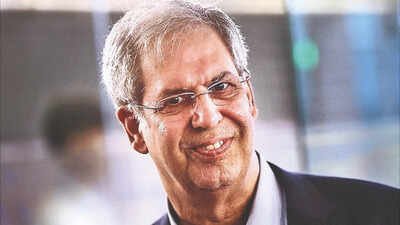
MUMBAI:Tata Trusts chairman Noel Tata has sharpened his opposition to a potential listing of Tata Sons, arguing that bringing in public shareholders could upend a century-old ownership structure in which philanthropy sits above profit.“My worry is that listing, which is what some people are proposing, will change the Tata way. And one day, if we have 30,000, 40,000 shareholders, profit may take precedence over philanthropy. I think that would fundamentally change the Tata way of working.”Framing the issue as central to the group’s identity, Tata added: “The whole essence of Tata Group today is that 66% of profits of Tata Sons are used for philanthropic causes. That is unique in the world.”“Charity precedes commerce. Charity owns commerce. It’s not the other way around,” he said at the HT Leadership Summit on SaturdayHis remarks come as Tata Sons faces pressure to comply with the Reserve Bank of India’s upper-layer non-banking financial company (UL-NBFC) regulations, which require the holding company to list. Tata Sons remains the only entity on the RBI’s UL-NBFC list that has not complied with the framework.While Tata has publicly opposed a listing, some Tata Trusts trustees have taken the opposite view. Trusts vice-chairmen Venu Srinivasan and Vijay Singh have argued listing and philanthropy can coexist, citing foundation-owned global companies such as Novo Nordisk and Hershey. They contend a listing would not dilute the Trusts’ controlling stake and could strengthen governance, transparency and accountability while enhancing the dividend stream that funds charitable activities.The differences underscore a rare public divergence within the Trusts. Noel succeeded Ratan Tata after his death in October 2024, and the debate has exposed fault lines over the future ownership structure of the $180-billion group.“Dividends from some of our listed companies, which come through the channel, become tomorrow’s hospitals, tomorrow’s flood relief, tomorrow’s education institutions, tomorrow’s relief for people in crisis,” Tata said. “This profit becomes, in a way, a public good. It repeats itself every year, year on year, by design.”Defending the existing structure, he said: “In this particular case, the owner cannot die. The owner cannot be bought. And the owner cannot retire. So there is a continuity in the Tata way.”Some trustees, however, maintain that Tata Sons shareholding is held by public charitable trusts and that trustees act only as custodians and fiduciaries, not owners.Tata also argued that remaining private gives Tata Sons the flexibility to support group companies in times of need.“The other thing that staying private does is Tata Sons remains the backstop for all or any Tata companies that ever gets into trouble. And that is an important glue which keeps the entire group together.”“The moment you have a separate set of investors in Tata Sons that requires funding, they’re quite right to ask, why do we want to make investments here? You should only be making investments in what will deliver and allocating capital to the most profitable ventures. And therefore the nature of the group is going to change.”At the same time, a listing would open new funding avenues for Tata Sons, giving it direct access to public equity markets and a broader debt investor base, options that are largely unavailable in its current form, some Tata observers said.“Why tinker with something that has delivered such value for 150 years? Why do we want to change that?” Tata asked. He said the Trusts would “play a constructive role with the regulators, with others, to try and find a solution which keeps the Tata way the way it is.”Tata also backed the group’s strategic direction but appeared to question its execution, in remarks seen as a veiled critique of Tata Sons chairman N Chandrasekaran.“The strategic direction, as I’ve said now twice or thrice, remains the same. Philanthropy on one hand, nation building on the other hand. This is independent of the leadership, of personalities. This is embedded in the DNA of the group,” he said. “I have not asked or questioned the direction of what we’ve done. I question sometimes the delivery of what we’re doing.”“The question is, do we have the discipline when we execute projects and not the direction? How will projects with a long gestation period succeed if we don’t have discipline? And how will we allocate capital to those projects?”“So very clearly, direction is fine, but we also need discipline of execution in these very large projects,” he said.