
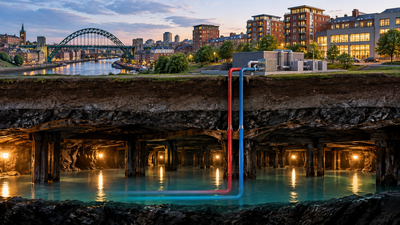
Water trapped deep beneath Gateshead is now helping heat hundreds of homes and public buildings, turning former coal mine workings into a source of heat for the city. The water lies around 150 metres below Gateshead town centre, where a 6-megawatt water-source heat pump extracts its heat and feeds it into an existing district heating network. According to the Mining Remediation Authority, the system went live on 29 March 2023 after about three years of work and is the largest mine water heat network in Great Britain. More than 5 kilometres of heat-network pipes carry the heat to buildings including Gateshead College, the Baltic Arts Centre, several offices and 350 council-owned homes. The network is also planned to reach another 270 privately owned homes, alongside a new conference centre and hotel development. The project is also being studied through the Gateshead Living Laboratory, where boreholes and monitoring equipment collect data on the mine water system.
Mine water heat pump powers Gateshead buildings
A 6 megawatt water-source heat pump recovers heat from the mine water and transfers it into the district heating network. The heated water is then distributed through more than 5 kilometres of heat-network pipes to connected buildings.The network currently supplies heat to several types of buildings across Gateshead. These include Gateshead College, the Baltic Arts Centre, several offices and 350 council-owned homes. The source states that the system is also planned to serve another 270 privately owned homes, as well as a new conference centre and a hotel development.
Why does mine water get warmer with depth
Mine water becomes warmer with increasing depth because of what the Mining Remediation Authority describes as a ‘geothermal gradient’. Mine water temperatures generally range from 10°C to 20°C, although they can reach 40°C at depths of around 1 kilometre. Water can be brought to the surface through boreholes, shafts or adits, before heat exchangers and pumps recover its heat. The authority says mine water temperatures are not affected by seasonal variations. It describes mine water as a potential source of “renewable, secure, low carbon heating for buildings in coalfield areas”, with the right support and sustainable management.
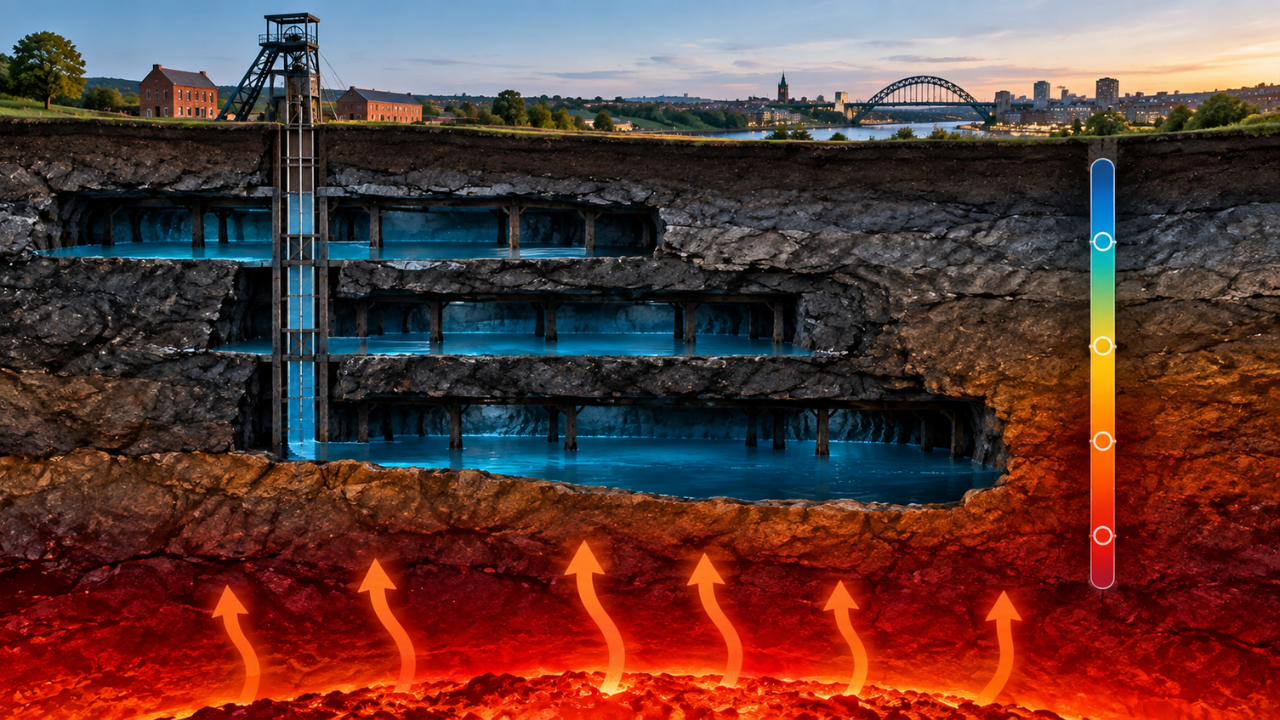
Image AI generated
What is the Gateshead living laboratory studying
The Gateshead mine water heating network is part of a wider research project known as the Gateshead Living Laboratory. The initiative is designed to collect evidence that supports future licensing, management and wider use of mine water heat schemes. It is located near three mine water heat schemes in the North East of England.With support from Gateshead Council, researchers drilled four boreholes and installed monitoring equipment to gather data. The information is available as open-access data for researchers, regulators, stakeholders and academic institutions. The government says the work will help researchers study the thermal and hydrogeological interactions between multiple mine water heat schemes in the Walker mining block in Tyne and Wear.