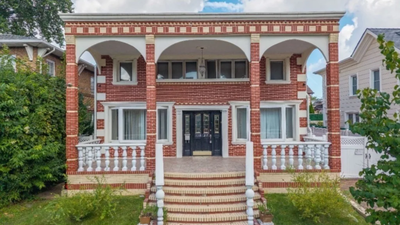
A Forest Hills home in Queens that was once owned by two brothers convicted in a major counterfeiting case is now headed for a federal auction, more than two decades after they bought it for $850,000. According to the US Treasury Department‘s auction listing, the five-bedroom property at 110-37 69th Ave. is scheduled to be sold online on October 23, with bidding starting at $900,000. The 3,572-square-foot house became entangled in federal forfeiture proceedings as authorities pursued the brothers’ involvement in a racketeering conspiracy involving counterfeit US currency and money structuring.
The home the brothers bought in 2003
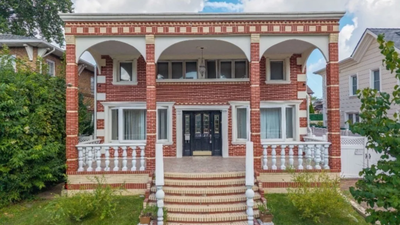
Eduard and Arkadiy Bangiyev purchased the Forest Hills property in 2003 for $850,000, using a $750,000 mortgage, according to a 2023 ruling by the US Court of Appeals for the Fourth Circuit. The house, built in 1930, sits on a roughly 5,000-square-foot lot. It has five bedrooms and 4½ bathrooms, along with an enclosed porch, finished basement, additional bedroom and bathroom, sauna and detached two-car garage.More than 20 years after the brothers purchased it, the property is being offered at a starting price only $50,000 above what they originally paid. But the house’s journey from a family residence to a federally auctioned property is tied to a much larger criminal case.
How the property became connected to a counterfeiting operation
Beginning in 2004, the Bangiyev brothers participated in a criminal enterprise involved in manufacturing and distributing counterfeit US currency, according to federal prosecutors and court records cited by Realtor.com. The operation produced counterfeit notes in Israel and the US and moved them into the country, including shipments concealed inside containers carrying machinery. At its height, the organisation was reportedly bringing as much as $3 million in counterfeit currency into the US every three months.Federal authorities ultimately linked the operation to more than $80 million in counterfeit currency that was passed or seized around the world. The brothers were involved in financing and distributing the counterfeit money. They also operated businesses in the jewellery and gold industries, including a retail jewellery store on Long Island and later a gold-refining business in Manhattan’s Diamond District. Both brothers eventually pleaded guilty in January 2015 to participating in a RICO conspiracy involving counterfeiting and money structuring.The brothers were later sentenced to federal prison, and their plea agreements also required them to forfeit property connected to or derived from their racketeering activity. The Forest Hills house later became part of the broader forfeiture dispute.
The property had another complicated legal history
The home’s legal problems did not end with the counterfeiting case. According to the Fourth Circuit, a federal district court found that money used to pay off the property’s mortgage and home-equity lines of credit in 2012 came from a separate scheme in which the brothers allegedly defrauded a jewellery customer of $1 million. The appellate court noted that this alleged fraud was separate from the RICO conspiracy for which the brothers were later convicted.The government had already initiated civil-forfeiture proceedings involving the Forest Hills home and another property in 2009. That earlier case was dismissed in 2011 after the brothers and their sister, Ilana Bangiyeva, agreed to a $662,500 settlement. Ownership then became the subject of another legal fight following the brothers’ convictions.
Years of dispute over who owned the home
Before the convictions, the deed divided ownership among family members. Arkadiy held one-third, their sister held another third, while Eduard and his wife, Irina Alishayeva, jointly held the remaining third. Ilana argued that she had acquired interests in the home and other assets using proceeds from a gold investment she had made with her brothers. Courts rejected that argument, finding that there was not enough evidence to show the claimed investment had generated the money used to acquire the properties. A district court ultimately determined that the Forest Hills property provided a “source of influence” over the brothers’ racketeering enterprise and ordered it forfeited.The government eventually obtained a two-thirds ownership interest, while Alishayeva retained one-third. There was still another hurdle. A federal judge initially allowed Alishayeva, whose primary residence was the property, to remain there for the rest of her life as long as she remained married to Eduard. That effectively prevented the government from selling its majority interest. The government challenged that decision.In 2023, the Fourth Circuit sided with the government, ruling that the lower court had exceeded its authority by preventing the government from exercising the property rights attached to its two-thirds ownership stake. The appeals court vacated that part of the forfeiture order and sent the matter back for further proceedings.
Home now headed for federal auction
The long legal battle has now brought the Forest Hills property to the auction block. The US Treasury Department is scheduled to conduct the online auction on October 23. Bidding will begin at $900,000, and prospective bidders must provide a $150,000 deposit to participate. The property is being sold “as is.” Public inspections are scheduled for October 11 and October 18 before the auction. For a home that was purchased for $850,000 in 2003, the $900,000 starting bid may appear modest compared with its current market value. But the price also reflects the unusual history attached to the property and the complicated legal proceedings that have surrounded it for years.What began as a Forest Hills family home ultimately became part of a federal forfeiture case connected to one of the larger counterfeit-currency operations investigated by US authorities. Now, after years of convictions, ownership disputes and appeals, the 3,572-square-foot Queens property is finally set to go under the hammer.