
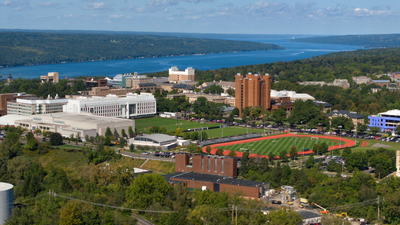
Cornell is one of the biggest and most esteemed universities in the world, sitting on a hill overlooking the 38-mile-long Cayuga Lake with an area of 2,300 acres. In the late 1980s and early 1990s, most institutions, including Cornell, used CFC chillers. These first-generation Ozone-Depleting Substances (ODSs) were destroying the ozone layer and warming the climate. When the university had to phase out its ageing CFC chillers due to unreliability and CFC bans under the Montreal Protocol, researchers and engineers looked down the campus slopes towards the cold and deep waters of Cayuga Lake.Earlier, the campus relied on conventional refrigeration chillers and cooling towers to cool down its campus, using about 33,000 gallons per minute. However, in 2000, the university launched its lake source cooling system that led to an 85% reduction in energy used for campus cooling, according to its website.
Lake source cooling
Lake source cooling is one of the most important environmental initiatives. With its startup in 2000, Lake Source Cooling (LSC) upgraded the central campus chilled water system to a more environmentally sound design that conserves energy and utilises a renewable resource, the deep, cold waters of nearby Cayuga Lake.LSC was proposed in 1994 and approved by the New York State Department of Environmental Conservation in 1998. Nearly four years of environmental study and review resulted in a four-volume, 1,500-page Environmental Impact Statement that thoroughly described the potential impacts of the project on the lake. The DEC determined that LSC could provide the stated environmental benefits without harm to Cayuga Lake.Construction began in March 1999, and the project was completed in the year 2000. The construction phase provided many benefits to the public, which total over $2 million in value to the taxpayers of the City and Town of Ithaca and the City of Ithaca School District.Initially, the entire project carried the price tag of $58.5 million, it did cost more than replacing existing campus chillers with new ones. However, a driver for Cornell’s investment was a commitment to reduce refrigerant use in campus equipment to benefit the environment.
How does it work?
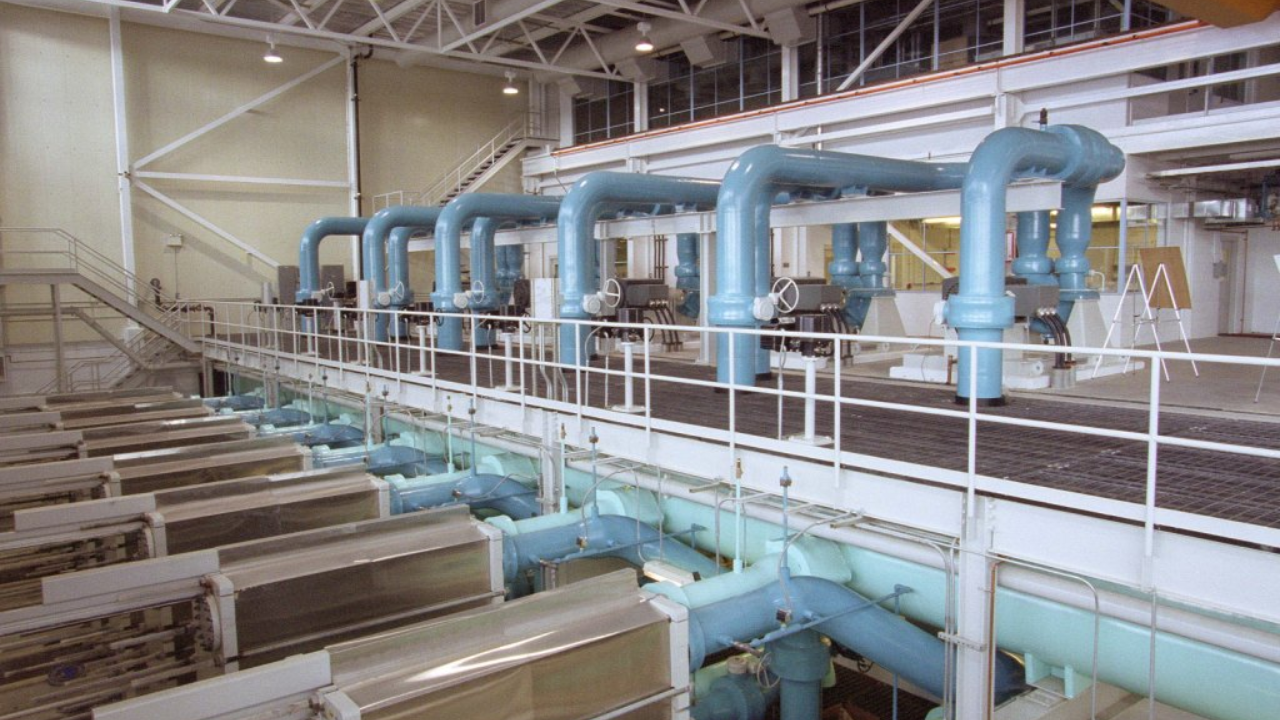
The deep waters of Cayuga Lake are a naturally renewable source of chill that saves approximately 85% of the energy used for cooling by conventional refrigeration
A well-proven cooling technology transfers the heat from the campus chilled water to the lake water through heat exchangers that separate the lake water and campus water – the two loops never mix. Because heat flows naturally from hot to cold, no extra energy is required beyond that needed to move the water through pipes.In the open lake-water loop, cold lake water is circulated past the metal surfaces of a heat exchanger in the plant, which cools a district cooling loop used by Cornell and Ithaca High School. This circulated water is then returned to the shallow waters in the lake. The deep waters of Cayuga Lake are a naturally renewable source of chill that saves approximately 85% of the energy used for cooling by conventional refrigeration. Then comes the closed campus loop, where large pipes reduce friction and a closed loop allows warm water coming down the hill to push the cooled water back up to the campus.The intake is 10 feet above the lake bottom in water located two miles out and 250 feet deep, where the temperature is about 39°F year-round. Water is returned to the lake gradually, dispersed through small holes at the outfall. Clearer than the shallow water it enters, and cooler in all but the coldest months, the returned water has no discernible impact.
The positive impact
Cornell’s lake source cooling system, the first and largest in the US, has earned the university recognition for its leadership in sustainable energy solutions. Among numerous honours received, the campus chilled-water and steam/combined heat and power systems were collectively named IDEA’s System of the Year in 2001.LSC saves over 29 million kWh per year versus previous cooling methods, enough to offset the annual electricity used by 7,970 homes in Tompkins County and an 85% reduction in energy used for campus cooling.Now, 98% of the cooling on Cornell’s Ithaca campus is renewable and refrigerant-free. During times of peak demand and maintenance, LSC is supported by a thermal storage tank and three chillers that use approved refrigerants. Since LSC is designed to last 75 to 100 years, more than twice the typical life of chillers, the innovative system is a long-term, cost-effective, planet-positive solution to the university’s cooling needs.