
Thomas Gilcrease was just nine-year-old when he became eligible for a 160-acre land allotment in Oklahoma through his Creek tribal membership in 1899. The land, near present-day Glenpool, later became part of the Glenn Pool oilfield, where oil was discovered in 1905. By 1917, 32 producing wells were operating on his property, giving Gilcrease the income to continue his education and eventually build a career in the oil industry. That wealth later supported his growing interest in American Indian history, art and culture.Gilcrease was born in 1890, in Robeline, Louisiana, the eldest child of his parents, according to Oklahoma Historical Society. His family moved to the Creek Nation in Oklahoma Territory soon after his birth and eventually settled at Wealaka. His Creek ancestry came through his mother, while his father was non-Indian.His name was entered on the Creek tribal rolls when he was nine which made him eligible for the 160-acre allotment under the Dawes Commission process. At the time, the value of the land was not yet tied to the oil wealth that would later come from it. Six years after Gilcrease received the allotment, the Glenn Pool oilfield was discovered in 1905 and by 1917, the property had 32 producing oil wells.The income from the land helped Gilcrease continue his education. He had attended rural one-room schools before studying at Bacone College and the Kansas State Teacher’s College in Emporia.At Bacone, one of his teachers was Alexander Posey, who taught Gilcrease about the Trail of Tears and American Indian leaders such as Sequoyah and Sitting Bull. He learnt about making bows and arrows, hunting and the operations of the Creek National Council at Okmulgee. These lessons became part of a wider interest in American Indian history that remained important to Gilcrease throughout his life.
Gilcrease becomes art collector
Oil became an important part of Gilcrease’s working life. He eventually worked in several fields, including ranching, farming, banking and the oil industry. In 1922, he founded the Gilcrease Oil Company. His company later brought in numerous wells in Oklahoma, Texas and Kansas.Gilcrease also discovered a new oil-producing strata near Wetumka. It became known as the Gilcrease sand. His business interests expanded further, and he obtained controlling interests in several banks, including the Fourth National Bank of Tulsa, the Bank of Bixby and state banks in Coweta and Wagoner.While his oil business was growing, so was his interest in art. Gilcrease bought his first painting, Rural Courtship by Daniel Ridgway Knight, in 1912. He later travelled to Europe to study fine art and petroleum. According to the Gilcrease museum. During these trips, he became interested in building a collection connected to American Indian history and the American West.Gilcrease gathered American Indian art and artefacts, books, manuscripts, maps and other historical material. He also became involved in archaeological work and personally excavated Indian archaeological sites in the United States and Mesoamerica.
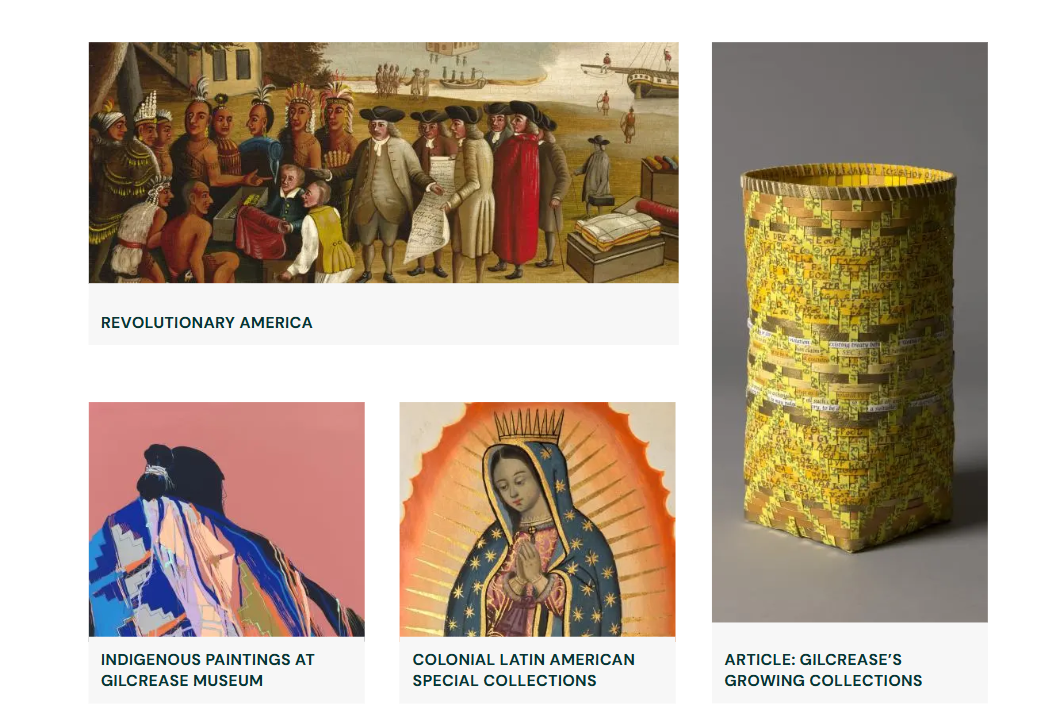
Some of the collection at Gilcrease museum
Building the dream museum
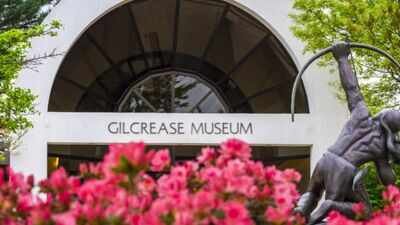
Gilcrease’s collecting became more active during the 1930s and 1940s. In 1942, he established the Thomas Gilcrease Foundation to gather, maintain and preserve material related to American Indians. A year later, he opened his first museum in San Antonio, Texas.Gilcrease had moved his company headquarters to San Antonio in 1937 to be closer to his major field operations. However, the museum did not attract enough public interest there. He closed the display in 1947 and moved his collection back to Tulsa.In May 1949, Gilcrease opened a new museum in Tulsa. The building stood beside his home west of downtown. The collection continued to grow as he acquired paintings, books, photographs, manuscripts and other historical material.One of the major additions came in 1944, when Gilcrease purchased Dr Philip G Cole’s Western art collection. The purchase included 636 works of art, along with books, photographs and archival material. It also brought paintings by Frederic Remington and works by Charles M Russell into his collection.Another major acquisition came in 1948, when Gilcrease acquired the estate of landscape painter Thomas Moran. It contained about 2,000 works of art, including watercolours of the Yellowstone region of Montana and Wyoming. He also acquired an important collection of art and correspondence connected to George Catlin, as well as works by Alfred Jacob Miller.Gilcrease’s collection also included works by artists such as Winslow Homer, John Singer Sargent and James McNeill Whistler. During visits to the artists’ colony at Taos, New Mexico, he bought paintings directly from artists including Ernest Blumenschein and Bert Phillips. He also collected the work of Native American artists including Acee Blue Eagle, Woody Crumbo and Willard Stone.
Tulsa secures ollection
The scale of Gilcrease’s collecting eventually created financial difficulties. By 1953, he was financially strained and owed about $2.5 million to business associates, galleries and art brokers for various acquisitions.The City of Tulsa then organised a bond issue in 1954 to pay Gilcrease’s debts and secure his collection for the community. In 1955, Gilcrease transferred the title to his collection to the city. The museum was renamed the Thomas Gilcrease Institute of American History and Art.In 1958, Gilcrease also deeded the museum buildings and more than 13 acres of land to the community. Revenue from some of his oil properties was committed towards repaying the original bond amount. That repayment was completed in 1985.Gilcrease, however, continued collecting after the transfer of his collection to Tulsa. His interest in archaeology and ethnology also led him to support field excavations of Indian mounds in the Mississippi Valley. Material from those excavations and his later collecting eventually reached the museum through a bequest after his death in 1962.The collection continued to expand after Gilcrease’s death. The museum now houses more than 12,000 works of fine art, while its Helmerich Center for American Research holds about 100,000 rare books, manuscripts and other archival materials.The museum’s collections also include more than a quarter of a million artefacts related to the Indigenous peoples of the Americas. The collection had grown to include 10,000 works of American Indian and related art, 250,000 artefacts and 100,000 rare books when the collection was presented to the people of Tulsa in 1955.