
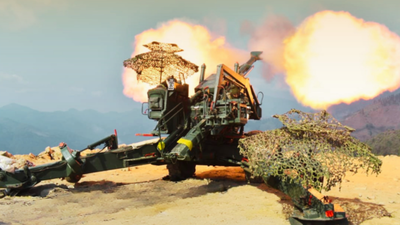
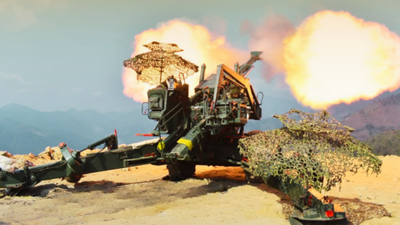
In the wee hours of May 7, 2025, the stillness and silence of the night was broken by the big guns of the Indian artillery. Although the attacks on the terror nerve centres at Muridke and Bahawalpur stole the headlines, the Army had struck seven more targets across both the Line of Control and the international border.These targets were hit by precision fire from artillery guns and loitering munitions. The message was clear: there was no safe space on the other side of the border.The pinpoint dropping of munitions on these terror targets was the latest feat in a long and storied history of the artillery arm, which now has nearly 200 years of service under its belt.The importance of long-range firepower in a non-contact but kinetic conflict has grown in the last few years, as demonstrated first in Ukraine and then reiterated by Iran. The Americans, too, have shown their dependence on long-range vectors such as the Tomahawk cruise missile and the PrSM to degrade adversarial air defences before sending in aircraft for stand-in attacks.India, which is unlikely to be inducting stealth aircraft in the near future, is more likely to depend on stand-off weapons in the initial phases of a conflict, as was demonstrated during Operation Sindoor. Artillery’s unique capability to “strike deep and strike hard” is therefore even more important for the country.
From Panipat to Mysorean rockets: India’s long artillery tradition
The Regiment of Artillery has, from its first use in the sub-continent during the mid-14th century Bahmani-Vijayanagar War, only grown in significance. In the Battle of Panipat in 1526, artillery was decisively used to defeat the much larger Delhi Sultanate army of Ibrahim Lodhi, thus laying the foundation of the Mughal Empire. Though the artillery arm of the Marathas was weaker than many of their contemporaries, Balaji Baji Rao organised the arm on professional lines and Madhavji Sindhia established a fairly efficient gun manufacturing foundry under the supervision of European gun makers.The Indian artillery tradition has left another mark halfway around the world. The American national anthem also gives an ode to the Indian artillery tradition, with the lines “and the rockets’ red glare, the bombs bursting in air, gave proof through the night that our flag was still there”. The red glare of the rockets that features prominently in the US national anthem came from rockets fired by the British at Fort McHenry during the War of 1812. But the British had themselves been at the receiving end of Mysorean rockets and, after the defeat of Tipu Sultan, adapted the technology into what came to be known as the Congreve rocket.
The modern Indian Artillery
The modern Regiment of Artillery traces its origins to September 28, 1827, when the British East India Company raised 5 (Bombay) Mountain Battery, originally the 8th Company of the Golandaz Battalion, Bombay Foot Artillery. It was the first unit of what would eventually become the Regiment and the first to be manned by native Indian soldiers. Specialising in mountain warfare, it set the template for the versatile artillery units the Army fields today.By the time of Independence, Indian Artillery had grown into a multi-branch arm, comprising Field, Medium, Air Defence, Counter Bombardment, Coastal, Air Observation Post and Survey units. Partition then split the Royal Indian Artillery, with India retaining eighteen and a half regiments while Pakistan received the remaining nine and a half.The Regiment has since fought in all the major conflicts the nation has fought in. In 1947-48, its guns helped hold key positions in the high-altitude terrain of Kashmir. In 1962, despite being outgunned and ill-prepared, artillery units inflicted considerable damage on the enemy. In 1965, its firepower proved decisive against Pakistani armour. In 1971, it provided overwhelming fire support in both the Eastern and Western theatres. During Kargil in 1999, artillery pounded enemy positions along the ridges, aiding the recapture of Tiger Hill and Tololing, with the Bofors guns earning particular praise for their accuracy.The vast majority of artillery regiments are equipped with the indigenous 105 mm Indian Field Gun or the Light Field Gun, while Pinaka, Dhanush and, in the future, the Advanced Towed Artillery Gun System (ATAGS) will increase the indigenous mix of equipment. The arm also has domestically assembled K9 Vajra guns, while the Russian-origin M-46 130mm artillery gun is also being up-gunned to 155mm domestically.
The growing importance of artillery
Artillery in the future will encompass a large portion of the battlefield. There won’t be a battle without artillery. Due to the nature of the arm it will be involved in long range kinetic operations and choke point operations in all types of terrain. This will have great value as this capability will have huge deterrent capability. But to fully exploit this, we need ground, air and space based sensors. There is a need to think of artillery differently, to make use of upcoming capabilities, the current way of thinking will not let us take full advantage of these systems.
Lt Gen PR Shankar (retired), Professor, Aerospace Dept IIT Madras and former DG Artillery
Since then, the Regiment of Artillery has grown by leaps and bounds in numbers and capability. The arm is now the second-largest arm of the Army, following the infantry and followed by the mechanised component. In terms of capability, the arm has grown from initially operating guns such as the 3.7-inch mountain gun and the 25-pounder to the 5.5-inch medium artillery gun.Now, the artillery is in the midst of a modernisation drive known as the Field Artillery Rationalisation Plan, which seeks to bring the gun regiments of the artillery to a common calibre of 155mm. This is the same bore as that of the now-famous Bofors gun.The Regiment of Artillery is also extending its reach with rocket systems such as the Pinaka, which is soon expected to reach an operational range of 120 km. The arm also demonstrated the Suryastra rocket system during this year’s Republic Day parade. This weapon system has a range of up to 300 kilometres.Apart from these battlefield weapons, the arm is also the custodian of the country’s tactical and strategic weapons. These range from the BrahMos missile that proved its effectiveness during Operation Sindoor to other weapons, including the Agni and Prithvi series of missiles. Once weapons such as the Long Range Cruise Missile (LRCM), Shaurya and Pralay are inducted, they will also equip the regiment. This means that in any future conflict, artillery will have a central role to play in any shooting conflict.
The eyes behind the guns: ISR, drones and the kill chain
Surveillance and Target Acquisition (SATA) regiments of artillery, which are tasked with monitoring the adversary’s dispositions, are being armed with Loitering Munitions (LM), thus giving the eyes and ears of the arm a precise manner of punching through the enemy’s defences in a more timely and effective manner. Artillery regiments are expected to deploy an increasing number of drones to keep a tab on enemy movements. Besides existing systems such as electro-optics, weapon locating radars and drones, the arm also requires a constellation of low earth orbit satellites to keep persistent eyes on target.Today, the force rests on two pillars: firepower and Intelligence, Surveillance & Reconnaissance (ISR). Firepower in contemporary warfare is often described through the acronym DRAM, standing for drones, rockets, artillery and missiles. The second pillar, ISR, covers intelligence, surveillance and reconnaissance. Without advanced sensors, fast communication and robust networking, firepower is effectively blind.An effective kill chain depends on the seamless pairing of sensor and shooter through secure networks, and the age-old sequence of seeing, acquiring and hitting a target remains a fundamental requirement. Meeting it means integrating space links, electronic warfare capabilities and persistent UAV surveillance so that long-range vectors can strike with precision.
What India now needs its artillery to do
Artillery is expected to deliver on five broad requirements. The first is conventional deterrence, the promise of overwhelming precision fire that discourages an adversary from embarking on a misadventure. The second is the ability to strike deep, using long-range vectors, both current and futuristic.The third concerns the contact battle. Rocket forces in several other countries operate in silos that do not lend themselves to battlefield synergy, whereas India needs a force that can reinforce the firepower available to frontline troops and provide additional punch from battalion to corps commanders. The fourth requirement is manoeuvre.In seemingly static battlefields, the force must enable manoeuvre or generate what is termed manoeuvre by fire, restoring mobility to a fight that has stalled, as seen in Ukraine. This also includes the idea of horizontal escalation, as witnessed in Iran, where strategic goals can be pursued without direct troop engagement.