
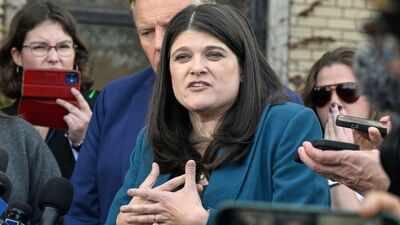
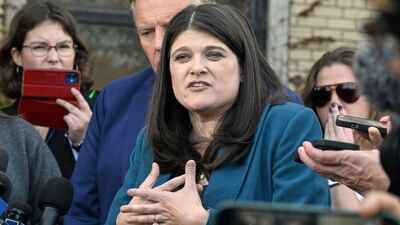
TOI Correspondent From Washington: Just when Democrats in America were beginning to entertain thoughts of a blue wave, possibly even a blue tsunami, along came Haley Stevens to remind them that nobody is quite as capable of complicating Democratic fortunes as a Democrat.In an extraordinary convulsion barely 48 hours before Tuesday’s midterm elections, the Democratic Michigan congresswoman, who lost a bitter party primary (inner party election) to progressive Abdul El-Sayed, crossed the political aisle to endorse his Republican opponent, Mike Rogers, in what would be called a last minute “defection” in Indian political parlance.The immediate political damage is difficult to quantify, but the optics and the timing – coming just when many polls are showing a Republican rout – could hardly be worse for Democrats, who are trying to persuade voters that they are united and ready to take back control of Washington. Instead, one of their own has provided Republicans with a ready-made advertisement for Democratic disarray. MAGA boss Donald Trump immediately jumped on the break, praising her “bravery.”The Stevens-El-Sayed rupture had been simmering since a bitter August primary,, which El-Sayed won by less than one percent. It was not simply a case of a disappointed politician nursing wounded ambitions within the party; the two represent sharply different constituencies and political instincts, particularly over Israel and the Gaza war.Stevens, a staunch supporter of Israel, was bankrolled by the so-called “Jewish lobby.” El-Sayed, a progressive son of Egyptian immigrants, campaigned on a more critical position towards Israeli policy and US military support for Israel. The primary exposed fault lines between pro-Israel Dems and the party’s vocal progressive wing, and the schism is now threatening to play out nationally, undercutting polls pointing to a big win.Stevens initially endorsed El-Sayed after losing — albeit without much enthusiasm — but the truce was always more a marriage of political convenience than a true reconciliation. The trigger for the final explosion was an ad by El-Sayed supporters linking U.S financial support for Israel to the rising cost of groceries. Stevens considered the advertisement antisemitic and demanded that El-Sayed disavow it. He eventually rejected the ad’s contents, but the dispute had gone personal by then, with El Sayed, likely emboldened by polls showing he was leading by 10+ points, torching a planned joint church appearance with Stevens and asking her to take a walk. She walked — over to Republican candidate Mike Rogers.Such election-eve defections being rare in America, Democratic leaders were aghast, even as Trump and his flock welcomed her. Democratic Party boss and NY Senator Chuck Schumer, who had backed Stevens during the primary, called her decision a “despicable betrayal,” while furious party flacks like James Carville used gross reproductive metaphors to warn her that Republicans would use her and discard.Democratic partisans are still hoping that a NYT/Siena poll showing the party leading in all seven crucial Senate — five of them by +5 percent ––can withstand the last minute Stephens torpedo. The numbers are unbelievable for Dems, particularly in Kansas and Texas, where they have not won a Senate seat in decades. Even allowing for polling error, the geographical breadth of the Democratic advantage suggests a national political environment hostile to Republicans.Still, the Dem are nervous, and the feeling is not entirely irrational. The party has repeatedly discovered that the electorate it sees in surveys is not necessarily the one that turns up at polling stations. Donald Trump’s political career has been built, in considerable measure, on voters who are difficult for traditional polling models to capture: less politically engaged people, rural and small-town voters, working-class whites, and those who are reluctant to identify openly with MAGA and some of its nativist and racist agenda.The 2016 election remains the defining example. Hillary Clinton’s 97 percent winning certainty evaporated in the industrial Midwest and boondocks America, where Trump mobilised voters who had been insufficiently represented in polling samples and turnout assumptions. Even in 2024, Dems were surprised by the extent of Trump’s support among working-class voters, including sections of the electorate that had previously been part of their coalition.This is the so-called hidden Trump voter: somebody who may not be particularly enthusiastic about the Republican Party, may not even like Trump personally, but will turn up to vote Republican when sufficiently motivated. There is another complication: Midterm elections generally have a different electorate from presidential contests. Older, more habitual voters tend to dominate, while younger and less politically engaged voters are more likely to stay home. That will favour Republicans if the Democratic advantage in current surveys – captured by a range of pollsters from Nate Silver to NYT, from Emerson College to Marist University – does not translate into actual turnout.Republicans, meanwhile, have their own problems. Trump’s economic message of unprecedented prosperity is difficult to reconcile with voters worried about grocery bills, tariffs and household expenses. His rallies, which many now see as entertainment, may fill arenas but they do not necessarily fill ballot boxes. The most important question on Tuesday will therefore not be whether Democrats are ahead in the polls, which they are. It will be whether their lead survives the transition from the pollster’s carefully constructed likely-voter sample to the rather less predictable business of actually voting.