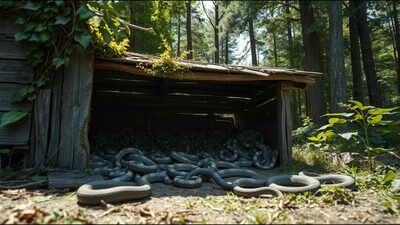
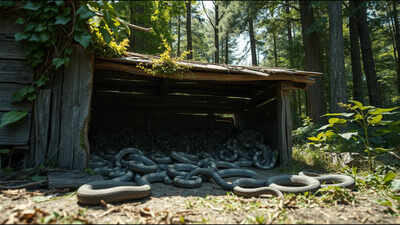
In central Mississippi, researchers stumbled across an abandoned shed covered in old snakeskins, an odd enough sight that they decided to set up cameras rather than simply walk away. What they eventually documented became a detailed study of gray ratsnakes, Pantherophis obsoletus alleghaniensis, after researchers Hensley and Hensley realised just how much snake activity was concentrated around the building. The shed itself, which researchers nicknamed the Snake Shed, turned out to serve several distinct purposes for the snakes gathering there, offering shelter, access to water and a convenient route into the surrounding tree canopy for basking in the sun. According to the Cornell Lab of Ornithology’s NestWatch program, the footage also gave researchers a rare, sustained window into ratsnake behaviour that went well beyond the assumption that these snakes spend most of their time hunting birds’ nests, revealing instead how the abandoned structure shaped their daily movements and habitat choices throughout the study period.
How researchers used NestWatch data to test what drives ratsnake climbing behaviour
According to NestWatch, a citizen science program run by Cornell’s Lab of Ornithology, the study’s authors wanted to know whether the availability of birds’ nests, and the seasonal abundance of eggs and nestlings that comes with it, actually explained when ratsnakes climbed into trees. To test that, they analysed 950 NestWatch records covering 62 bird species collected between 2009 and 2019 to establish when peak nesting activity occurred in the region. They then compared that timeline with the periods of greatest snake-climbing activity recorded by cameras at the shed. If ratsnakes were climbing primarily to raid nests, the 2 patterns should have closely matched.
Why ratsnake climbing activity peaked before nesting season, not during it
The results challenged that assumption. Climbing activity peaked early in the local nesting season and then declined sharply even while eggs and nestlings remained available in surrounding trees, according to the study titled Patterns of Habitat Use and Behaviours by Gray Ratsnakes (Pantherophis obsoletus alleghaniensis) Occupying an Abandoned Building, published in Herpetological Conservation and Biology. The timing suggests that nesting activity alone does not explain why the snakes climb. The finding also fits with earlier research into the species’ diet. A 2003 study by Weatherhead and colleagues found that small mammals make up a substantial portion of gray ratsnakes’ diets, even during nesting season, when bird eggs and chicks are abundant. The Snake Shed observations therefore suggest that climbing trees may serve several purposes beyond simply searching for nests.
Why ratsnakes get blamed for nest predation more than their behaviour suggests
People monitoring bird nests can encounter ratsnakes near nest boxes or recently emptied nests, helping reinforce the species’ reputation as a dedicated nest predator. But NestWatch notes that ratsnakes primarily consume small mammals, while their presence around nests is especially noticeable because that is also where bird researchers are looking. Other research shows that snakes can nevertheless be important nest predators in some regions. A 2016 study by DeGregorio and colleagues, using video recordings of open-cup bird nests, found that snake predation accounted for a particularly high proportion of nest losses in the southeastern United States. The broader picture, however, is more complicated than simply labelling ratsnakes as bird hunters: their diet, habitat use and climbing behaviour all vary with circumstances.
What bird watchers can do if ratsnakes threaten a nearby nest?
For people dealing with repeated nest losses, NestWatch recommends 2 tested deterrents: predator guards fitted around nest boxes and tree wraps placed around trunks. Research has shown that both measures can reduce access by climbing predators without requiring the removal of the animals themselves. That matters because gray ratsnakes are themselves part of the food web. They can become prey for birds including owls, hawks and herons, and footage from the Snake Shed study may even have captured a red-tailed hawk attacking a ratsnake, although the researchers considered that particular recording inconclusive. The abandoned shed ultimately revealed something more interesting than a snake gathering place. By following the animals over time, researchers found that the structure functioned as shelter, a water source and a gateway into the surrounding canopy while also providing a rare opportunity to observe how much of a ratsnake’s life happens away from the bird nests that have given the species its reputation.