
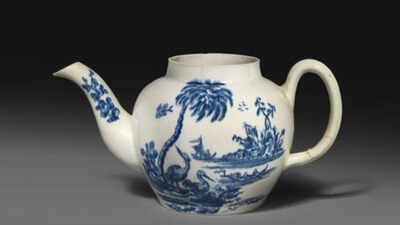
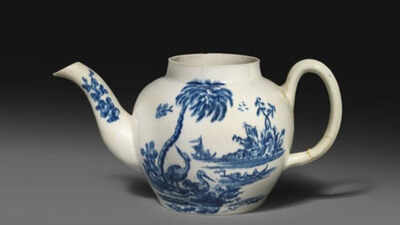
A UK collector who paid just £15 for a broken, lidless teapot at an auction in 2016 later discovered that the piece was one of the rarest known examples of early American porcelain. The teapot was eventually sold for £575,000, after experts identified it as a piece made by Staffordshire potter John Bartlam in South Carolina in the 1760s.The collector, a private buyer from south-west England, had bought the teapot at a general auction in the Midlands, The Independent reported. It had a broken handle and was missing its lid. At the time, the piece was thought to be Isleworth pottery, made at a factory in Middlesex between 1766 and 1800. However, the buyer was not convinced by that identification.He then took the teapot to Clare Dunham, an expert at Woolley and Wallis auctioneers in Salisbury. Its blue and white decoration, including a distinctive palm tree design, led Dunham to identify it as the work of John Bartlam. Bartlam had left England around 1763 and established a pottery business in South Carolina.The identification changed the significance of the damaged teapot. Experts said it was only the seventh recorded piece of Bartlam porcelain to have reached the market and the only known Bartlam teapot. This made it the earliest American-manufactured teapot to have been discovered.The teapot was then put up for auction by Woolley and Wallis. It was given an estimate of £10,000 to £20,000, while The Independent reported that it was expected to reach as much as £50,000. Instead, bidding pushed the price much higher, with the hammer falling at £460,000.After the buyer’s premium and fees were added, the teapot sold for £575,000. It was bought by London dealer Rod Jellicoe, who was bidding on behalf of The Metropolitan Museum of Art in New York.
How the teapot was identified
The teapot had several features that helped connect it to Bartlam’s pottery. Woolley and Wallis described it as a previously unrecorded American porcelain teapot attributed to John Bartlam and dated it to around 1765–69.The auction house said it was made of porcelain with underglaze blue decoration. One side showed two cranes beneath a tall palm tree, with figures in a sampan and another figure in a separate boat. The other side featured a version of the Man on the Bridge pattern, showing a bridge connecting small islands in a Chinese pagoda landscape.The teapot was about 9cm high and 17.5cm across. Its cover was missing, while the handle had broken off and been restuck.Woolley and Wallis said the teapot had only recently been identified as an example of early American porcelain. It was believed to have been part of a matched tea service that reached England in the late 1760s or 1770s.The auction house also linked the teapot to other pieces associated with Bartlam’s pottery. Four teabowls from the same group had been found to match pieces of pottery excavated at Bartlam’s factory site in Cain Hoy, South Carolina.The teapot was one of only seven recorded pieces of Bartlam porcelain at the time. The other known pieces included four teabowls and two saucers from the same set.
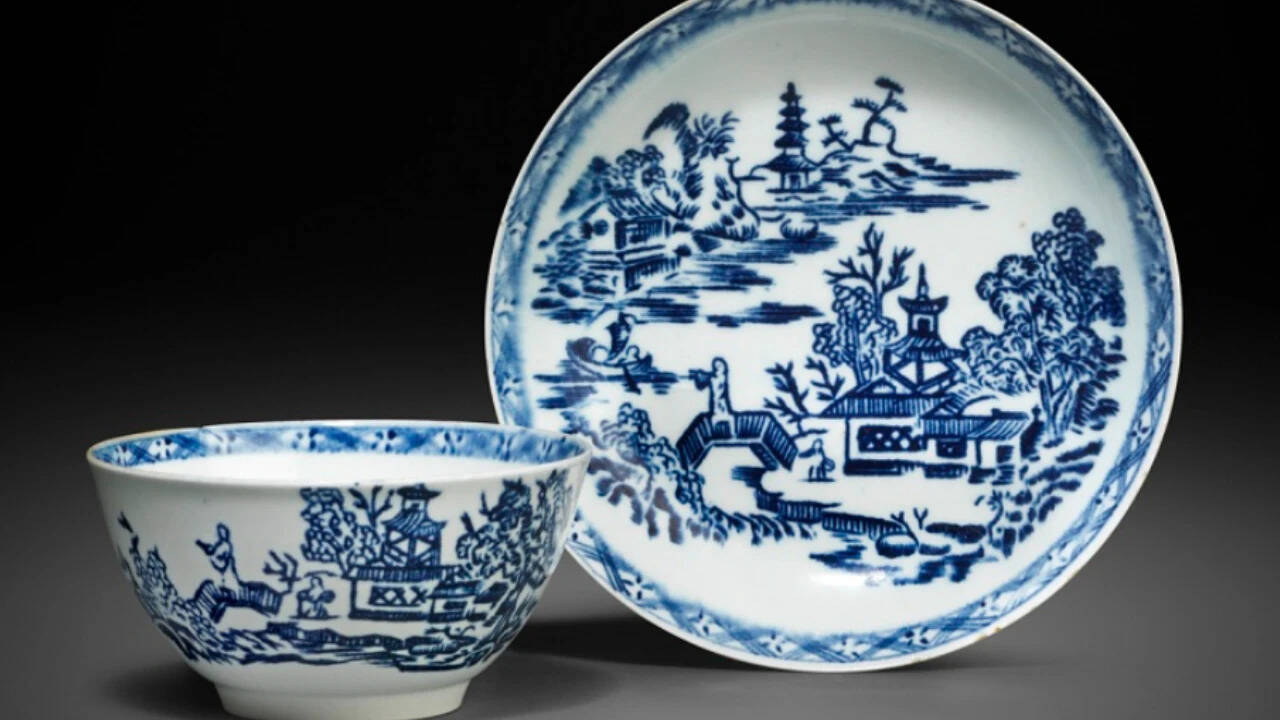
Another example of John Bartlam’s pottery
John Bartlam and his South Carolina pottery
Bartlam was trained in Staffordshire, England, and moved to South Carolina around 1763. He established his pottery at Cain Hoy, outside Charleston, with the aim of producing porcelain in America rather than relying on luxury porcelain imported from England.The Met says the teapot was made at Bartlam’s pottery in Cain Hoy around 1765–69. It describes the object as soft-paste porcelain with underglaze blue decoration.The pottery was established at a time when deposits of the special clay needed to make porcelain had recently been discovered in the Carolinas. The clay was being mined and shipped from Charleston to England.Bartlam wanted his business to compete with the luxury porcelain being produced in England and sent to the American colonies. His work therefore represented an attempt to produce similar goods in the colonies.The Met’s records also note that Josiah Wedgwood was concerned about the competition. In a 1767 letter to Thomas Bentley, Wedgwood referred to a “Pottwork in Charles Town” that was using Cherokee clay from the Carolinas to make porcelain.Research and archaeological excavations in the early 1990s later provided evidence of a porcelain factory at Cain Hoy dating to the late 1760s. According to The Met, the factory predates the American China Manufactory established by Gousse Bonnin and George Anthony Morris in Philadelphia in 1770.
Why the teapot is significant
The teapot is now part of The Metropolitan Museum of Art’s collection and is on view at The Met Fifth Avenue in Gallery 723. The museum identifies John Bartlam as its manufacturer and dates it to around 1765–69.The Met says the object is one of only seven examples that can be associated with Bartlam’s factory. All seven are teawares and feature the palmetto, a motif not found in English porcelains. The palmetto is the state tree of South Carolina and provides a direct connection to the teapot’s American origin.The museum also notes that the teapot has a very white porcelain body and is thinly potted. Its decoration includes landscape scenes in the chinoiserie style, a style that reflected the popularity of Asian-inspired designs in European porcelain at the time.For the collector who originally bought the damaged piece, the discovery was unexpected. He said he had spent decades studying ceramics but had never expected to find such a rare object. “I have been studying ceramics for 30 years and I never dreamt that I would find such a rarity as this teapot,” he said as qouted by The Independent.He also said he was pleased not only with the auction result but with where the teapot would eventually go. “Not only am I extremely pleased for the result for myself, but also because the teapot is going home to America where it will be on public display for generations to come.“I spent a lot of time in the ceramic galleries at the Victoria and Albert Museum when I was first learning about ceramics and just never thought that one day I would have a hand in providing a major museum with such a unique and wonderful object”.Woolley and Wallis said the teapot had “caught the imagination of many” and that it was “absolutely delighted” with the sale.