
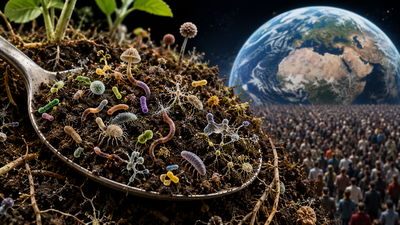
Beneath every footstep lies a world most of us will never see. A single teaspoon of soil, scooped from a healthy forest floor, holds more living organisms than there are humans on the planet, bacteria, fungi, protists and nematodes packed together in numbers that barely make sense on a human scale. Stranger still, the vast majority of these creatures have never been named or formally described. They work quietly out of sight, breaking down matter, cycling nutrients and holding entire ecosystems together, yet science has only begun to catalogue who they actually are. Christine Sprunger, Assistant Professor of Soil Health at Michigan State University, has spent her career trying to make sense of this hidden abundance, and what it means when it starts to disappear. Her research offers a rare window into a world that supports nearly all life above ground, despite going almost entirely unnoticed beneath it.
How can a teaspoon of soil contain more life than there are humans on Earth
Soil is often dismissed as inert dirt, yet it is one of the most densely populated habitats anywhere on the planet. Within a single gram, researchers can find billions of bacterial cells alongside vast fungal networks, single-celled protists and countless microscopic nematodes, each playing a distinct role in breaking down organic matter and cycling nutrients. This constant biological activity is what allows soil to support plant growth, filter water and store carbon.According to the study published in ResearchGate, titled ‘ Deteriorating soil health: A teaspoon of soil contains more life than there are humans on earth’, this scale of life is almost impossible to grasp using everyday comparisons. As she puts it, “a teaspoon of soil contains more life than there are humans on Earth.” Sprunger explains that soils function as a living ecosystem that sustains not only plants and animals but human life too, which is precisely why the health of that ecosystem carries such weight.
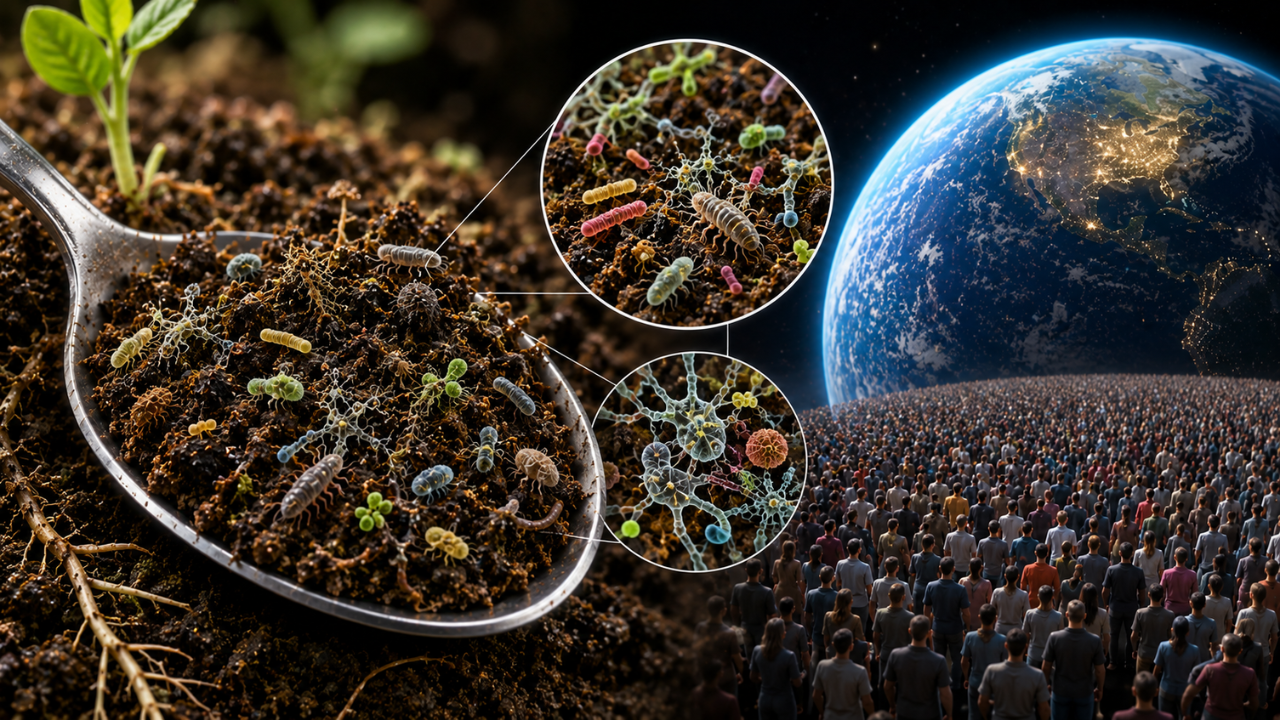
Image AI generated
Why are thousands of soil fungi still unknown
Despite decades of soil science, taxonomists have only catalogued a small fraction of the microorganisms living underground. The sheer density and diversity of soil life makes full identification an enormous task, and many species exist in such specific micro-habitats that they have simply never been sampled. Fungal networks alone are thought to contain thousands of undescribed species, each interacting with plant roots and neighbouring microbes in ways still being pieced together.Sprunger notes that scientists are still working out how losses in microbial diversity affect the wider functioning of soil, though the general pattern is already clear: greater diversity supports greater multifunctionality, meaning a soil system can provide a broader range of services to the organisms depending on it, humans included. Without knowing what lives in soil, it becomes far harder to know what is being lost when that soil degrades.
How is human activity threatening soil biodiversity
Soil biodiversity does not exist in isolation from human activity. Land conversion, climate change and the steady loss of biodiversity are reshaping soils on a global scale, while at a more local level, tillage and reduced organic matter inputs are stripping soils of nutrients and weakening their biological activity. Converting natural landscapes into agricultural land has long been linked to nutrient loss and erosion, releasing carbon that soils would otherwise hold in place.Historical examples show how severe the consequences can become. The Dust Bowl in the United States, triggered by the removal of native vegetation and intensive farming during a period of prolonged drought, stripped topsoil across the Midwest and forced entire farming communities to abandon their land. Sprunger points to Haiti as a further case, where deforestation and intensive agriculture have left the country with only a small fraction of its native forest and ongoing struggles with food security, illustrating how the loss of healthy soil can undermine a nation’s ability to feed itself for generations.
What causes declining soil health
Soil carbon sits at the centre of soil health, closely tied to the chemical, physical and biological processes that keep an ecosystem functioning. When soil health declines, soil carbon typically declines with it, and that carbon does not simply disappear. It is released into the atmosphere as carbon dioxide, feeding directly into climate change and undermining the very systems soils are meant to regulate.Reversing this trend does not require exotic solutions. Reduced soil disturbance, greater plant diversity, living roots throughout the year and continuous ground cover are the four principles most closely associated with restoring soil health, and they are most often found in perennial polyculture systems rather than conventional monocultures. Protecting the unnamed organisms living in that teaspoon of soil, in other words, may be one of the more practical steps available in the fight against further ecological and climate decline.