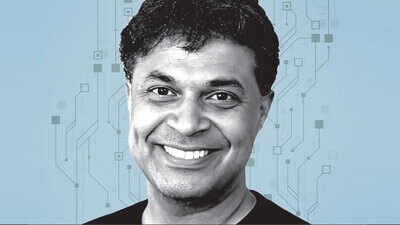
For more than a decade, Vivek Raghavan worked on a technology project that would eventually touch the lives of more than a billion Indians: Aadhaar. Today, the IIT Delhi graduate has found himself at the centre of another technological transformation.Raghavan, co-founder of Bengaluru-based Sarvam AI, has been named to TIME’s TIME100 AI 2026 list, which recognises 100 influential figures shaping the future of artificial intelligence. But his journey to the list did not begin with chatbots or generative AI. It began years earlier with the challenge of building technology at an unprecedented scale for India.Raghavan served as Chief Project Manager and Biometric Architect for Aadhaar and was associated with the project from its early years through its expansion into the world’s largest biometric identity system. His work included building and scaling technology capable of handling an extraordinary volume of identities while also using AI to improve service quality and detect identity fraud.
From IIT Delhi to Carnegie Mellon, and then Aadhaar
Raghavan completed his B.Tech in Electrical Engineering from IIT Delhi before pursuing an MS and PhD in Electrical and Computer Engineering from Carnegie Mellon University.Before becoming closely associated with India’s digital public infrastructure, he spent years in electronic design automation and held senior positions at technology companies. He also founded and ran companies in the sector.But the Aadhaar project gave him experience with a problem few technologists anywhere in the world have encountered: building technology for a population of India’s scale.That experience would later shape his approach to artificial intelligence.
The next challenge: Can India build its own AI?
Along with Pratyush Kumar, Raghavan worked with AI4Bharat at IIT Madras, an initiative focused on developing open-source artificial intelligence technologies for Indian languages.The two later co-founded Sarvam AI in 2023 with an ambitious objective: building AI models and a technology stack designed for India’s linguistic diversity rather than relying entirely on systems developed overseas.For Raghavan, the question is also about technological independence.In an interview cited by TIME, he raised concerns about India becoming heavily dependent on foreign AI platforms, arguing that the country risks “exporting our data and importing intelligence”.That idea sits at the heart of Sarvam’s mission: developing AI that can work across India’s many languages and dialects.
Building models for an India that does not speak just one language
India’s AI challenge is fundamentally different from simply building another English-language chatbot. The country has 22 officially recognised languages and hundreds of dialects, creating a need for systems that can understand, generate and process information across diverse linguistic contexts.Sarvam has been working on multilingual models, including open-weight systems for tasks such as reasoning, coding and mathematics. The company has also developed vision-language technology aimed at processing documents in Indian languages.The journey has attracted major investor interest as well. In August 2026, Nvidia became a strategic investor in Sarvam AI as part of its Series B funding round.
From building India’s identity infrastructure to shaping its AI future
The TIME100 AI recognition marks another milestone in a career that has moved from digital identity to artificial intelligence.Vivek Raghavan’s story also offers an interesting lesson for engineering and technology students. The technologies that eventually define a career do not always exist when that career begins.When he graduated from IIT Delhi, Aadhaar did not exist. Neither did generative AI in its present form. Yet decades of work in engineering, computing and large-scale public technology eventually placed him at the intersection of two of India’s biggest technology transformations.From helping build an identity system for more than a billion people to attempting to build AI for a country of nearly 1.5 billion, Raghavan’s journey now carries another distinction: a place among TIME’s 100 most influential people in artificial intelligence.