
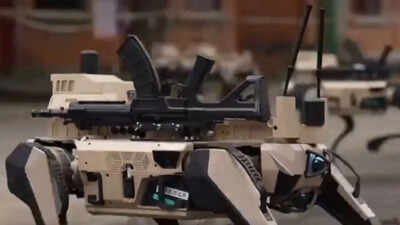
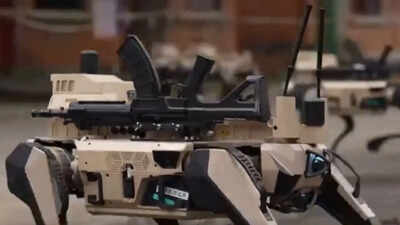
China’s military is pushing the boundaries of unmanned warfare with the development of advanced canine robots that can operate in coordinated “wolf packs”, sharing intelligence and executing complex missions in urban combat scenarios, the South China Morning Post reported.These robotic units represent a major leap from earlier models used by the People’s Liberation Army. The new “robot wolves” have made a transformational shift from operating as a “single-soldier support system” to functioning as a “coordinated swarm combat platform”, state broadcaster CCTV said in a documentary series episode that aired on Thursday.The new generation of “robot wolves” was showcased in a documentary series titled Unmanned Competition, which highlights China’s expanding arsenal of unmanned systems across land, air and sea.In simulated urban operations, these robotic packs function through a shared sensing network effectively a collective “brain,” enabling real-time communication, joint decision-making and autonomous coordination. The system also allows seamless integration with aerial drones for combined air-ground missions.
Specialised roles within the pack
Mirroring real wolf packs, each robotic unit is assigned a specific battlefield role. The “Shadow” variant is designed for reconnaissance and situational awareness, while the “Bloody” unit is tasked with offensive operations, including target neutralisation. The “Polar” variant provides logistical and operational support.The “Bloody” unit can be equipped with a range of weapons, including micro-missiles, grenade launchers and automatic rifles, significantly enhancing its combat capability, CCTV noted.Compared to earlier versions, the new robots feature improved mobility, with flexible joints and a top speed of up to 15 km/h. They can carry payloads of up to 25 kg (55lbs) and are designed to operate in extreme environments and varied terrain.Operators can control the robots through multiple interfaces, including terminal consoles, voice commands, tactical gloves or rifle-mounted control sticks. Despite their advanced autonomy, human confirmation is still required before any strike is executed.
Drone swarms and AI-powered warfare
The documentary also showcased an unmanned aerial swarm system called “Atlas”, comprising 96 drones performing roles such as reconnaissance, jamming and strike operations under a single operator.“During a mission … with advanced swarm control algorithms, each drone is as though it is equipped with its own intelligent ‘brain’ that enables real-time communication, information sharing, and continuous adjustment of relative positions to maintain a tightly synchronised formation,” the report said.Chinese researchers are working towards achieving “coordination without communication”, where drones can interpret each other’s actions and operate collaboratively even without active signals, a capability aimed at countering electronic warfare and signal jamming.
Laser weapons and maritime drones
The report also highlighted China’s progress in counter-drone systems, including laser weapons such as the Guangjian 11-E, designed to disable drones, and the more powerful Guangjian 21-A, capable of destroying them.In the maritime domain, unmanned surface vessels like the L30 were demonstrated conducting patrol operations. These vessels can autonomously navigate, avoid obstacles, identify targets using AI and even form tactical formations to encircle threats.“The patrol group can also automatically manoeuvre into tactical formations via a swarm control system to encircle and blockade targets, and if necessary, even disable them by ramming,” the report said.Chinese scientists say the long-term goal is to develop fully autonomous systems capable of operating as unified teams without human intervention.Zhang Wei, from the China Electronics Technology Group Corporation, said future systems would aim for “large-scale full autonomy”, enabling multiple unmanned platforms to carry out complex missions independently, even in environments where satellite navigation is unavailable.As warfare increasingly shifts towards AI-driven and unmanned systems, China’s “wolf pack” concept signals a significant evolution in how militaries may conduct coordinated operations on future battlefields.