

The 2026 Global Terrorism Index, released Thursday, records sharpest drop in terrorism deaths in years, yet the geopolitical storm clouds gathering over South Asia, the Sahel, and the West suggest the reprieve could be short-livedThe geography of global terrorism has shifted again. In 2025, Pakistan replaced Burkina Faso as the country most affected by terrorism, recording 1,139 deaths and 1,045 incidents — its worst toll in over a decade. The change reflects deeper structural currents, from the Taliban’s return in Afghanistan to the reorganisation of militant groups operating across porous borders.For Pakistan, the shift is not an abrupt spike but a sharp escalation of an entrenched trend. The country has featured in Global Terrorism Index’s (GTI) top ten in each of the past 12 editions published by the Institute for Economics and Peace, but the pace of deterioration in recent years is striking, with incidents in 2025 six times higher than in 2020.
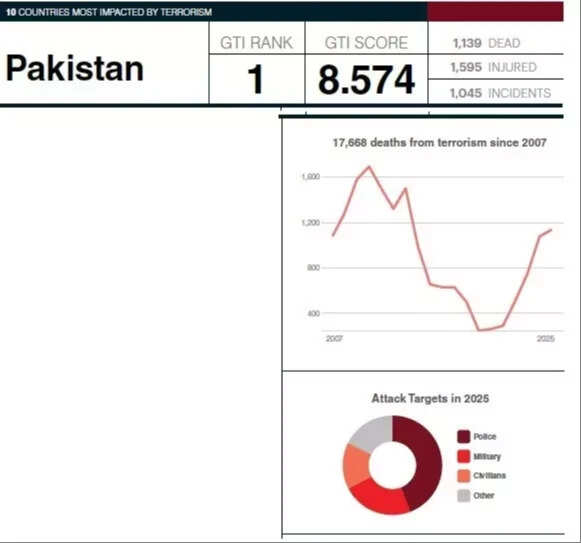
The driver is not hard to identify. The Taliban’s return to power in Afghanistan in 2021 transformed the security calculus along one of the world’s most volatile borders. Militant groups, principally Tehrik-e-Taliban Pakistan (TTP), have used Afghan territory as a staging ground, sanctuary, and training base, launching a sustained campaign against Pakistani security forces and civilians.TTP attacks rose 24% in 2025, reaching 595 incidents and 637 deaths, the highest figure attributed to the group since 2011. The Balochistan Liberation Army added its own toll, most dramatically through the hijacking of the Jaffar Express passenger train near Quetta, where 442 hostages were taken and dozens killed.Meanwhile, Pakistan’s relationship with India deteriorated sharply in May 2025 when the Indian Air Force (IAF) launched overnight missile operations over Pakistani cities, triggering retaliation and heightening regional instability.At the time of writing, Pakistan has declared a state of war with Afghanistan following cross-border airstrikes on Kabul and Kandahar in Feb 2026. The GTI report warns these developments are likely to displace populations, weaken border controls, and create the security vacuum in which groups like TTP thrive.
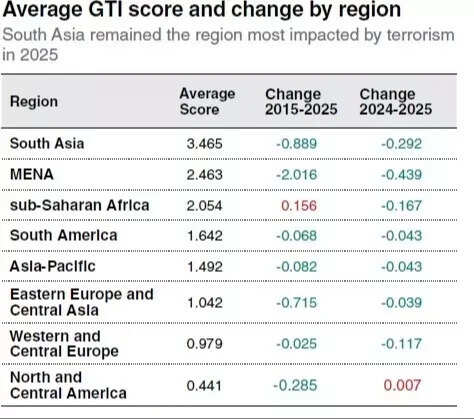
India, a regional bright spotRanked 13th globally with a GTI score of 6.428, India sits third in South Asia behind Pakistan and Afghanistan. But its trajectory is one of the more encouraging stories in the region.India recorded a significant improvement in its terrorism profile in 2025, with the number of terrorist attacks falling 43% compared to the previous year deaths from terrorism also declined, continuing a broader downward trend that has seen India’s GTI score fall by 0.415 points over the past decade. (note the report doesn’t give absolute death and incident numbers for India).The country rose two places in the global rankings, though its position at 13th still places it firmly among the world’s most terrorism-affected nations.Within South Asia, the region the GTI identifies as the most impacted by terrorism globally, with an average score of 3.465, India’s performance stands in sharp contrast to its neighbours. While Pakistan tops the table globally, Afghanistan, ranked 11th despite a continued decline in recorded incidents following the Taliban’s consolidation of power.Bangladesh and Nepal both recorded stronger improvements than India, with Bangladesh seeing a 100% fall in attacks and Nepal recording no terrorist incidents at all in 2025 for the third consecutive year.
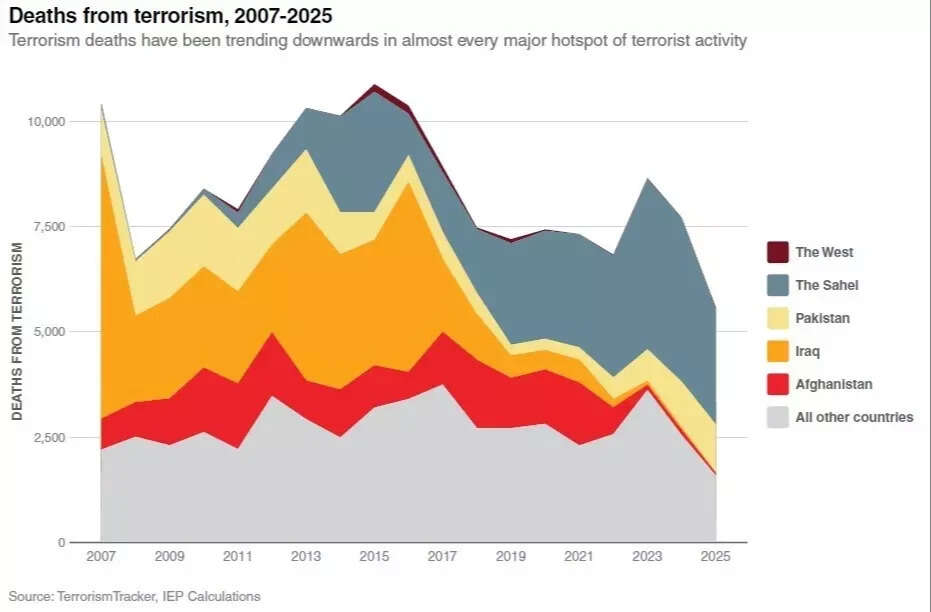
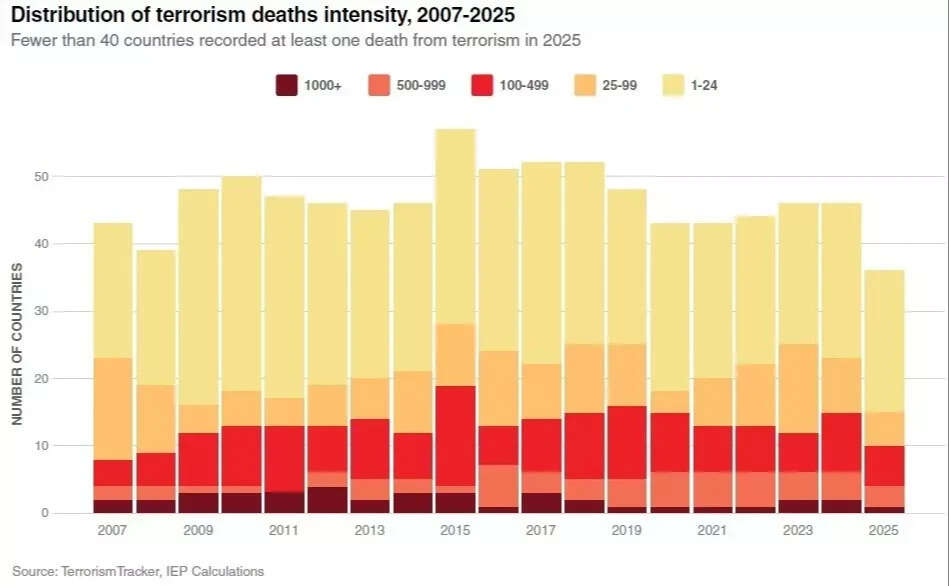
Good news while it lastsStep back from these crises, and the 2026 report carries grounds for cautious optimism. Global terrorism deaths fell 28% between 2024 and 2025, dropping from 7,714 to 5,582, the lowest figure recorded since the index’s baseline period. The number of attacks fell by nearly 22% to 2,944.Eighty-one countries improved their GTI scores — the highest number of annual improvements since 2021 — while just 19 deteriorated, the lowest on record.The year was also notable for the absence of mass-casualty attacks. The deadliest incident of 2025 killed 120 soldiers in Burkina Faso’s Sahel province in Oct, carried out by JNIM (Jama’at Nusrat al-Islam wal-Muslimin). That figure compares to 237 in 2024 and over 1,100 in 2023. Average lethality per attack fell from 2.1 to 1.8 deaths.The four groups responsible for the most deaths — Islamic State (IS), JNIM, TTP, and Al-Shabaab — collectively killed 3,869 people, or 70% of all terrorism fatalities. Three of the four recorded fewer deaths than the previous year. The exception was TTP.The long decline of terrorism in the Middle East and North Africa (MENA) continued. No country in the region recorded a deterioration in its GTI score in 2025, the first time this has occurred. Deaths fell 81% in a single year, from 1,064 to 205.Iraq, once the epicentre of global jihadist violence, has seen terrorism deaths fall by 99% over the past two decades. Libya and Lebanon recorded zero deaths for the third and second consecutive years, respectively — outcomes that would have seemed unlikely a decade ago.Africa’s shifting battlefieldThe most consequential regional story remains sub-Saharan Africa, home to six of the ten countries most affected by terrorism and responsible for over half of all global deaths. Yet even here, the picture is more nuanced than headlines suggest.Burkina Faso, the index’s number one in 2023 and 2024, recorded the largest absolute decrease in deaths, with fatalities falling 45% to 846. This was driven largely by a collapse in civilian casualties, which fell 84%, from 996 to 157.The paradox is that the country is not necessarily becoming safer — it is becoming differently dangerous. Lethality per incident increased to 14.3 deaths per attack, as JNIM shifted tactics towards fewer but more intense strikes, primarily targeting security forces. Analysts estimate the Burkinabe military controls 30% or less of national territory, while jihadists impose blockades and disrupt trade routes.This tactical evolution is visible across the Sahel. JNIM is no longer simply waging an insurgency — it is targeting economic lifelines. In Mali, the group spent 2025 attacking fuel convoys bound for Bamako, aiming to trigger economic disruption capable of destabilising the ruling junta. The report identifies this as a shift in ambition: from weakening governance to collapsing it.Nigeria moved in the opposite direction, recording the largest increase in terrorism deaths, with fatalities rising 46% to 750. Islamic State West Africa Province re-escalated its campaign, with attacks rising from 20 in 2024 to 92 in 2025.On Christmas Day 2025, the United States fired Tomahawk missiles into northwest Nigeria, striking IS camps in coordination with the Nigerian government, underlining the scale of concern over ISWAP’s resurgence.The Democratic Republic of Congo reached its worst-ever position on the index, with 467 deaths across 35 incidents — an average of more than 13 deaths per attack. All incidents were attributed to IS-affiliated groups. The violence included the beheading of 70 civilians abducted from Mayba village and a funeral attack that killed 71 people in North Kivu.Terror comes WestThe concentration of terrorism in the Global South can obscure trends in Western democracies, where a 280% increase in deaths — from around 15 to around 57 — carried significant political impact. Australia experienced its deadliest modern attack when two jihadist extremists opened fire on a Hanukkah gathering at Bondi Beach on Dec 14, killing 15 and injuring over 40.The US recorded 27 deaths, including those in the vehicle attack in New Orleans that killed 14 and the assassination of political commentator Charlie Kirk. The UK saw two people killed in a synagogue attack in Manchester.These incidents reflect a broader trend. Politically motivated attacks rose nearly 20% globally in 2025. In the West, the line between terrorism and political violence is becoming harder to define, particularly as lone-actor attacks — which accounted for 93% of fatal incidents in Western countries over the past five years — continue to dominate.
Children at the front lineOne of the most concerning findings relates to age. Children and adolescents accounted for 42% of all terror-related investigations in Europe and North America in 2025, a threefold increase since 2021.In the UK, 82 minors were arrested for terrorism offences between April 2023 and March 2024, compared to 12 in 2019. The radicalisation timeline has compressed sharply. Where the journey from first exposure to operational readiness once took around 16 months, it can now occur within weeks.Algorithmic amplification on mainstream platforms, followed by migration to encrypted messaging apps, has created what counterterrorism analysts call an “acceleration gap” — the growing mismatch between the speed of radicalisation and the ability of states to respond.Ninety-seven per cent of plots involving minors were foiled between 2022 and 2025, compared to 68% for adult-only plots. Young people are being recruited, but they are also, for now, being intercepted.Temporary reprieve?The report’s authors caution against overstating the improvement. At the time of writing, IS has announced a renewed phase of operations in Syria, more than 20,000 individuals have escaped IS-affiliated detention facilities, and the joint US–Israeli military operation against Iran launched in February 2026 has increased the risk of proxy attacks.At the same time, jihadist territorial gains across the Sahel — partly masked by falling civilian death counts — represent a slow-moving threat not fully captured by headline figures.The 2026 Global Terrorism Index records measurable progress. But the convergence of a Pakistan–Afghanistan conflict, an emboldened IS, the rapid radicalisation of younger recruits, and a fragmented political climate in the West suggests that 2025’s decline may prove, as the report itself notes, “a temporary reprieve for many countries, rather than the beginning of a sustained downward trend”.