This week, twenty-five years ago, few were giving Indian cricket any hope. Bruised, sullied from the match-fixing scandal barely a year before and fighting to save face, here was a rudderless team hosting Steve Waugh’s ‘Invincibles’. What unfolded would change Indian cricket forever. TOI revisits a watershed moment…Eyes twinkling, she was bounding down the stairs when she suddenly stopped. The Eden Gardens ground floor lobby was swarming with journalists, officials and hangerson as the Indian cricket captain, just a year into the job, walked out of the dressing-room, opened the glass door and waded into the delirious pool. Sourav Ganguly, yet to change out of his whites, looked up, gave Mrs Ganguly a beaming smile and said, rather loudly, “After the press conference…”Go Beyond The Boundary with our YouTube channel. SUBSCRIBE NOW!But his liquid gaze conveyed a deepseated yet effusive joy that can never be lost in translation — even after 25 long summers. “Yes, we did it, love,” he simply conveyed.Memories bring diamonds and rust and that 30-second vignette and what preceded at the Eden Gardens remains the shining light in Indian cricket after the dust settled down long after Steve Waugh’s “Invincibles” returned from the final frontier.It was the summer of 2001. Indian cricket was gasping for fresh air to clear away the stench of the match-fixing scandal that refused to leave the white flannel. The Board of Control for Cricket in India (BCCI) had censured former captain Mohammed Azharuddin with a lifetime ban and Ajay Jadeja with a five-year banishment. Sachin Tendulkar spurned captaincy leaving a dangerous void that needed immediate attention. Under such undesirable circumstances, Ganguly was given the charge of a rudderless ship, a decision that would go on to pay a multi-fold dividend.
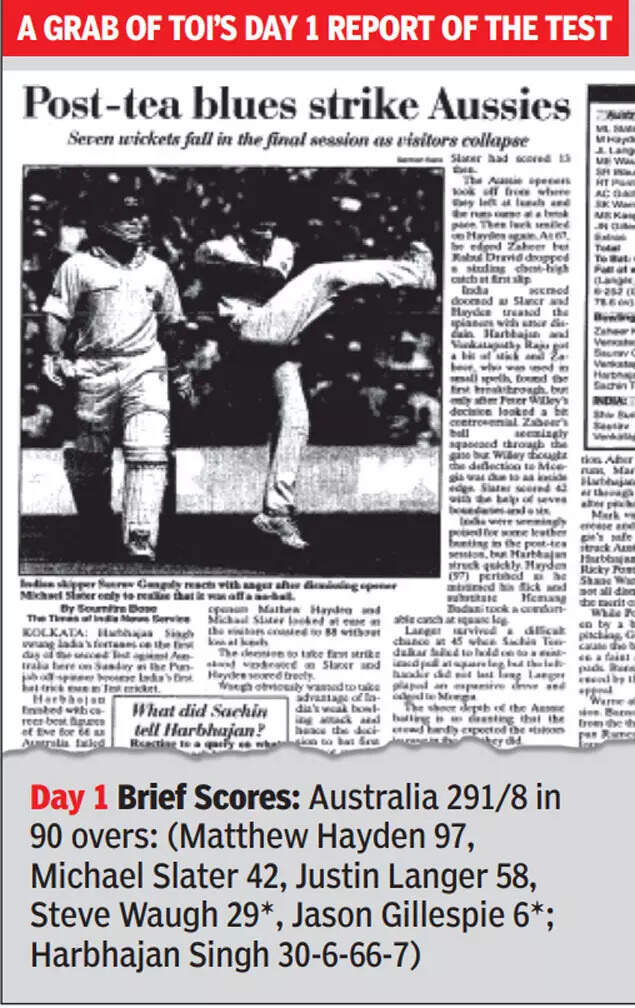
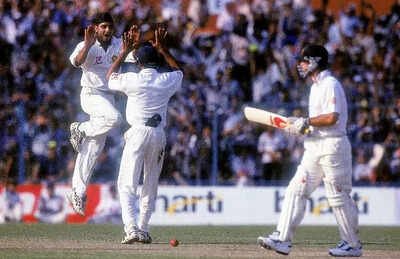
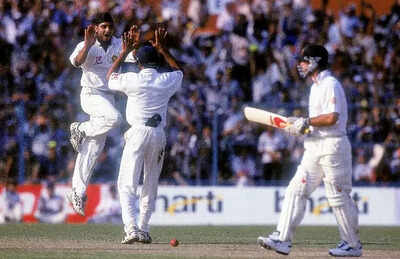
The team hit the ground running with a 3-2 One-day win over South Africa, and in came Steve Waugh’s Australia for a three-Test series on the back of 15 consecutive Test victories. Comparisons with Donald Bradman’s Invincibles of 1948 were part of the dinner table conversations and the Australians were on the Waugh-path in Mumbai. Finishing off the first Test match within three days, the Australians lived up to their reputation that preceded them taking their tally to 16.Kolkata, just renamed two months before, was their next stop. Captain Waugh scored a century – his lone one in India — and his bowlers including the irrepressible Glenn McGrath and Shane Warne bared open India’s usual failings, reducing them to a hard, long chase in the match.A small blip or a bump on the road shook the Australians in the first innings. A sprightly young off-spinner, who grew up to become Bhajji, trapped Ricky Ponting and Adam Gilchrist in front off two successive balls and then scalped Shane Warne with the third to become the first ever Indian to notch up a Test cricket hat-trick. Harbhjahan Singh’s youthful impudence (7/123) was rather unscripted allowing the packed audience to dance in the prospect of a fight.The visitors failed to read the writing on the wall. So did the scribes in the press box who were mostly convinced of an Australian victory.Ganguly’s team wasn’t up for a hiding without hitting back.
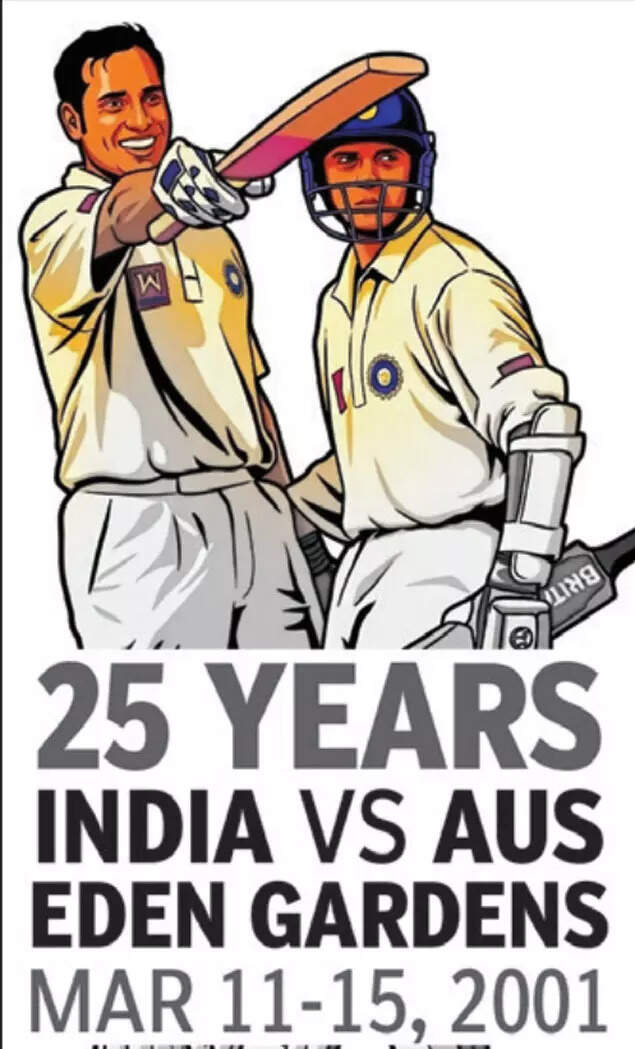
Waugh enforced a follow-on after India succumbed in the first innings and he rued his decision long after the last ball was bowled by none other than Harbhajan as the shadows lengthened on the Eden pitch three days on. Scoring a fighting half century amid the crumbling edifice of the Indian batting in the first innings, VVS Laxman earned a promotion to bat at No 3 when Waugh forced the follow-on.Through Day Four Laxman and Rahul Dravid batted and chiselled a sporting sculpture that can draw parallels with Michelangelo’s David if you are an art buff. If political history is your calling, you can think of Stalingrad.The match turned on its head. The magnitude of the fall may be grasped by the fact that it was the Australian wicket-keeper, Adam Gilchrist’s first taste of defeat in Test cricket since his debut in Nov ’99, 15 Tests prior.The match turned, so did the fortunes of Indian cricket led by the redoubtable Ganguly who had left the visiting captain waiting pitchside before the toss, just to make a point. Taking the fight to the opposition, psychologically and tactically, was his brainchild, unheard of in Indian cricket annals.Asked about the fallout of the reversal, the Australian captain said, “The sun will rise tomorrow.” It really shone on Ganguly’s India.The third Test in Chennai was another streetfight and young Harbhajan ended up with 32 wickets helping India wrap up a Test series against the high and mighty. Though the impact of the series win wasn’t felt immediately.The Eden Test was the inflection point where Ganguly’s team turned the corner. From the unflushed, odorous path to the tree-lined avenue of sporting greatness.Twenty-five years on, the Eden Test match remains a dangling conversation without the superficial sighs.
| Before the start of the second Test at Eden Gardens, Kolkata in March 2001, Australia, with their ten-wicket triumph in the first Test at Wankhede Stadium, Mumbai had extended their winning streak to sixteen, the best by any team in Tests. They had taken a 1-0 series lead. |