

Every generation believes it is witnessing unprecedented family drama, convinced that the conflicts of its time are sharper, crueler, more psychologically fraught than anything that came before. That instinct is usually wrong. Families have always fractured, parents have always disappointed children, and institutions have always demanded obedience in the name of continuity. What is new, however, is the theatre in which these conflicts now unfold, the moral language used to justify them, and the fact that reconciliation has become structurally incompatible with modern celebrity culture.
This is why the ongoing Beckham family fallout and the long, slow implosion of Meghan Markle’s relationship with the British Royal Family belong in the same analytical universe. Not because one involves footballers and fashion designers while the other involves crowns and castles, but because both are stories about institutions mistaking themselves for families, families mistaking discipline for love, and younger generations refusing to accept that inheritance must come with silence as its price.These are not gossip stories. They are case studies in how legacy power collapses when confronted with the logic of the platform age.When families turn into institutionsLong before tensions became visible, both the Beckhams and the Windsors crossed an invisible but decisive line. They stopped functioning primarily as emotional units and began operating as systems of continuity, reputation, and control.In the case of David Beckham and Victoria Beckham, the transformation was gradual and largely celebrated. What began as sporting excellence and pop-cultural fame matured into something far more structured: a carefully managed global brand that blended fashion, philanthropy, masculinity, aspiration, and British respectability into a marketable ideal. Their children were born not merely into wealth or privilege, but into a narrative with expectations, optics, and unspoken rules.The British Royal Family, of course, has been an institution far longer than it has been a family in any conventional sense. Its members are raised to understand that personal comfort is secondary to symbolism, that restraint is a virtue rather than a coping mechanism, and that emotional sacrifice is not tragedy but duty.In both cases, harmony was never organic. It was curated, reinforced, and defended. The problem with curated harmony is that it collapses the moment someone refuses to perform it.
The outsider spouse as structural threat
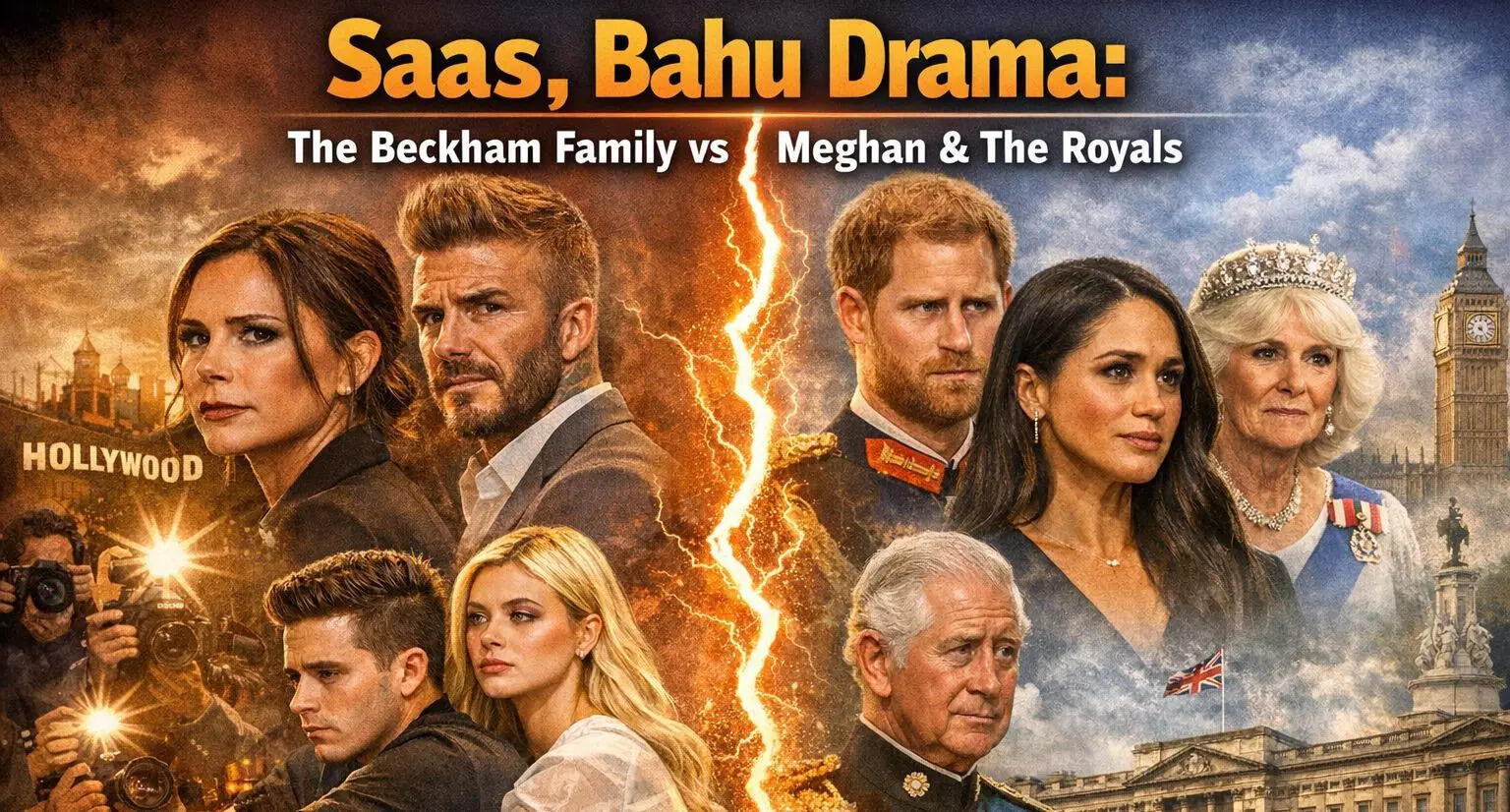
Every institutional family eventually encounters the same destabilising force: an outsider who enters not knowing that love alone is insufficient, and that adaptation, silence, and strategic invisibility are part of the entry fee.For the House of Windsor, that figure was Meghan Markle. For the House of Beckham, it was Nicola Peltz. The differences in class, nationality, and circumstance between the two women are obvious, but analytically irrelevant. What matters is the role they were assigned the moment they arrived.Both women entered families that expected assimilation without negotiation, loyalty without reciprocity, and gratitude without transparency. Both were met with the same institutional reflex: if friction emerges, the problem must be the newcomer, not the system itself.This is not because either family consciously plotted exclusion, but because institutions are structurally incapable of interpreting resistance as anything other than threat.
When brothers become collateral damage
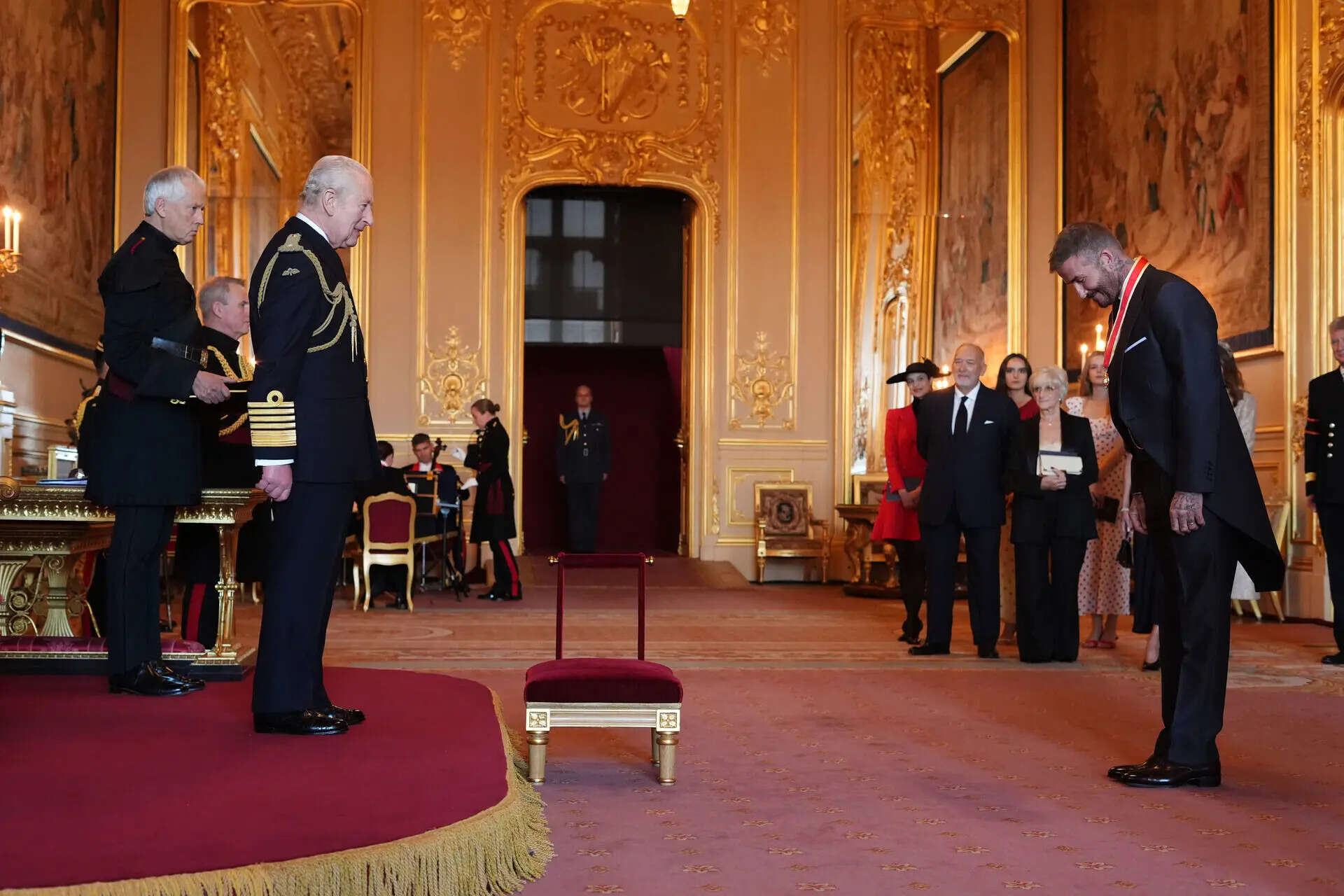
Sir David Beckham is made a Knight Bachelor by Britain’s King Charles III during an Investiture ceremony at Windsor Castle, Berkshire, England, Tuesday, Nov. 4, 2025. (Jonathan Brady/PA via AP)
The most emotionally corrosive consequence of institutional family conflict is rarely the parent–child rupture that dominates headlines. It is the quieter, more enduring collapse of sibling relationships, which tend to absorb pressure long after the original dispute has moved beyond repair. In both the British royal family and the Beckham household, sibling bonds did not fracture overnight or through a single dramatic confrontation. They eroded gradually, shaped by shifting loyalties, media framing, and the transformation of brothers into symbolic stand-ins for competing worldviews.In the royal family, the estrangement between Prince Harry and Prince William unfolded in parallel with Harry’s growing disillusionment with royal life and his marriage to Meghan Markle. For years, the brothers were presented as a unified front, bonded by shared trauma following the death of their mother and cast as complementary heirs to a modernised monarchy. That image began to fracture as Harry increasingly framed the institution as emotionally suffocating, while William remained embedded within it, tasked not merely with personal loyalty but with preserving continuity. By the time Harry publicly articulated his grievances through interviews, the Netflix documentary series, and later his memoir Spare, William was no longer described primarily as a brother, but as an enforcer of an institutional ethos that Harry believed prioritised hierarchy over human cost. The rupture was therefore not simply fraternal; it was ideological, with William representing permanence and Harry positioning himself as a defector from a system he viewed as fundamentally resistant to change.A comparable, if less publicly articulated, pattern appears to have emerged within the Beckham family. Brooklyn Beckham’s distancing from his parents unfolded alongside a visible recalibration of his relationship with his siblings, marked not by overt conflict but by prolonged absence, missed milestones, and asymmetrical displays of public solidarity. Unlike Harry, Brooklyn has not offered a narrative explanation for the drift, nor has he framed his estrangement as a moral stand against an institution. Yet the structural dynamics remain similar. As the eldest child in a family whose public image relies heavily on cohesion, Brooklyn occupied a symbolic role as the inheritor of continuity. His decision to align himself primarily with his wife, rather than the broader family unit, effectively disrupted that narrative, creating an implicit hierarchy in which spousal loyalty superseded sibling solidarity. In such settings, siblings are rarely free to remain neutral; they are drawn, often unwillingly, into the gravitational pull of parental authority or institutional preservation.
Silence as authority, speech as insubordination
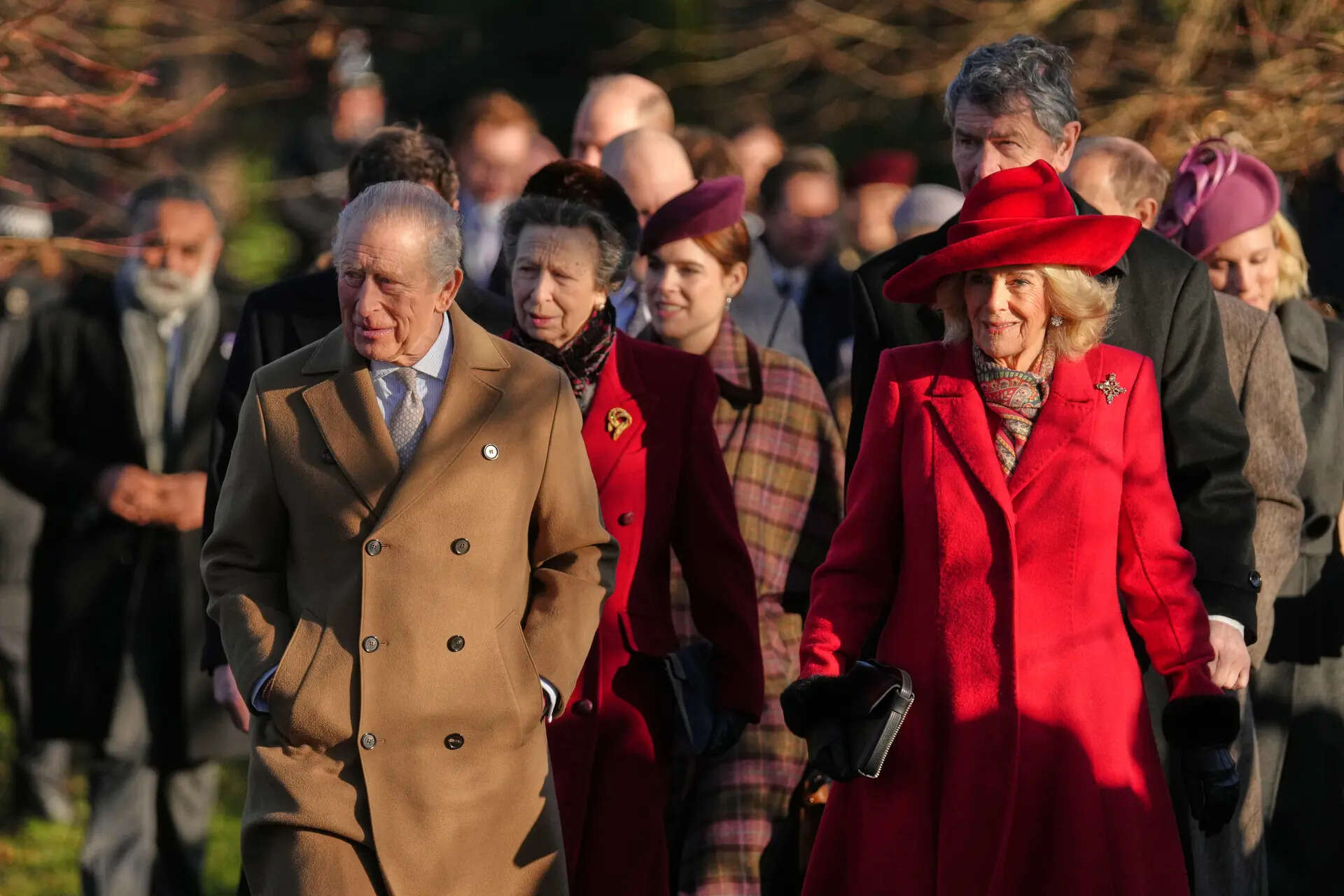
Britain’s King Charles III and Queen Camilla arrive to attend the Christmas Day service at St Mary Magdalene Church in Sandringham, Norfolk, England. AP/PTI(AP12_26_2025_000012B)
One of the most striking parallels between these two sagas lies in how power imagines itself to function.The older generation in both families operates under an older moral logic, one that treats silence as dignity and discretion as proof of strength. The monarchy’s near-total refusal to engage publicly with Meghan’s allegations was not accidental; it was a reaffirmation of the belief that institutions endure precisely because they do not dignify individual grievance with response. Similarly, the Beckhams’ instinctive restraint, their avoidance of open confrontation or emotional exposition, reflects a worldview in which public composure is both shield and sword.The problem is that this worldview no longer aligns with how legitimacy is produced.In the platform era, silence does not signify authority. It creates narrative vacuum, and narrative vacuum is quickly filled by the most emotionally coherent story available. Meghan’s account hardened into accepted truth not because it went uncontested in private, but because it was uncontested in public. In the Beckham case, the visible emotional and physical distance between Brooklyn Beckham and his parents has functioned as a statement precisely because nothing has been formally said.The old world believes dignity is self-evident. The new world understands that meaning must be articulated or it will be assigned.
Incompatible moral languages
The deepest reason reconciliation remains elusive in both cases has little to do with ego or misunderstanding and everything to do with moral translation.The monarchy speaks the language of duty, endurance, and institutional primacy. Within that framework, suffering is not injustice but contribution, and personal discomfort is a small price for historical continuity. Meghan speaks the language of emotional harm, mental health, and individual well-being, a moral vocabulary shaped by American therapeutic culture and contemporary media ethics.Similarly, the Beckham parents appear to prioritise unity, hierarchy, and collective identity, while Brooklyn and Nicola’s posture reflects a moral universe in which emotional alignment with one’s spouse outweighs inherited obligation, and distance is framed not as betrayal but as self-preservation.Neither side is necessarily dishonest. They are simply operating within ethical systems that do not share a common grammar.
The generational revolt against inheritance
At the core of both conflicts lies a rejection of inherited identity as destiny.Prince Harry’s departure from royal life was not merely a rejection of protocol but a refusal to accept that birthright entailed emotional silence. Brooklyn Beckham’s apparent disengagement from the family brand suggests a similar instinct, a resistance to being permanently positioned as an accessory to a legacy rather than an autonomous adult.To the older generation, this reads as ingratitude, even betrayal. To the younger generation, it feels like survival in a world where identity must be chosen rather than assigned.This generational divide is not ideological in the traditional sense. It is existential.
When rupture becomes identity
The most uncomfortable parallel between these two stories is also the most decisive.Over time, the conflict itself becomes a source of meaning, relevance, and coherence. Meghan’s post-royal public identity is inseparable from her rupture with the monarchy. Brooklyn and Nicola’s public positioning increasingly derives its clarity from their distance from Beckham centrality.This does not imply cynicism or calculation. It reflects a structural reality of contemporary media ecosystems, where personal narratives solidify into brands, and brands resist revision.Reconciliation, in such contexts, is not merely emotional. It is reputationally destabilising.
What these stories actually reveal
Strip away the celebrity and the spectacle, and both sagas reveal the same underlying truth: families that function as institutions are brittle precisely because they cannot accommodate dissent without interpreting it as existential threat.The tragedy is not that these families fractured. The tragedy is that they were never designed to absorb refusal.In an era where legitimacy flows upward from audiences rather than downward from tradition, institutions must negotiate consent rather than assume it. Both Houses learned this lesson too late. They will survive. Institutions always do. What they may never fully recover is the comforting illusion that continuity alone guarantees belonging. And that, more than any tabloid detail, is what binds these two stories together.