
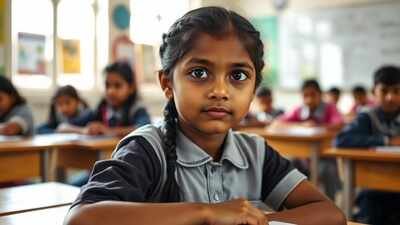

Discrimination against women is not always violent but visible in nuances. More often, it is a routine. It has been knitted and embedded in our culture in ways that it almost appears invisible. It flamboyantly sits at the dining table, where a girl serves and eats last. It appears in the school register, where her name disappears after Class 8. It shows up in family decisions where her ambitions are weighed against “practicality,” marriage, or money. Long before a girl learns what inequality means, she has already lived it.Education, which could fill the gap and become an equaliser, has rather mirrored the existing inequalities. For a plethora of girls, schooling ends not because of a lack of ability, but because investment in their futures is seen as optional. Dropouts at the secondary level are rarely treated as systemic failures; they are normalised as a social inevitability.This is what the India Beti Bachao Beti Padhao (BBBP) was speaking about when it was launched in 2015. The scheme was necessary in a country where daughters were still being negotiated, sometimes welcomed, but most times not. The falling sex ratio and educational inequalities were not just a statistic but an indictment. The scheme has recently completed 11 years; PM Modi also took to social media to celebrate the journey.
Why BBBP was necessary
By 2014–15, India’s Sex Ratio at Birth (SRB) had fallen to 918 according to the data released by PIB, an unmistakable signal of gender-biased sex selection. This was not confined to rural India or poverty-stricken regions; it cut across classes, cities, and educational backgrounds. Medical access had improved, but ethical restraint had not kept pace.BBBP was designed as a direct response to this demographic warning. Its objective was explicit: Improve the SRB by two points every year, keep institutional deliveries above 95 per cent, increase early antenatal registration, and push girls’ participation in secondary education and skill development. It was, in many ways, an attempt to intervene before discrimination became irreversible.
What a decade of data shows
Eleven years later, the numbers tell a more complex story, one of progress, but not resolution. The national Sex Ratio at Birth has improved from 918 in 2014–15 to 930 in 2023–24, according to PIB data. This 12-point rise matters. Demographers will argue, correctly, that such shifts do not occur without sustained intervention. Awareness campaigns, stricter monitoring of diagnostic centres, and district-level accountability have played a role.Education outcomes also show movement. Girls’ Gross Enrolment Ratio at the secondary level increased from 75.51 percent in 2014–15 to 78 per cent in 2023–24. Programmes such as Kanya Shiksha Pravesh Utsav helped re-enroll more than 100,000 out-of-school girls, signalling that retention, not just access, was finally being taken seriously.Healthcare indicators present one of BBBP’s strongest success stories. Institutional deliveries rose sharply, from 61 per cent in 2014–15 to over 97.3 per cent by 2023–24. Safer births, improved antenatal care, and early registration reduced risks that historically fell disproportionately on women and girl children.These are not abstract victories. They translate into lives carried safely to term, daughters staying in classrooms longer, and mothers surviving childbirth.
Awareness worked, up to a point
BBBP’s most visible interventions were its campaigns. Initiatives such as Selfie with Daughters or community celebrations like Beti Janmotsav deliberately targeted social attitudes, particularly among fathers and families. In a society where discrimination is often defended as “tradition,” public disruption mattered.The scheme’s later integration with Mission Shakti broadened its reach. Under the Sambal and Samarthya components, BBBP became part of a wider safety and empowerment framework, linking One Stop Centres, women’s helplines, working women’s hostels, creches, and skilling initiatives. District-level Hubs for Empowerment of Women were intended to reduce fragmentation and bring services under one roof.
Where the numbers fall silent
For all the gains, the data also exposes the limits of BBBP. While secondary enrolment has risen, the transition from education to employment remains weak. Workforce participation among women continues to lag, despite skilling efforts and policy convergence.Improving the sex ratio does not automatically improve a woman’s life chances. Many girls educated during the BBBP decade still leave the workforce early, constrained by unpaid care work, unsafe public spaces, or social expectations around marriage and motherhood.There is also uneven progress across districts. Funding allocations vary based on SRB performance, ₹40 lakh for districts with SRB below 918, ₹30 lakh for those between 919 and 952, and ₹20 lakh for better-performing districts. Yet administrative capacity, not funding alone, often determines success. Where local governance is weak, the scheme struggles to move beyond events and slogans.
Ten years later, what has really changed?
Beti Bachao Beti Padhao succeeded in doing what few policies manage: It made gender bias a national conversation backed by measurable targets. It improved key indicators, especially in healthcare and survival. It created pressure points where silence once prevailed.But it also revealed the limits of awareness-led reform. Gender discrimination in India is sustained not only by attitudes but also by economics, labour markets, and social expectations that policy posters cannot dismantle.As the scheme marks its tenth year, the challenge is no longer about saving the girl child alone and sending her to school. It is about ensuring that the girl who survives, studies, and grows up is not quietly pushed back into dependency.The numbers show progress. They also show restraint. What comes next will determine whether BBBP is remembered as a turning point, or merely as the moment India finally admitted it had a problem.