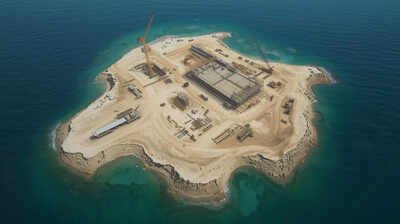
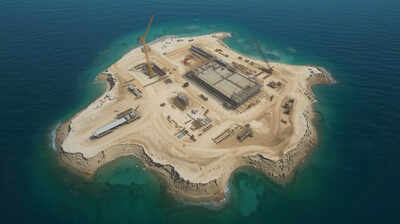
Island building in the open ocean is not a modern idea. Cities such as San Francisco and Miami expanded their coastlines decades ago by reshaping shallow waters. In recent years, however, large-scale island construction has increasingly taken place far from any mainland. In the South China Sea, extensive land reclamation has transformed submerged reefs into permanent artificial islands. While these projects are often discussed in terms of shipping routes and infrastructure, their environmental footprint receives less attention. The Spratly Islands sit within one of the most biologically rich marine regions on Earth. Here, construction activity has altered seafloor landscapes that took thousands of years to form. Marine scientists warn that the physical changes now visible from satellites may also signal more serious ecological damage beneath the surface.
China’s island-building over the past decade has reshaped the seabed
Creating land in the middle of the sea requires enormous quantities of material. Dredging ships scrape sand, coral and sediment from the seabed, often from nearby reefs and lagoons. This material is then pumped onto shallow features until they rise above the waterlineThe process stirs up fine sediment, which can drift for kilometres. Suspended particles reduce sunlight penetration, making it harder for corals and seagrasses to survive. Once settled, the sediment can smother living reefs, blocking the flow of water and oxygen.
What happens to coral reefs underneath
Coral reefs are not just rocks. They are living structures built slowly by coral animals over centuries. When reefs are buried under sand and concrete, the organisms that form them die. In the Spratly Islands, reefs support a wide range of species, from small reef fish to larger predators. They also serve as nursery grounds for larvae that replenish fisheries across the South China Sea. Damage to these reefs affects ecosystems far beyond the immediate construction sites. Marine biologists say that once a reef is destroyed at this scale, recovery is unlikely within any human timeframe.
These waters matter for marine life
The South China Sea contains some of the highest marine biodiversity in the world. Its reefs, seagrass beds and open waters support endangered species including sea turtles, sharks and giant clams. Many coastal communities around the region depend on these ecosystems for food. Fish stocks that spawn or feed around the Spratly reefs supply fisheries hundreds of kilometres away. Disrupting these habitats can weaken already stressed fish populations. Scientists note that environmental damage in shared waters rarely stays local.
Artificial islands change water movement
Natural reefs shape currents and waves in subtle ways. When they are replaced with solid land and concrete walls, water flow changes. Altered currents can increase erosion in some areas while causing sediment build up in others. This can affect nearby reefs that were not directly dredged. Changes in wave patterns may also influence how nutrients and larvae move through the region. These secondary effects are difficult to predict and even harder to reverse.
Can the environmental impact be undone
Experts largely agree that the damage caused by large-scale reef burial is permanent. Unlike oil spills or surface pollution, the physical removal of reef structures leaves little to recover. Some artificial islands include measures such as limited green spaces or energy installations. These do not replace lost ecosystems. Coral restoration projects exist, but they operate on a small scale and require stable, undisturbed conditions. In heavily altered areas, marine life often shifts rather than returns.
What remains beneath the surface
From above, reclaimed islands appear solid and orderly. Below the waterline, the picture is less clear. Broken reef fragments, altered seabeds and disrupted habitats tell a quieter story. Marine scientists continue to study the long-term effects, though access to some sites is limited. What is already evident is that island building in sensitive waters carries costs that extend well beyond the visible shoreline.Information is based on a publication ofEarth Island Institute.