

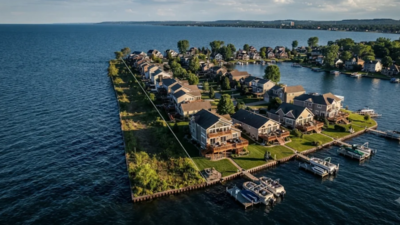
Homeowners along an Ohio lakeside peninsula can keep their claim to the land after a property company tried to expand its borders following a 2019 survey. The Ohio Sixth District Court of Appeals ruled that a company could not claim ownership of the disputed peninsula after its own court papers specifically left the area out of the property rights it wanted. The ruling followed a fight involving residents who used nearby beach land for fun and built decks, docks, and other structures along the waterfront over several decades.The case involved 1643 Limited LLC and the Shades of Nantucket Unit Owners Association, along with individual homeowners in Sandusky, Ohio. The company argued that an updated property description included land next to its industrial site, leading to claims that residents’ structures were crossing onto its property. In a ruling issued on 13 November 2026, the appeals court partly backed and partly overturned earlier decisions by the Erie County Court of Common Pleas. It protected the Nantucket Drive peninsula from the company’s ownership claim, but backed the company’s rights over a separate beach area that formed slowly along the Lake Erie shoreline, rejecting the homeowners’ attempts to gain ownership or permanent use rights over the beach through decades of recreational activities because their proof did not meet legal standards.
Dispute began after a revised property survey
According to the court’s judgment in 1643 Limited, LLC v. Shades of Nantucket Unit Owners Association, the disputed land sits beside Sandusky Bay, part of Lake Erie, in Sandusky, Ohio. It is made up of two separate areas: a small beach next to the company’s existing property and a narrow strip of land running along the western edge of a man-made peninsula called Nantucket Drive. The peninsula is part of Snug Harbor, a yacht basin made up of three man-made peninsulas, where several homeowners own properties along Nantucket Drive and some built decks, docks, and concrete platforms on a protective stone wall known as riprap.The history of Snug Harbor goes back to 1947, when the United States War Department issued a permit letting a man from East Canton build a yacht basin in Sandusky Bay, allowing the building of bulkheads, boathouses, and dredging work. The court noted that the permit clearly stated it did not grant ownership rights over land or materials, only giving federal approval for the building work in relation to public navigation rights. Snug Harbor was eventually built into three man-made peninsulas and formally laid out in 1948, with the western lots, including those along Nantucket Drive, replatted in 1956.1643 Limited bought vacant industrial land at 1643 First Street in Sandusky in 2017, consisting of two parcels measuring about 10 acres and five acres, with an original deed that described a border leaving out the disputed beach area. That changed in 2019, when the company arranged a new survey while preparing an application for the Ohio Environmental Protection Agency, producing an updated property description that included both the beach and part of the Nantucket Drive peninsula. The company then issued a new deed to itself using the updated description, claimed that several decks and a concrete walkway built by homeowners crossed onto its property, and sent letters to residents in March 2020 pointing out the alleged crossings before filing a lawsuit when the two sides failed to reach a deal.
Company claimed ownership of the beach
In its lawsuit, 1643 Limited asked the court to recognize its ownership of the disputed beach and remove structures it said were built on its land. The company argued that the beach formed naturally through a process called accretion, which happens when water slowly builds up sand, mud, or other material along a shoreline, creating new dry land that owners of property bordering Lake Erie can gain ownership of under Ohio law.The company relied on proof from registered surveyor John Hancock, who said the beach formed through accretion, while the homeowners fought the ownership claim and argued they had used and cared for the area for more than 27 years. According to court records, residents said their activities included swimming, boating, weddings, family gatherings, seasonal cleaning, adding sand, caring for trees, and putting in fire pits and picnic areas, arguing that their long-time use gave them ownership rights through a legal rule called adverse possession.
Residents failed to establish ownership of beach
The homeowners argued that their use of the beach had been open, steady, and without the company’s permission for more than the 21 years required under Ohio law, and also asked for a prescriptive easement, which would have given them a legal right to keep using land owned by someone else. The appeals court rejected both arguments, noting that under Ohio law, adverse possession requires clear and convincing proof that a person has exclusively occupied and treated someone else’s land as their own for at least 21 years, and found that the homeowners had not given enough proof to show that either the Shades of Nantucket association or specific individual residents had actually possessed the beach.Much of their case relied on a sworn statement from resident Joyce Byington, which the court found described activities done by individual residents rather than by the homeowners’ association itself, while failing to name which individual property owners had done the activities or show that they had personally possessed the beach. The court similarly rejected the claim for a prescriptive easement because the residents could not prove the needed steady use by the association or identifiable individual homeowners, and also rejected their arguments based on acquiescence and estoppel because they lacked proof that neighboring landowners had mutually agreed on a certain border for 21 years or that the company had tricked them into believing they had a permanent right to use the beach, upholding the company’s ownership of the beach area.
Court says company had limited its peninsula claim
The most important part of the ruling dealt with the separate strip of land along the Nantucket Drive peninsula, where homeowners argued that 1643 Limited had already told the lower court it was not seeking ownership of the peninsula itself and that the trial court went beyond the company’s request by accepting the expanded property description from the 2019 deed. The appeals court agreed after checking the company’s summary judgment motion, finding that 1643 Limited had clearly stated it was not claiming ownership of any part of the peninsula and had limited its request to stopping residents from using or occupying land lying west of the western peninsula, while its reply to the motion also stated it was seeking no action regarding the western peninsula or the removal of the residents’ riprap.The appeals judges said the lower court should have respected those limits rather than giving the company ownership of land it had left out of its request, ruling that the trial court made a mistake by including any part of the Nantucket Drive peninsula in the company’s property. The court also rejected the argument that the original 1947 War Department permit gave homeowners ownership rights, stating the permit only allowed the building of the yacht basin and did not transfer property ownership to the developer or later owners.
Ejectment order and injunction overturned
The appeals court also reviewed the lower court’s decision to remove residents from the disputed areas, finding that while the company had the right to remove homeowners from the beach because it had proved legal ownership of that land, the same logic could not apply to the peninsula that had wrongly been included in the company’s property description. The judges therefore overturned the removal order covering the peninsula and canceled a permanent court order that had stopped residents from entering the beach and other disputed areas and required the removal of structures built along the peninsula.The court said the company had not shown proof about the residents’ use of the beach during the hearing on its request for the court order and could not justify an order stopping them from entering that area, nor did it have grounds for forcing residents to remove structures on the peninsula without proving ownership. The appeals court ordered 1643 Limited to get a new property description within 90 days covering only the beach area, backing some parts of the lower court’s decisions and reversing others in its 13 November 2026 judgment, 1643 Limited, LLC v. Shades of Nantucket Unit Owners Association, while ordering the two sides to split the costs of the appeal equally.