A landowner in Washington state carried out repairs on a dam without obtaining the required permit or consulting an engineer. When the dam failed months later, water and decades of accumulated sediment rushed onto a neighbour’s property, filling one pond and damaging another. Nearly nine years after the work, an appeals court has upheld a judgment awarding the neighbour more than $554,000 for trespass and nuisance.The dispute involved Robert Shawn Noecker and the owners of an adjoining property in Bothell, Washington. On November 16, the Washington Court of Appeals, Division One, affirmed the trial court’s findings that the dam work and separate drainage alterations had caused unlawful damage to Noecker’s land.The court also sent the case back to the lower court to consider whether Noecker should receive additional compensation for emotional distress. It awarded him reasonable attorney fees and costs for the appeal.
How the dam failure damaged the neighbouring property
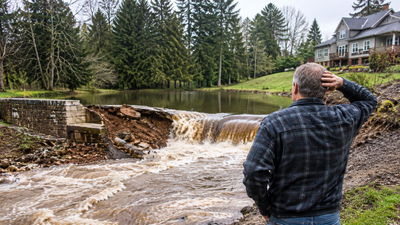
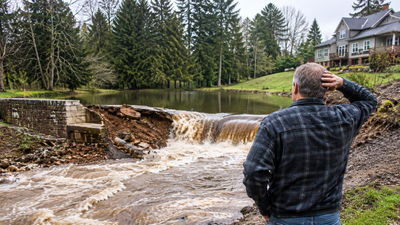
According to the court’s opinion available online, the dam had been built in 1981 by a previous owner of the Bernhart property, under a permit from the Washington Department of Ecology. It blocked a natural stream to create a pond and controlled the release of water through a six-inch pipe.The dam also held back sediment that accumulated over the years. Water and sediment were released in a regulated manner onto the neighbouring South Noecker property, where they flowed into two ponds. Noecker had raised concerns about the dam’s condition from May 2014 onwards, warning Craig Bernhart that it could fail and cause damage.In 2017, Bernhart undertook repair work. This included installing a new pipe, filling the dam walls with soil and compacting it using the shovel of a backhoe. The court noted that Bernhart contacted the Department of Ecology but did not obtain a permit or permission for the work. He also did not consult an engineer.The work did not meet industry standards, according to the court’s findings. In October 2017, the dam failed, creating a large opening through which much of the stored water escaped. The breach released large quantities of sediment that had accumulated behind the structure over approximately 40 years.The water flowed towards Noecker’s property, completely filling its upper pond with sediment. The lower pond also began filling and was expected to be completely filled if the damage continued. Snohomish County Planning and Development Services issued a stop-work order on October 6, 2017, and a notice of violation on October 9 over the unpermitted work.
Separate drainage work also sent water onto his land
The court case involved another set of alterations made in 2017. Bernhart had dug drainage ditches to connect the northern part of his property to an existing ditch on Noecker’s North property. The new channels artificially collected and redirected water towards Noecker’s land. This increased the volume and speed of water flowing onto the property, particularly during heavy rainfall.The excess water and sediment clogged the pump in Noecker’s retention pond and caused standing water to collect around his workshop. The court noted that the drainage work had been carried out without the necessary Snohomish County land-disturbance permit. It also found that Bernhart had failed to take steps to prevent harm to the neighbouring property. A contractor who assessed the work described it as poorly executed and said it had caused avoidable damage.
Why the appeals court upheld the damages

Photo: Canva
Noecker filed a lawsuit alleging trespass, negligence, nuisance and statutory waste. The case went to a bench trial in August 2024, meaning a judge rather than a jury heard the evidence.In January 2025, the trial court found in his favour. It awarded $554,294.35 for trespass and nuisance, along with separate damages under Washington’s statutory waste law, costs and attorney fees. It also issued an injunction preventing further unlawful water discharge or interference with his property.Bernhart challenged the findings, arguing that the water diversion did not amount to trespass or nuisance and that the court had wrongly rejected legal defences available to landowners dealing with surface water. The Court of Appeals rejected those arguments. It found that the drainage channels had artificially collected and redirected water in a way that differed from its natural flow and caused substantial damage.The judges also concluded that the dam repairs had been carried out without the required permit and that the resulting water and sediment flow continued to damage Noecker’s property.The court said the trial judge had sufficient evidence to conclude that the work amounted to trespass and nuisance. It therefore affirmed the $554,294.35 award for those claims. The judgment also records separate awards of $72,051.84 for statutory waste, $144,103.68 in trebled damages under that law, $24,207.62 in costs and $65,457.62 in attorney fees. These are additional amounts and should not be confused with the $554,294.35 awarded for trespass and nuisance.
Court sends emotional distress claim back for review
Noecker had also sought compensation for the anxiety and emotional distress caused by the damage to his property. The trial court had acknowledged that he experienced distress but refused to award damages for it.The appeals court disagreed with that decision. It said emotional distress damages can generally be recovered for intentional torts such as trespass and nuisance. It therefore directed the lower court to reconsider whether Noecker should receive compensation on this ground. The ruling means the original damages award remains in place, while the question of additional compensation for emotional distress is still to be decided.