
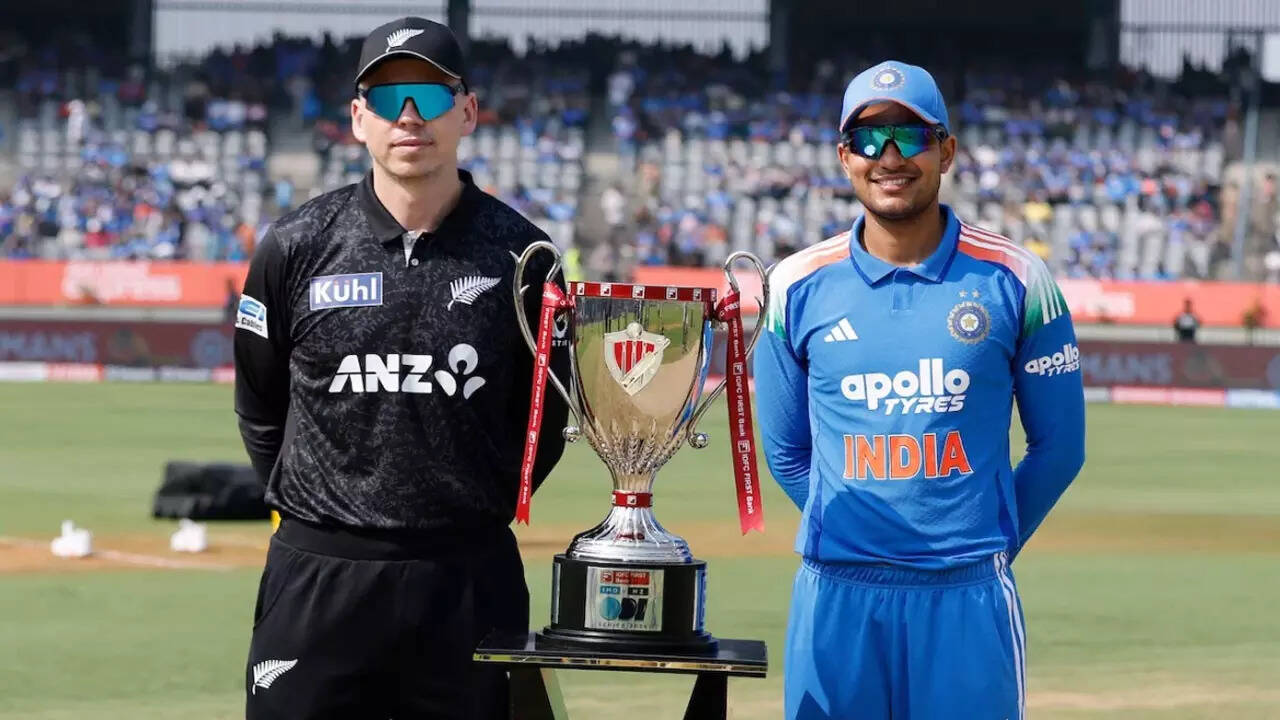
India have not lost a bilateral ODI series at home since March 2019, when Australia overturned a 0-2 deficit to clinch the series 3-2, including the decider in Delhi. That long-standing dominance, however, is now firmly under scrutiny.
For New Zealand, the stakes are just as significant. The Black Caps have toured India for bilateral ODIs since 1989 but have never managed to win a series on Indian soil. Given the balance of this contest and India’s recent vulnerabilities, this represents one of their strongest chances yet to end that drought.
India head coach Gautam Gambhir would be keen to avoid another setback at home during his tenure, which has already seen a few unwanted firsts. Under Gambhir, India have lost five Tests at home and also suffered their first-ever bilateral ODI series defeat in Sri Lanka.
India’s loss in the second ODI at Rajkot was shaped not by a single moment of brilliance but by New Zealand’s grip over the middle overs. Daryl Mitchell’s unbeaten century was a study in measured aggression, particularly against spin — an area where India have shown signs of discomfort in recent times.
Indore, with its short boundaries and flat pitch, offers even less margin for error. On a ground where totals can escalate rapidly beyond 350, lapses in the middle overs can prove decisive.
India’s struggles against spin remain a talking point. Despite their batting depth and power, the side has often found it difficult to rotate strike consistently through the middle phase. Those stalled periods have forced batters into riskier options, disrupting rhythm and momentum.
Will there be a RoKo show?
Much of the attention will be on Rohit Sharma, who has endured a lean run in the series. His ultra-aggressive approach at the top has defined India’s ODI blueprint in recent times, but repeated early exits have brought added pressure.
Virat Kohli, meanwhile, continues to be the axis around which India’s ODI batting revolves. With India’s next 50-over assignment for senior players likely to come in July during the tour of England, fans will be hoping for another decisive RoKo partnership.
Selection balance
The choice between Nitish Kumar Reddy and Ayush Badoni presents a classic trade-off between depth and control. Reddy provides seam-bowling cover, albeit used sparingly, along with late-innings power. Badoni, on the other hand, offers composure and a sounder technique against spin in the middle overs.
The case for including left-arm pacer Arshdeep Singh also strengthens at Indore, where variations often trump raw pace. His ability to swing the new ball, target the stumps and execute yorkers at the death adds a different tactical layer, especially against New Zealand’s largely right-handed batting order.
His presence could also ease the load on India’s spinners by allowing greater reliance on pace-off deliveries, wide yorkers and hard lengths — strategies better suited to the Holkar Stadium surface. The challenge, however, lies in finding space in the XI. Mohammed Siraj’s role with the new ball makes him hard to omit, leaving a spinner or seam-bowling all-rounder as the likely casualty depending on conditions and batting depth.
One area of clarity is KL Rahul’s role. His consistent returns at No. 5 reinforce the value of keeping him there, rather than pushing him down to six, where his ability to manage tempo and rebuild under pressure is reduced.
New Zealand, meanwhile, arrive with clarity and confidence. Mitchell’s dominance, backed by Devon Conway, reflects the Black Caps’ sharp understanding of match-ups and disciplined execution. Their bowlers, despite lacking big names, have relied on variations and hard lengths to good effect on surfaces offering little assistance.
At a venue where bowlers are often reduced to damage control, the contest is likely to be decided as much by decision-making as by skill. For Shubman Gill and his side, the challenge extends beyond winning the series — it is about showing tactical flexibility and situational awareness when pressure is real and margins are thin.
Teams (from):
India: Shubman Gill (c), Yashasvi Jaiswal, Virat Kohli, Rohit Sharma, KL Rahul (wk), Dhruv Jurel (wk), Ravindra Jadeja, Nitish Kumar Reddy, Ayush Badoni, Kuldeep Yadav, Arshdeep Singh, Prasidh Krishna, Mohammed Siraj, Harshit Rana.
New Zealand: Michael Bracewell (c), Devon Conway (wk), Mitchell Hay (wk), Nick Kelly, Henry Nicholls, Will Young, Josh Clarkson, Zak Foulkes, Daryl Mitchell, Glenn Phillips, Adithya Ashok, Kristian Clarke, Kyle Jamieson, Jayden Lennox, Michael Rae.