
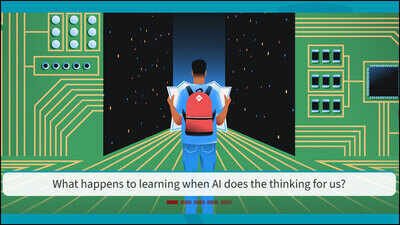

Generative artificial intelligence (AI) can help students understand difficult concepts, practise new skills and improve their learning experience. However, relying on the technology to complete academic assignments may come at the cost of actual learning, according to a new review by Stanford University researchers. The findings highlight a distinction between using AI as a learning assistant and allowing it to replace independent thinking.The November 2026 update of The Evidence Base on AI in K-12, published by Stanford University’s SCALE Initiative on November 10, examines causal research on the impact of generative AI on students and educators. While the evidence base has expanded considerably, researchers say there is still insufficient evidence to establish whether AI tools deliver lasting improvements in academic performance.
Stanford review expands AI education research to 52 studies
The latest review brings the number of causal research papers examined by Stanford researchers to 52, up from 20 in the March 2026 edition. The increase includes 32 additional studies published between October 2025 and June 2026.Of these, 28 examined student-facing AI tools, while four focused on tools designed for educators. Notably, five of the newly included student-facing studies were conducted in US K-12 settings, compared with none in the earlier review.The researchers assessed randomised controlled trials and quasi-experimental studies to understand how AI interventions affect educational outcomes. However, they cautioned that the findings should not be considered broadly representative of all K-12 schools, given the limited number and varied settings of the studies.
Using AI to understand concepts may be more beneficial
One of the central findings is that AI appears more useful when students use it to understand and practise academic material than when they rely on it to produce work on their behalf.AI tools can explain unfamiliar concepts, provide personalised feedback and offer opportunities to practise problems. Such learning-focused applications show greater promise, although the results remain mixed and do not consistently translate into improved academic performance.The review also found that AI can improve students’ learning experiences, confidence and certain aspects of well-being, even when measurable learning outcomes do not improve.
Relying on AI to complete assignments can undermine learning
The review raises concerns about students using AI to offload academic tasks rather than engage with the underlying material. Although AI can help students complete assignments, producing a correct answer does not necessarily mean they have understood the concepts involved.Research included in the broader evidence base, including studies involving higher-education students, points to this distinction. In an undergraduate coding context, for instance, AI assistance enabled students to complete programming tasks, but completing the work did not necessarily translate into stronger independent understanding.This finding should be distinguished from the newly added K-12 research, as the undergraduate evidence does not establish the same effect among schoolchildren. Nevertheless, it highlights a wider educational concern as students increasingly turn to chatbots for answers, written assignments and problem-solving.
AI can save teachers time but affect student motivation
The review also identifies potential benefits and drawbacks of educator-facing AI tools. Earlier research found that AI could reduce teachers’ lesson-planning time without compromising the quality of their work.AI-generated suggestions can also help educators provide more detailed feedback and improve instructional support.However, one newly included study found that providing teachers with an AI-based support tool reduced students’ motivation and confidence. This suggests that the way educators use AI can have unintended consequences for classroom learning.
Long-term benefits of AI in education remain uncertain
Stanford researchers conclude that the impact of AI depends on how the technology is designed, introduced and used. Interactive formats, adaptive learning exercises and clear guidance show promise, but more research is needed to establish which approaches consistently improve learning.The review emphasises that AI is more promising when it supports students’ thinking and teachers’ instructional work than when it replaces independent learning or professional judgement. Whether these benefits translate into lasting academic improvements remains an open question.