
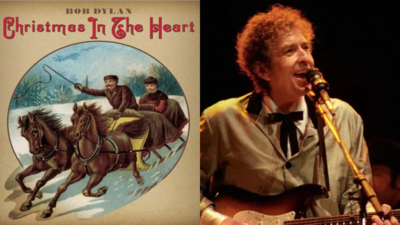
When legendary singer-songwriter Bob Dylan announced his first-ever Christmas album in 2009, the release came with an unusual promise. Rather than keeping the royalties generated by the record, the musician decided to donate them to organisations working to fight hunger and homelessness across the world. Titled Christmas in the Heart, the album featured 15 traditional Christmas songs and was released on October 13, 2009. Dylan pledged all his US artist royalties to Feeding America, while international earnings were directed towards the World Food Programme and British homelessness charity Crisis. The arrangement also covered future royalties in perpetuity, turning the holiday record into a continuing source of support for charitable causes.
Bob Dylan’s first Christmas album came with an unusual charitable promise
The announcement was made on August 26, 2009, when Columbia Records confirmed that Christmas in the Heart would be released in October.For Dylan, whose career had largely been associated with folk, rock and socially conscious songwriting, a Christmas album was an unexpected musical departure. However, the charitable commitment attached to it made the project particularly distinctive.Dylan announced that he would donate all his US artist royalties from the album to Feeding America, a nationwide network of food banks and hunger-relief organisations. The commitment extended beyond the initial release, with future US royalties also pledged to the organisation in perpetuity.International royalties were assigned to two other organisations: the World Food Programme, which works to address hunger in developing countries, and Crisis, a British charity supporting people experiencing homelessness.In his announcement, Dylan highlighted the scale of food insecurity in the US, noting that more than 35 million people, including 12 million children, were affected. He expressed hope that the project would help improve food security for people struggling to access regular meals.
Three charities were selected to receive royalties from the album
The initiative was structured around three organisations working in different parts of the world, allowing the proceeds to support people facing hunger and homelessness across several communities.Feeding America received the US royaltiesFeeding America was selected to receive all of Dylan’s artist royalties generated in the United States. The organisation operates a nationwide network of food banks and community-based agencies that distribute food to people facing hunger.At the time, Vicki Escarra, then president and chief executive of Feeding America, said the organisation had initially approached Dylan without expecting him to make such an extensive commitment.The initial arrangement was expected to generate more than four million meals for over 1.4 million people in the US during the holiday season.Crisis was chosen to support homeless people in BritainThe UK-based charity Crisis was designated to receive international royalties for its work supporting people experiencing homelessness.The initial commitment was expected to provide 15,000 meals to homeless people in Britain between December 23 and January 1.Crisis works with people facing homelessness through accommodation, practical assistance, education, employment support and other services designed to help them move towards more stable living conditions.World Food Programme was assigned royalties for school mealsThe United Nations World Food Programme was selected to receive another share of the international royalties.The initial initiative was expected to support 500,000 meals for schoolchildren in developing countries. School meal programmes are an important part of the agency’s work, helping children access nutritious food while encouraging school attendance.The three organisations were therefore expected to benefit from the same album through different hunger-relief and humanitarian programmes.
Bob Dylan explained why he chose the three charities
In an October 2009 interview with journalist Bill Flanagan, published by Street Roots on December 10, Dylan was asked why he had selected the three organisations for the project.His response offered a glimpse into the thinking behind the decision. He said he chose them because they delivered food directly to people who needed it, rather than relying on complicated administrative structures.“Because they get food straight to the people. No military organization, no bureaucracy, no governments to deal with,” Dylan explained.During the conversation, he also discussed his relationship with Christmas music. Although he grew up in a Jewish family in Hibbing, Minnesota, he recalled being surrounded by Christmas traditions, including carollers, church bells, snow and Nativity plays.He described the songs as familiar parts of his life and said he approached the recordings sincerely rather than as a humorous experiment.
How the international royalties were channelled to charities
The international side of the initiative involved a separate financial arrangement to ensure that royalties generated outside the US could reach the designated organisations.In December 2009, Columbia/Epic worked with CAF America, an organisation specialising in international charitable giving, to establish a donor-advised fund for distributing the overseas royalties.A December 15, 2009 report by InvestmentNews revealed that the international royalty fund had already generated $125,000 for charitable distribution.The arrangement was also notable because CAF America described it as apparently the first time a donor-advised fund had been used to channel royalties from a major music recording towards charitable foundations.The money was intended to support the commitments made to Crisis and the World Food Programme, including meals for homeless people in Britain and schoolchildren in developing countries.
What made Christmas in the Heart different from other Christmas albums?
Released on October 13, 2009, through Columbia Records, Christmas in the Heart marked Dylan’s first full-length Christmas album. It contained 15 traditional Christmas songs, hymns and holiday standards.The tracklist included familiar festive recordings such as Here Comes Santa Claus, Winter Wonderland, Little Drummer Boy, Silver Bells, Have Yourself a Merry Little Christmas and O Little Town of Bethlehem.The album also featured Must Be Santa, a traditional Christmas song that Dylan performed with a lively arrangement.The recording brought together musicians associated with his touring band, along with guitarist David Hidalgo of Los Lobos and guitarist Phil Upchurch. Dylan used the production pseudonym Jack Frost, which he had also employed on other recording projects.The arrangements retained a traditional holiday sound, with brass, backing vocals and country-influenced instrumentation complementing Dylan’s distinctive voice.
The album reached the top of Billboard’s holiday chart
Despite being an unusual release in Dylan’s extensive musical career, Christmas in the Heart attracted considerable commercial attention.The album debuted at No. 23 on the Billboard 200, selling approximately 20,000 copies during its first week in the US, according to contemporary music industry reporting.It also reached No. 1 on Billboard’s Top Holiday Albums chart and the US Folk Albums chart.Its commercial performance was important to the charitable arrangement because sales generated royalties that could be directed towards the participating organisations.
Dylan’s promise extended beyond the 2009 holiday season
The most distinctive part of the arrangement was its long-term nature. Dylan did not limit his commitment to the album’s initial sales or the Christmas season in which it was released.His pledge covered future US artist royalties in perpetuity, while the international royalty arrangement was also designed to continue supporting the selected charities.This meant that subsequent earnings generated by the album could continue contributing to hunger-relief and homelessness programmes long after its original release.The initiative brought together Dylan’s music, the work of three established humanitarian organisations and a continuing royalty commitment that was intended to support people facing food insecurity.