
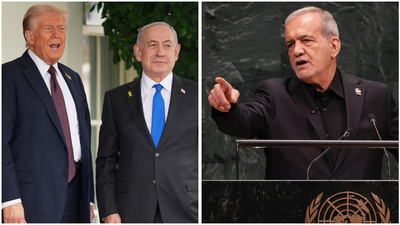
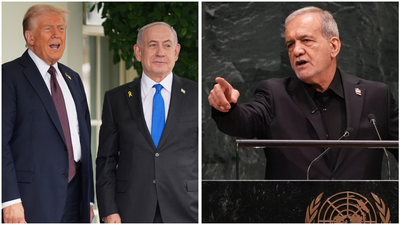
The United States and Israel have drawn up plans for renewed military strikes on Iran after the US midterm elections, according to a report by The New York Times.Meanwhile, Tehran has threatened to unveil a weapon it calls the “Father of All Bombs” amid escalating tensions in West Asia.The proposed US-Israeli operation could involve a short but intensive campaign targeting Iran’s energy infrastructure, nuclear facilities and missile and drone arsenal.Citing US officials and others briefed on the deliberations, The New York Times reported that the two militaries had stepped up exercises, including flights over Iraq to practise strike manoeuvres.US war secretary Pete Hegseth also met Israeli Prime Minister Benjamin Netanyahu in Israel this week to discuss the possibility of renewed strikes, according to the report.Some US officials believe another round of attacks could push Iran’s economy to the brink and pressure Tehran into making diplomatic concessions after nearly eight months of conflict.However, it remains uncertain whether US President Donald Trump will approve a fresh operation.A White House official said the administration did not comment on military plans “that may or may not exist”, adding that Trump was keeping all options on the table to ensure Iran could not acquire nuclear weapons.
Iran threatens to unveil ‘Father of All Bombs ’
Amid reports of possible renewed strikes, Iran has warned that it would respond to any fresh military action.Islamic Revolutionary Guard Corps (IRGC) spokesperson Hossein Mohebbi said Iran was preparing to unveil a weapon described as the “Father of All Bombs”, according to statements carried by Iranian media outlets.“The United States has the ‘Mother of All Bombs.’ We will show them the ‘Father of All Bombs,’ and it will definitely be something new for them,” Mohebbi said, according to Iran’s Student News Network (SNN).In separate remarks carried by Iran’s Young Journalists Club news agency, Mohebbi said, “We are in the stage of preparing to unveil the ‘father of all bombs.’ This is something new for the enemy.”He did not provide details about the weapon or explain its capabilities.Mohebbi also said Iran’s missile stockpile had increased 1.5 times following the 12-day war between Iran and Israel in June 2025, without providing specific figures. He claimed that missile quality, range, destructive power and accuracy had improved significantly.The IRGC spokesperson said Iran was moving towards a defence doctrine based on permanent deterrence and asymmetric warfare.“Now, we say that if a country attacks us, we will not only respond but also launch an offensive,” he said.“Our doctrine will no longer be merely offensive; it will be asymmetric. We will attack the enemy in a way that makes them feel the intensity of our response,” Mohebbi added.
Questions over possible use of ‘Mother of All Bombs’
The Iranian threat follows reports that Trump has considered using the US GBU-43/B Massive Ordnance Air Blast (MOAB), commonly known as the “Mother of All Bombs”, against Iran’s deeply buried Pickaxe Mountain nuclear facility.The conventional bomb weighs approximately 9,800 kg (21,600 pounds) and is among the largest non-nuclear weapons in the US arsenal. Trump authorised its first use during his initial presidential term, when it was deployed against an Islamic State tunnel complex in Afghanistan in April 2017.However, weapons specialists have questioned whether the bomb could destroy Iran’s underground nuclear facility, which is believed to be protected by layers of granite.The MOAB explodes above ground rather than functioning as a deep-penetration weapon. Military officials have also raised concerns about its delivery, as the bomb would have to be carried by a relatively slow-flying MC-130 transport aircraft that could be vulnerable to Iranian anti-aircraft fire.A separate report by CNN last week said US military planners had developed strike options that included the potential use of the MOAB against Iranian energy infrastructure and nuclear sites.The report also highlighted doubts over whether the weapon could penetrate deeply enough to destroy heavily fortified underground facilities.The bomb could cause extensive destruction at the surface but might not achieve the intended military objectives against deeply buried targets.
US builds up military presence as diplomatic efforts continue
According to The New York Times, the United States is assembling a substantial military force expected to be fully in place by early November. The planned deployment includes three aircraft carriers, thousands of Marines, fighter jets and Special Operations forces.The report said political considerations, including Trump’s earlier pledge not to launch strikes against Iran before the midterm elections, could affect the timing of any operation.The US and Israel reportedly came close to launching another attack earlier this month, but Trump postponed the operation shortly before it was due to begin, despite extensive preparations and heightened alert levels among their air forces.Washington is also seeking to use the threat of renewed military action as leverage in negotiations over Iran’s nuclear programme and control of the Strait of Hormuz, the report said.Iranian negotiators, however, have resisted making concessions on the nuclear issue, insisting that it be addressed later in the talks.Some US planners believe a three-day campaign could inflict enough economic damage to change Tehran’s position.However, previous US-Israeli strikes between February and April drove up energy prices and inflation worldwide, affected security across West Asia and severely strained the Pentagon’s supply of missile interceptors, according to the report.Iranian officials have warned that any renewed conflict could extend beyond commercial shipping and energy infrastructure to data centres and underwater internet cables.Mahdi Mohammadi, a senior adviser to Iran’s negotiator General Mohammad Bagher Ghalibaf, rejected the prospect of a swift end to renewed hostilities.Describing the idea that the US could conclude another round of strikes within 72 hours as a “fantasy”, Mohammadi said Iran would determine when the war would end.“Our attacks will be more fierce, creative and different,” he said. “We are determined and confident and strong planning has been put in place.”
Pezeshkian says Iran faces a ‘super-challenge’
Iranian President Masoud Pezeshkian has described the situation as a major challenge for Tehran.Addressing the Iranian Parliament, Pezeshkian said, “The memorandum of understanding we signed was very good; we hadn’t given anything. The current situation is neither good for us, nor for the region, nor for the world.”He added, “We are in a super-challenge, not a challenge. America didn’t think we would stand firm despite the pressure and war, but we stood firm, and we will continue to stand firm.”Iran’s representative to the United Nations also alleged, according to SNN, that Starlink had been used to identify and target locations in military attacks against Iran, adding that the country’s space and scientific infrastructure had come under attack.The timing of any renewed operation could also be affected by Israel’s October 27 election.Analysts believe Netanyahu could face difficulties initiating a war if he loses and becomes a caretaker prime minister.Others believe the prospect of joint US-Israeli strikes could be used to pressure political rivals into joining a unity government.With military preparations continuing and negotiations yet to produce a breakthrough, uncertainty remains over Trump’s decision and the scale of Iran’s potential response.