
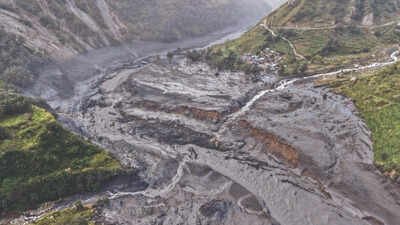
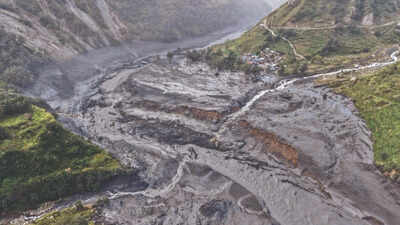
A massive rock avalanche, possibly involving glacial ice, may have triggered Sunday’s destructive flash flood in Nepal’s Budhi Gandaki valley after debris temporarily blocked a river, preliminary scientific assessments suggested.The disaster, which left five people missing and damaged houses, bridges and hydropower infrastructure, occurred 46 days after Rasuwa avalanche on Aug 26, less than 100km away.Christian Huggel, a University of Zurich professor, said avalanche likely originated on Chamar massif’s southern slopes, where peaks exceed 7,000 metres. Cloud cover prevented identification of precise source, while scientists could not rule out glacial ice. He estimated collapsed material could total several tens of millions of cubic metres, based on satellite changes and a seismic signal equivalent to magnitude 5.1. Rasuwa avalanche involved an estimated 110-130 million cubic metres.Himalayan Geological Research traced debris through about 4.6km of Udilung Khola into Syar Khola and Budhi Gandaki system. Scientists suspect avalanche blocked Syar river, forming a natural dam whose failure released water, sediment and rocks downstream.ICIMOD also cited a possible landslide-induced blockage failure near Chumchet in Gorkha district. The avalanche travelled about 7km before stopping in main valley.