

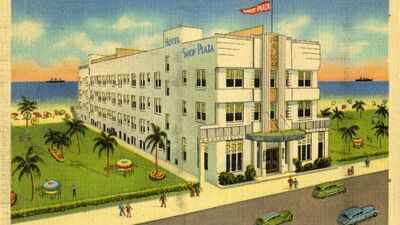
The Savoy Hotel has stood on Miami Beach’s Ocean Drive since 1937, a low-rise Art Deco landmark in a neighbourhood defined by that style. Now, a plan filed by Allied Partners would demolish most of the Savoy and the neighbouring Arlington Hotel to make way for a 38-story, 480-foot tower designed by Arquitectonica. The project relies on Florida’s Live Local Act to bypass local zoning limits and on the Resiliency and Safe Structures Act to allow demolition of flood-vulnerable historic buildings, according to WLRN and project filings. Read on to know more details here:
A landmark from the 1930s
The Savoy Hotel was built in 1937, during the era when Miami Beach’s Ocean Drive was taking shape as a showcase for Art Deco architecture. Its low-rise footprint and distinctive facade have made it a familiar sight in the South of Fifth neighbourhood for nearly a century. The neighbouring Arlington Hotel, built in 1941, shares the block and has been closed since it was badly damaged by Hurricane Irma. Under the current proposal, the Arlington would be demolished entirely, while the Savoy would lose most of its structure. What remains would be the hotel’s lobby and a small section of its Ocean Drive facade, both of which would be retained and restored intact. The developer says the new building’s street front is designed to match the scale of the two old hotels and sit in line with the preserved elements, as per Oftmw.com.That partial preservation is a compromise that has drawn criticism from preservation advocates. Meg Lousteau, executive director of the Miami Design Preservation League, told WLRN that the loss of most of the Savoy would damage the city’s iconic brand and image. She warned that the combination of state laws could lead to wholesale changes in how many parts of Miami Beach feel at street level.
How Florida’s Live Local Act enables the tower
The Live Local Act, passed in 2023, allows developers to sidestep many local zoning regulations when building large structures. Under the law, a project can qualify for the highest density and tallest height within a one-mile radius if at least 40 percent of its units are maintained as workforce housing for at least 30 years. This provision is what makes a 38-story tower possible on a strip known for its low-rise Art Deco and Mid-Century Modern buildings, as per WLRN NPR News.The proposed Savoy tower would rise about 480 feet, or 453 feet depending on the measurement cited in filings, well above the surrounding buildings. It would include 90 market-rate condominiums averaging 2,851 square feet, 60 workforce rental units in the parking podium, and a 76-key hotel. The workforce rentals would be restricted to households earning at or below 120 percent of area median income for at least 30 years, as per Oftmw.com.Reports further suggest that the project also calls for 257 parking spaces, a sixth-floor pool deck, a beachfront hotel restaurant, and a beach club. The mix of uses reflects a broader trend in Miami Beach development, where residential towers increasingly incorporate hotel and retail components. The Live Local Act’s density and height provisions make such projects financially viable in areas where local zoning would otherwise limit them.
The Resiliency and Safe Structures Act and demolition
The Resiliency and Safe Structures Act, passed in 2024, is the other key piece of legislation enabling the project. The law bars local governments in coastal communities from preventing the demolition of historic structures that do not meet modern flood standards or have been deemed unsafe. It also prevents local governments from requiring the preservation of any elements of a demolished structure.Almost all of Miami Beach falls within a FEMA flood zone, which means many older buildings qualify under the law’s criteria. The Savoy Hotel sits in the South of Fifth neighbourhood, just outside the Miami Beach Architectural District, which was listed on the National Register of Historic Places in 1979. That placement matters because the law includes an exception for historic properties within districts recognised before January 1, 2000, and the Savoy falls outside that boundary.Miami Beach Commissioner Alex Fernandez told WLRN that the city has been stripped of its authority to stop the demolition of historic properties like the Savoy and Arlington. He described the situation as a horrible state preemption that affects every coastal community in Florida. The city still has limited authority to review plans, but that authority has been diluted under the new laws.
Community pushback and the limits of local control
Residents and local officials have pushed back against the project, but their options are constrained by state preemption. The Miami Design Preservation League had warned as early as 2024 that the Resiliency and Safe Structures Act could lead to the demolition of the Savoy and other historic properties. Lousteau told WLRN that the outcome was predictable and predicted, and that the combination of the two laws could reshape the character of Miami Beach.Community activism did succeed in blocking an earlier version of the demolition bill in 2023, but the legislation passed the following year. Commissioner Fernandez said the current situation is the fulfilment of a prophecy, with everything opponents warned about now happening. He noted that the city’s hands are tied and that residents have virtually no way to stop the demolition under the current legal framework.The debate reflects a broader tension between state-level development policy and local preservation efforts. Florida’s coastal cities face pressure to build more housing and improve resilience, but critics argue that the current laws remove too much local control. For Miami Beach, the Savoy case has become a symbol of that tension.
What comes next for the Savoy site
The project is still in the planning and review stage, with construction not yet underway. Allied Partners filed a letter of intent in April 2026 invoking the Live Local Act, and the plans have since been filed with the city. The developer, Savoy Hotel Partners LLC, is owned by Allied Partners CEO Eric D. Hadar and family.If the project moves forward, the new tower would bring a significant change to Ocean Drive’s skyline. The 38-story building would stand in sharp contrast to the low-rise Art Deco character that has defined the street for decades. Whether the partial preservation of the Savoy’s lobby and facade will be enough to satisfy preservation advocates remains to be seen.For now, the Savoy’s future hangs on the interplay between two state laws and the limits they place on local authority. The case highlights how development pressure, flood risk, and historic preservation can collide in coastal cities. As Miami Beach continues to evolve, the Savoy may become a test case for how much of the city’s architectural heritage can be retained under Florida’s current legal framework.