NEW DELHI: “The sarpanch is also responsible for my death. I had questioned Cheema about drugs. My son takes drugs. My house was sold. I don’t have anything and finally now I have consumed poison. The problem of drugs has not been solved anywhere in Punjab.”Those were among the last recorded words of Gulzar Singh, a 47-year-old Dalit man from Dirba in Sangrur district, before his death. His family alleged that he had been pushed to the edge after questioning Punjab finance minister Harpal Singh Cheema about the easy availability of drugs in the area.Gulzar died, but his words reverberated across poll-bound Punjab. The BJP, Congress and Shiromani Akali Dal trained their guns on the Bhagwant Mann government, accusing it of failing to control the drug menace. AAP hit back, questioning their own records in power.Drugs have shadowed election after election in the state. Captain Amarinder Singh went into the 2017 polls promising to break the backbone of the drug trade within four weeks. Five years later, AAP sought votes with its own promise of eliminating the menace within months. Now, with Punjab headed for another assembly election in 2027, drugs are again moving to the centre of the conversation.Only the roles have changed.AAP, which once attacked Congress and the SAD-BJP government from the outside, now has nearly five years in office to defend. Congress wants to use AAP’s old promises against it. And the BJP, still trying to expand its footprint in Punjab, has launched perhaps its biggest statewide campaign yet around the issue.
BJP takes the drug battle on the road
Leading the opposition charge is the BJP, which has the weakest presence in the state as of now, but is making the strongest pitch for power.The Punjab BJP, on September 18, launched its 13-day ‘Nasha Mukt Yatra’ to turn its anti-drug campaign into a statewide political roadshow ahead of the 2027 assembly elections. The party divided its campaign into four yatras covering nearly 4,000 km and all 117 assembly constituencies.The campaign will end on September 30, with Union home minister Amit Shah likely to address the concluding rally. All the top BJP leaders including Union ministers and party chief ministers from other states have joined the campaign against drugs in Punjab.
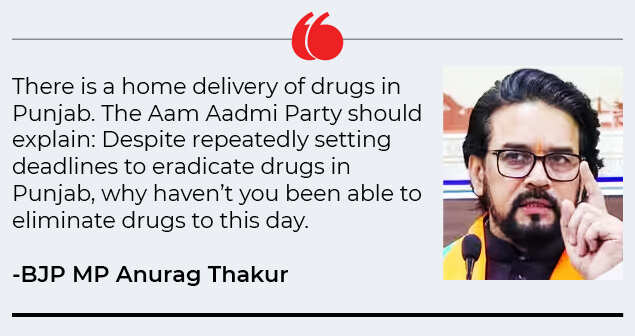
BJP leader Anurag Thakur said the state has to be made ‘Aam Aadmi Party Mukt’ for turning it into ‘Nasha Mukt’
Yet the BJP has a political history to answer for too. For 10 years, from 2007 to 2017, it shared power with the Shiromani Akali Dal, the period AAP repeatedly points to whenever its record on drugs is questioned.
From four weeks to three months: Punjab’s many deadlines
Ahead of the 2017 election, Amarinder Singh’s four-week promise became one of the defining messages of the Congress campaign. He later clarified that his pledge was about breaking the backbone of the drug supply chain rather than completely eliminating every trace of drugs within a month.By 2022, the roles had changed. AAP was the challenger and Arvind Kejriwal and other party leaders promised quick action, speaking of tackling the menace within three to four months of forming the government.The BJP has done its homework well. It knows that the drug menace in Punjab is deep-rooted and hence has sought a timeframe of two years to eradicate it. However, Union minister Shivraj Singh Chouhan has claimed that the BJP will destroy and eliminate the entire drug network within six months if voted to power in the state.Therein lies Punjab’s problem: Congress cannot remind AAP about its three-month promise without being reminded of its own four-week vow. BJP cannot attack AAP without being taken back to its decade in government with SAD.Almost every party pointing fingers today has a past of its own to explain.
Congress, SAD join the attack
The Congress narrative on the drug menace seems to have been lost in the face of BJP’s high-decibel anti-drug campaign. The party, which for a long time was struggling to set its own house in order amid infighting, has done little till now to capitalise on the alleged failures of the AAP government to tackle the drug menace.The first big Congress show on the ground was only after Sachin Pilot took charge as state incharge and managed to get the rival state unit factions on one stage to protest against Punjab minister Cheema over the suicide of Gulzar.
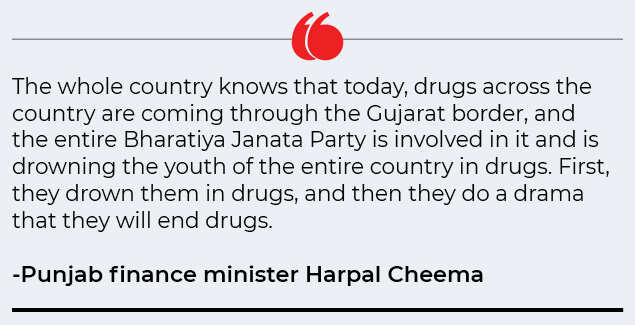
Punjab finance minister blamed BJP-SAD for the drug menace in the state,
Pilot said: “If someone raises their voice against drugs, they face such attacks. I believe the government can go to any extent to suppress and conceal these voices. There are two sets of laws in the country, one for ministers and another for the common man. This cannot go on. I feel the government is completely on the back foot regarding the issue of drugs.”He then turned to AAP’s pre-2022 promise: “The Aam Aadmi Party had promised in Punjab that they would eliminate the drug menace within three months of forming the government. They stand completely exposed. I sense a stir for change in Punjab, and change will happen.”Leader of opposition Partap Singh Bajwa has blamed both the AAP-led state government and the BJP-led Union government for turning the state’s drug crisis into a political blame game instead of dismantling the drug supply chain.“Bhagwant Mann cannot wash his hands of responsibility by talking about cross-border, the BSF and Mundra Port. At the same time, the BJP cannot absolve itself by blaming Punjab while the international border, ports and the national drug-trafficking network fall within areas where the Union government has a critical responsibility. Punjab’s youth need action, not a Mann-Modi blame-game,” Bajwa said.
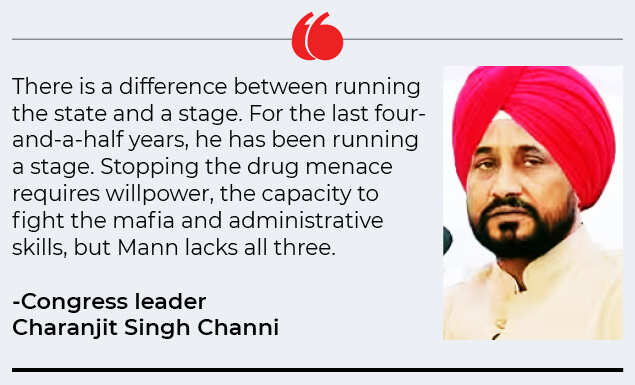
Channi hits out at AAP govt
The Congress challenge is daunting. While on the one hand it has to target the AAP government’s failures, on the other, it also has to prevent the BJP from running away with the anti-drug fight initiative.SAD faces much the same problem. Bikram Singh Majithia recently took a jibe at the Punjab government when he said: “Under AAP’s regime, delivery of drugs is faster than that of food.”Bathinda MP Harsimrat Kaur Badal has also appealed to women in Punjab to unite and launch an ‘andolan’ to free the state from the drug menace, including through ‘thikri pehra’, a community policing practice in which people guard their localities during emergencies.
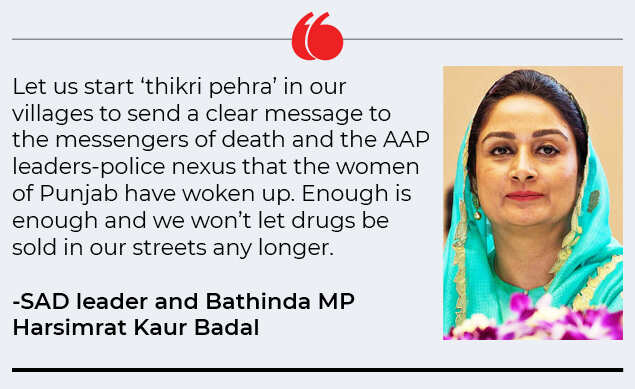
Bathinda MP Harsimrat Kaur Badal has appealed to women in Punjab to unite and launch an ‘andolan’
AAP hits back: What about the years before 2022?
AAP’s response is to ask its rivals to look backwards before judging the Mann government.Punjab minister Cheema, who is at the centre of the row over Gulzar’s suicide, shifted the blame to the BJP and the SAD.“The BJP should look at its own record. The drug menace intensified during the 10 years of the SAD-BJP government from 2007 to 2017. It was during that period that terms such as ‘chitta’ and ‘smack’ became widely associated with Punjab, with countless young lives being destroyed by addiction,” Cheema said.Countering the BJP offensive, AAP national convenor Arvind Kejriwal has alleged that the majority of narcotics entering the country originate from Bharatiya Janata Party-ruled states and major maritime entry points controlled by the Centre.Kejriwal alleged: “Today, 80% of the drugs are coming from BJP-ruled states – Gujarat, Rajasthan, Haryana, UP, Delhi. Has the BJP failed to stop the drug trade in its own states, or does it not want to stop it? Their government has been in power in Gujarat for thirty years, and the highest drug trade is there. Drugs enter India through Mundra Port, and stopping that is the responsibility of the central BJP government.”Bhagwant Mann, meanwhile, has launched the ‘Soorma’ campaign to honour drug-rehabilitated people with specially crafted ‘Soorma’ rings and T-shirts. The chief minister said the initiative aimed to transform recovered drug victims into “Ambassadors of Hope”, who will lead the fight against addiction at the grassroots.
Beyond the blame game, what do the numbers say?
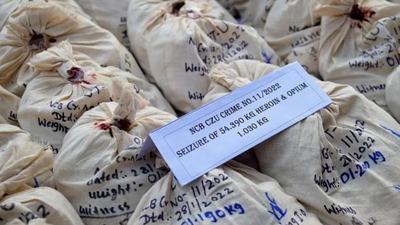
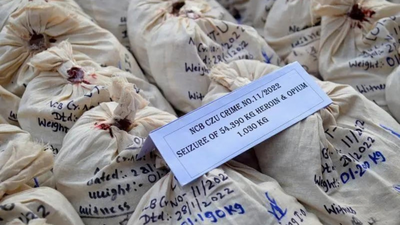
The Mann government has numbers with which to defend itself.Punjab Police says its ‘Yudh Nashean Virudh’ campaign has resulted in tens of thousands of cases and arrests. More recent state figures put the tally since March 2025 at 61,824 FIRs, 81,433 arrests and 3,918 kg of heroin seized.AAP presents the numbers as evidence that the state machinery is finally going hard after the networks. Its opponents turn the argument around: if such large quantities are still being seized and so many people are still being arrested, how deeply rooted does the trade remain?High seizures can show a crackdown is working but they can also show the scale of the problem being confronted.The government says its strategy now goes beyond policing. It has expanded treatment and rehabilitation under ‘Yudh Nashean Virudh’, with 547 OOAT centres, 219 de-addiction centres and 91 rehabilitation centres, besides programmes involving schools and local communities.
Share your thoughts in the comments
Be respectful · TOI community guidelines
For AAP, this forms the other half of its defence: the battle against drugs cannot be measured only through FIRs and seizures but also through treatment and rehabilitation.
Punjab has seen this cycle before.
In 2017, anger over drugs was directed largely at the SAD-BJP government and Congress promised quick action. By 2022, Congress was on the defensive and AAP used the same issue to argue that Punjab’s traditional parties had failed. In 2027, AAP is the incumbent being asked many of the questions it once asked others.The slogans have changed and the roles have reversed, but the question has survived different governments and different deadlines: after so many promises to make Punjab drug-free, why is the state heading into yet another election talking about the same problem?