
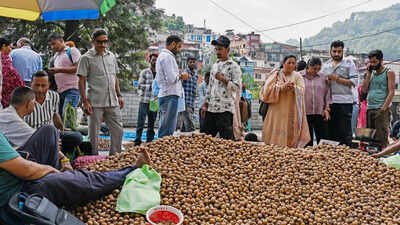
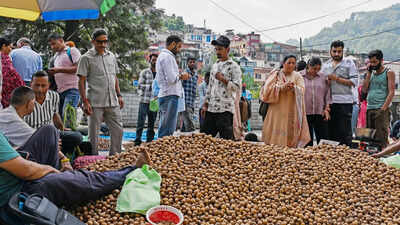
KOKERNAG: In Gohan village, around 100km south of Srinagar, Shabir Ahmad was among many harvesting walnuts from a towering tree. The work has become increasingly difficult. “My back aches now,” Ahmad said. J&K produces 3.5 lakh tonnes of walnuts annually, around 90% of the country’s total output.Like other villagers, Ahmad had no safety gear and he was proud of it. “We have been doing it for centuries,” said Ahmad, also a clerk at a local court. However, the bravado doesn’t help in harvesting seasons. Dr. Mohd Yaqoob Bhat, a surgeon at Paras Hospital in Srinagar, said Valley healthcare units treat dozens of patients each year after falls from walnut trees, some with serious spinal injuries. “There is no mechanism to address the issue,” Bhat said.Ahmad’s younger brother sold one walnut for one rupee and no two fruits are similar. For generations, Kashmir’s walnut trees have been grown from seeds. J&K and Sher-e-Kashmir University of Agricultural Sciences and Technology (SKUAST) are now promoting medium-sized, grafted walnut trees to bring greater uniformity and help the produce compete globally amid competition from soft-shelled varieties grown in California and Chile.The initiative aims to replace scattered plantations with organised orchards of known varieties, allowing farmers to grow more trees in the same area and produce walnuts more consistent in size and color.J&K has about 80,000 hectares under walnut cultivation, most of it made up of seedling-origin trees. “When someone plants a walnut seed in the ground, whatever grows becomes a tree. Every tree is a variety of its own,” Ashfaq A. Pandit, professor and head of fruit science at SKUAST, said. This natural variation, once considered an advantage, has become a challenge in the modern market where buyers seek consistent produce.Traditional walnut trees can take about 15 years to bear fruit without using pesticides. Unlike traditional seedling-origin trees, grafted walnuts belong to known varieties.Imtiyaz Ahmad Lone, professor and head of SKUAST’s Walnut Research Centre, said the university released new walnut cultivars and grafting-based cultivation had spread over nearly 90,000 hectares despite lack of subsidies.Farmers argued, however, that the grafted varieties are no match for the traditional Kashmiri walnut. “It is no match in taste. The new varieties are brittle, tasteless. They are a no-show,” Mohammad Sultan, a Pulwama farmer in the business for 50 years, said.
Share your thoughts in the comments
Be respectful · TOI community guidelines
Researchers differed. Lone pointed out that grafted trees have early bearing, give faster returns as orchards and nut quality are uniform. “They have higher productivity and better export potential. There is a gradual opportunity to replace unproductive seedling trees,” he said.The transition has impacted walnut woodcraft industries. Walnut trees cannot be cut in J&K without govt permission. The matter was debated in the assembly in March when CM Omar Abdullah opposed a bill allowing landowners to cut walnut trees on private property. Omar defended the restrictions, saying the law served a broader purpose of conserving walnut and chinar trees.