
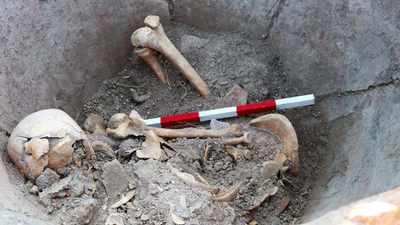
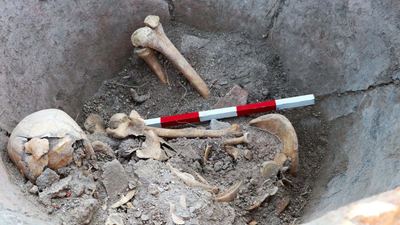
More than 1,600 years ago, as fire engulfed a Roman settlement in what is now Bulgaria, a young man appears to have made a desperate decision: he climbed inside a huge storage jar and hid. He never came out. Archaeologists uncovered his remains inside the vessel during excavations at the ancient Roman colony of Deultum in southeastern Bulgaria. The discovery, first reported by Live Science and subsequently detailed by Archaeology Magazine, offers a rare glimpse into the chaos of an ancient attack.
A skeleton hidden inside a Roman storage jar
The remains were discovered on August 10 inside a Late Roman turret forming part of Deultum’s western gate. The individual was found at the bottom of a large ceramic vessel known as a dolium, which Romans used to store commodities including wine and olive oil.The surviving portion of the vessel measures roughly 1 metre across. Some ancient dolia were enormous, capable of holding more than 1,000 litres. Finding human remains inside the city was unexpected. According to excavation leader Lyudmil Vagalinski of the Bulgarian Academy of Sciences, such remains are particularly unusual in ancient urban settlements because the dead were generally recovered and buried outside city walls. The circumstances at Deultum, however, appear to have been anything but ordinary.
Signs of a violent attack were everywhere
Around the jar, archaeologists found extensive evidence of a major fire: ash and charcoal, broken bricks and roof tiles, blackened walls, melted glass and burned animal bones. Bronze coins were also scattered through the area, suggesting that whatever happened unfolded in considerable chaos. Deultum had faced attacks from East Germanic groups and Huns during the fourth and fifth centuries. Archaeologists have not yet established which particular attack was responsible for the destruction, but the evidence points to a violent episode around A.D. 400, pending further analysis.
He may have climbed in after the fire started
The most intriguing clue is inside the jar itself. Ash was found beneath the man’s remains. That suggests he did not climb into the vessel before the fire began. Instead, archaeologists believe he may have sought refuge there after the flames had already spread through the structure.
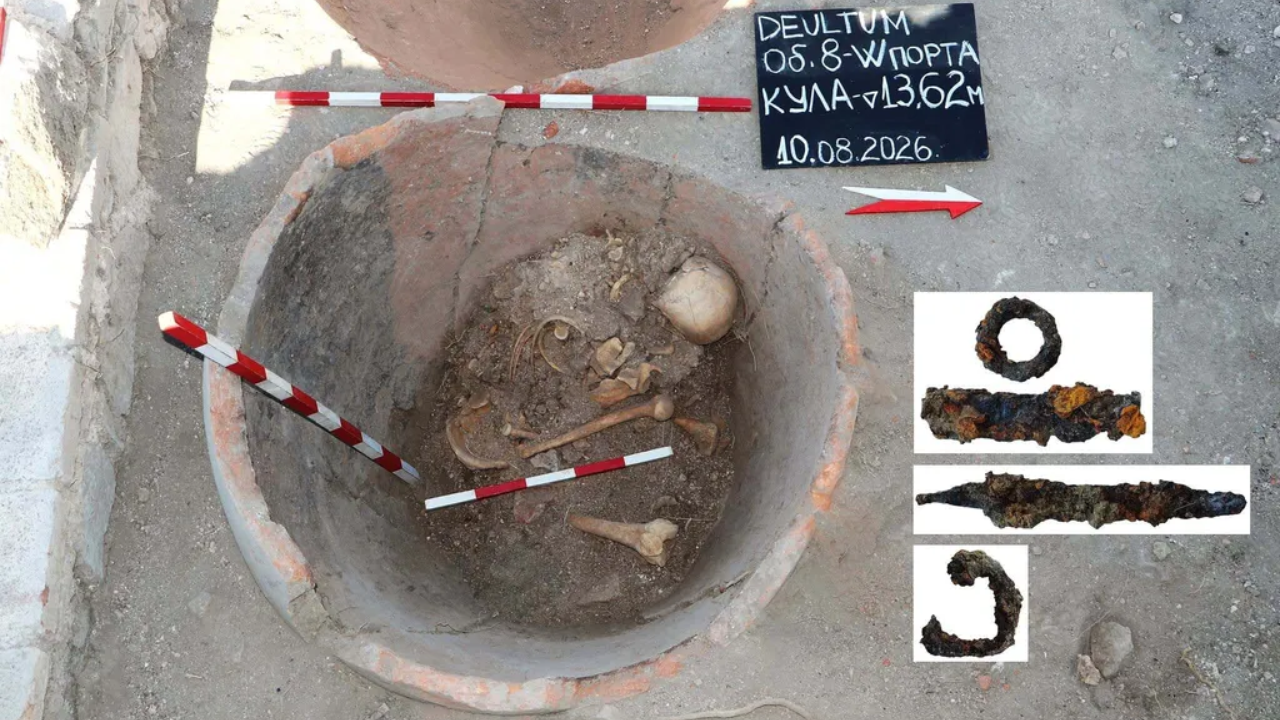
His remains were found alongside two iron knives and a belt. One knife was associated with his belt, while the other was positioned between his legs, possibly indicating that he was prepared to defend himself if someone discovered his hiding place. The evidence does not establish that he was a Roman soldier. Rather, archaeologists believe he was likely a young man caught up in the attack. His position also suggests that he never managed to escape. The way his body was preserved inside the vessel is consistent with someone who had curled up inside it for shelter.
A final hiding place preserved for centuries
The tragedy may have remained hidden because of what happened after the attack. Archaeologists believe the inhabitants later levelled the damaged remains of the tower and constructed a new, higher floor over the ruins. The man inside the dolium was therefore effectively sealed beneath the rebuilt structure.His remains have now been transferred to Sofia for anthropological examination, which could reveal more about his age, sex and physical condition. For now, the identity of the man, and the exact attack that killed him, remains unknown. But the jar has preserved something remarkably intimate: the final moments of someone who, faced with a burning Roman settlement, apparently believed that the safest place left was inside a giant storage vessel.