

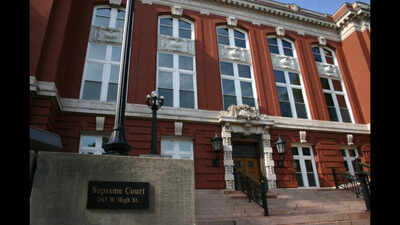
In 1904, a Missouri family acquired 15 acres of land in what is now Chesterfield. More than a century later, St Louis County condemned the property for a highway project, turning the land into the centre of a long legal battle over how much it was worth.The 15-acre tract at 1653 Creve Coeur Mill Road was deeded to Arthur Novel in 1904, according to FindLaw.Arthur and his wife, Stella, lived on the property and operated it as a farm until their deaths. The property had been vacant since 1968 and no house stood there when the county took it.By then, the land was heavily wooded, with a creek, steep bluff and sloping terrain. St Louis County wanted the property for the Page/Olive Connector as part of the extension of Highway 141. The county filed a condemnation petition on December 22, 2009, naming Arthur and Stella’s descendants and their spouses as defendants.The county initially offered $238,000 for the property, according to a 2012 Missouri Lawyers Media report. The family rejected the amount, arguing that the land had greater value because it could be developed for housing despite flood-related restrictions. The dispute eventually reached a jury, which valued the property at $1.3 million.
From $320,000 award to a $2.1 million judgment
After the condemnation order was issued in February 2010, the owners and the county could not agree on compensation. A court-appointed three-member commission initially awarded the family $320,000.The Novels objected and asked for a jury trial. Before the trial, the commissioners amended their report to state that the family had owned the property for more than 50 years. That became important because Missouri law allowed additional “heritage value” for qualifying family-owned property.The trial took place from December 12 to 15, 2011. The jury awarded $1.3 million for the property. The trial court then added $650,000 in heritage value, equal to 50% of the jury’s fair market value finding, along with $158,769 in prejudgment interest.That brought the judgment to about $2.1 million. The county appealed, challenging the amount as well as several decisions made during the trial.
Family and county disagreed over the land’s value
The family’s appraiser, Ernest Demba, used the comparable-sales approach to value the property. He said its highest and best use was residential villa development, pointing to nearby Mill Ridge and Terra Vista developments.Demba valued the Novel property at $2 per square foot. The 15 acres covered 648,373 square feet, putting his valuation at $1,296,746.Demba did not use a Terra Vista transaction as one of his three comparable sales because the land had sold for only 30 cents per square foot. He said the transaction involved non-money consideration and was not a true market sale.The county challenged Demba’s testimony about Terra Vista and information concerning changes to the land’s flood designation. However, the Supreme Court noted that the county had itself questioned Demba extensively on those issues and had not properly preserved its objections.The family’s lawyer, Robert Denlow, described the trial as an explanation of how the land could potentially be developed.“We basically gave the jury a mini-course on how to be a developer using 15 acres of floodplain and floodway with a creek running through it,” Denlow said, as quoted by Missouri lawyers media.The county argued that development would be legally difficult and expensive. County Counselor Patricia Redington also objected to testimony about the family’s attachment to the property.“The constitution calls for just compensation, and just compensation means fair market value, not sentimental value,” Redington said.
Supreme Court rejects county’s challenges
The county also challenged testimony about a possible $496,000 settlement figure. A county employee testified that Arthur Novel had said he would settle for that amount during an earlier commissioners’ hearing.But the trial court concluded that the figure represented a settlement position, not Novel’s opinion of the property’s fair market value. The Supreme Court agreed that the trial court could accept or reject the testimony and noted that settlement negotiations are generally protected from being used as evidence.The county also challenged limits placed on testimony from two Chesterfield employees, civil engineer Jeff Paskiewicz and planning director Aimee Nassif. The trial court allowed them to explain general development requirements but did not allow them to give undisclosed, property-specific opinions.The Supreme Court upheld that decision, saying the county had not disclosed such opinions during discovery.
$1.3 million verdict upheld
The county argued that the jury’s $1.3 million award was excessive. The Supreme Court rejected the claim.Demba’s calculation came to $1,296,746, which he agreed was close to $1.3 million. The court said the jury had reasonably rounded the figure and that the testimony of a single qualified expert could provide substantial evidence supporting the verdict.The court also rejected the county’s constitutional challenge to Missouri’s heritage-value law. Under the law, property held by the same family for at least 50 years could receive an additional 50% of its fair market value when a taking prevented substantially the same use.The Supreme Court held that the law did not replace the constitutional requirement of fair compensation. Instead, it provided additional compensation. It also ruled that determining heritage value did not improperly interfere with the jury’s role because the jury decided the property’s fair market value, while the additional statutory amount was determined by the judge.The Missouri Supreme Court ultimately affirmed the trial court’s judgment, leaving the family with an award of about $2.1 million for the property taken for the Highway 141 project.