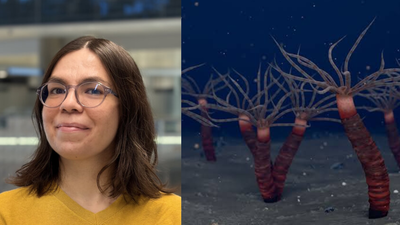
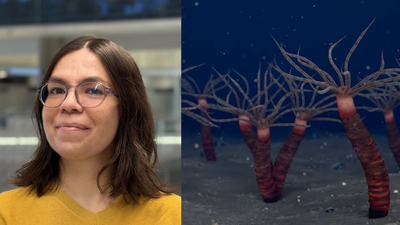
Greta Ramirez-Guerrero was studying fragments of ancient life that had survived in Quebec rock for roughly 450 million years when she encountered an unusual problem: the animal she was examining had almost nothing that should have fossilised well. Paleocanna tentaculum was a soft-bodied relative of modern jellyfish, shaped more like a narrow tube than the drifting creatures familiar from today’s seas. Yet dozens of its delicate remains had endured in limestone from the Ordovician period. Ramirez-Guerrero, a PhD candidate at the Université de Montréal, led the study that pieced together what the fossils represented.Across 15 slabs, the team identified around 135 specimens, giving her an unusually large collection of evidence for an animal of this kind. Their arrangement in the rock also offered clues about how quickly the creatures were buried and how their soft bodies managed to leave a trace behind.
Greta Ramirez-Guerrero identified a 450-million-year-old jellyfish relative
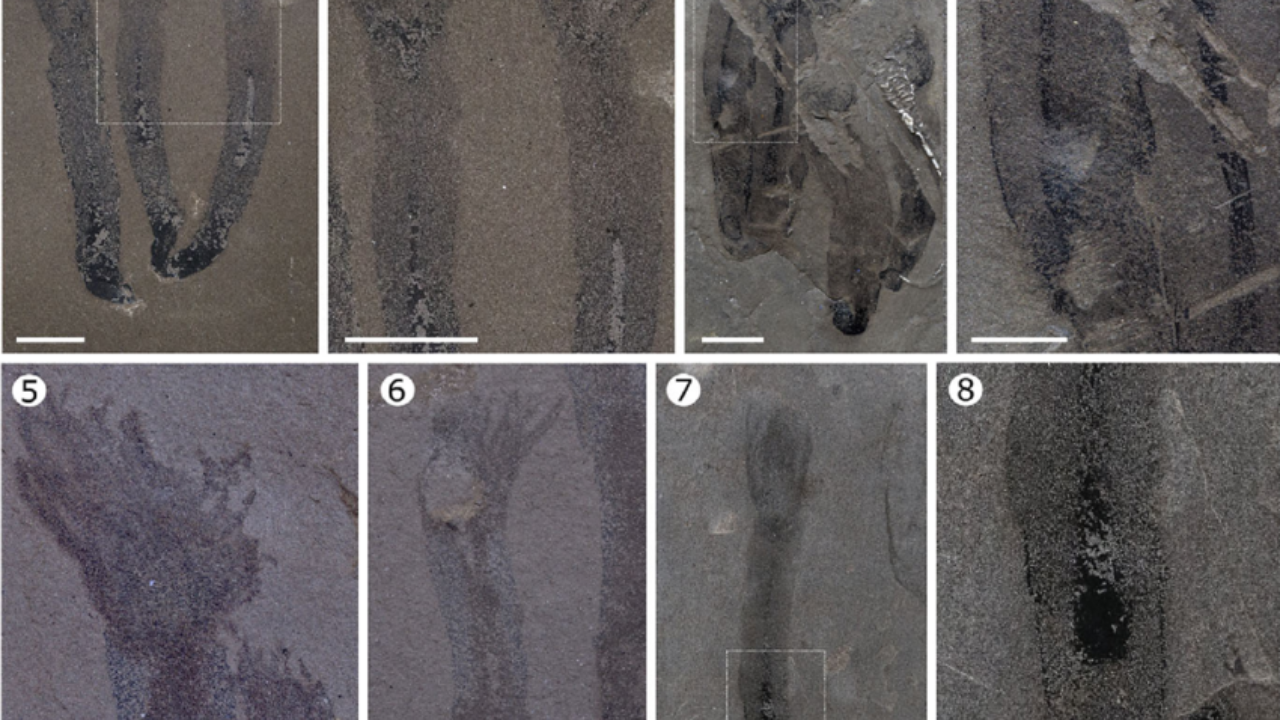
The fossils did not resemble the image most people have of a jellyfish. Paleocanna tentaculum was a polyp, with an elongated body enclosed within a narrow tube. At one end was a ring of tentacles.That distinction mattered to Ramirez-Guerrero’s work because soft-bodied organisms are notoriously difficult to preserve. Once an animal dies, its tissues can disappear quickly, leaving little behind for future palaeontologists to find.Yet these specimens had survived as carbonaceous impressions in the Upper Ordovician Neuville Formation of Quebec. The study, published in the Journal of Paleontology in February 2026, described the fossils as a new genus and species of medusozoan.For Ramirez-Guerrero, the task was therefore not simply recognising an unusual shape in a rock. She had to work out what the animal was, where it belonged among ancient relatives and what its preservation could reveal about the circumstances in which it had been buried.
PC: ResearchGate
135 fossils gave Greta a rare chance to trace its ancient lineage
According to Discover Magazine, the material gave her a reasonable amount to work with, even if the fossils themselves were delicate. Around 135 Paleocanna individuals were spread across 15 slabs of shaly limestone.39 specimens were measured and photographed in detail. Their physical characteristics were then compared with 69 fossil and living species related to jellyfish. A fossil can resemble several different organisms when only part of its anatomy has survived, so Ramirez-Guerrero and her co-authors used a much wider set of morphological features to establish its position.Their analysis placed Paleocanna tentaculum as an early-branching member of the crown group Medusozoa. The results indicated that it was more closely related to the group containing modern cubozoans, scyphozoans and staurozoans than to some other fossil medusozoans.
Greta found clues in the way the fossils were arranged
Some of the most useful information was not simply in the shape of the individual animals. It was in their arrangement.Several specimens were aligned in the same direction. Others occurred in small clusters, with two or three tubes attached near their bases. Ramirez-Guerrero interpreted the alignment as evidence that the animals had probably been buried where they lived, or had moved very little before burial.That observation helped reconstruct what happened at the seafloor hundreds of millions of years ago. Fine sediment appears to have covered the organisms rapidly. Conditions around the buried animals were also relatively low in oxygen, slowing the decay of their soft bodies before the sediment eventually hardened into rock.It was an unusual chain of events. Without it, there may have been nothing for Ramirez-Guerrero to study.
A 2010 fossil find eventually led Greta to a new species
According to the Université de Montréal, Ramirez-Guerrero did not discover the fossils in the field herself. They had been collected in 2010 by John Iellamo, an amateur fossil collector and member of the Musée de paléontologie et de l’évolution in Montreal. He recognised that the specimens were scientifically important and donated them to the museum.Years later, that material became the basis for Ramirez-Guerrero’s study. The scientific description established the Paleocanna tentaculum as both a new genus and a new species. The name refers to the animal’s ancient, tube-like form, while the species description reflects its tentacles.The physical measurements also give an idea of its proportions. The fossils analysed in the study had an average length of about 36.9 millimetres and an average width of around 6 millimetres, although individual specimens varied.For an animal that lived in the Ordovician seas, those measurements might seem like a small detail. They become more useful when combined with the tube structure, tentacle arrangement, surface markings and relationship to other medusozoans.Together, they allow palaeontologists to distinguish the species from other ancient organisms that occupied similar marine environments.
Greta’s study adds another piece to the ancient jellyfish family tree
Jellyfish and their relatives have an extremely old evolutionary history, but their fossil record is patchy. The problem is partly biological: animals made mostly of soft tissue are much less likely to leave recognisable fossils than organisms protected by shells or other hard structures.That makes Ramirez-Guerrero’s study useful beyond the naming of one species. Paleocanna tentaculum provides another anatomical point of comparison for scientists trying to understand how medusozoans changed through deep time. Its position in the evolutionary analysis suggests that some of the features associated with the modern jellyfish lineage have roots extending into the Ordovician.The fossil does not fill every gap. It does, however, give researchers another well-preserved organism to work with.
The site may offer Ramirez-Guerrero more fossils to study
The fossils came from Saint-Joachim in the Saint Lawrence Lowlands, a locality known for its rich Ordovician record. The researchers examined only the material available on the 15 slabs used in their study.That leaves plenty of room for further work, particularly because fossil sites of this kind can continue producing specimens after an unusual organism has first been recognised.The existing fossils are now curated at the Musée de paléontologie et de l’évolution in Montreal. For Ramirez-Guerrero, they represent more than a new name in an old rock. They provide a rare opportunity to examine a soft-bodied member of an ancient lineage and to work out how an animal that vanished hundreds of millions of years ago fits into the evolutionary history of jellyfish and their relatives.