
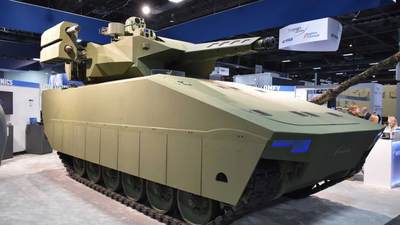
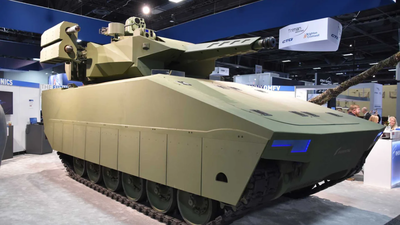
Just four months after DRDO‘s Vehicles Research and Development Establishment (DRDO) rolled out its Advanced Armoured Platforms, which will compete to replace the army’s aging Soviet era BMP-2K Sarath Infantry Combat Vehicles (ICV), the US Army is set to receive the first prototypes of its XM30 Mechanized Infantry Combat Vehicle (MICV). This comes at a time when around the world armies are attempting to replace their IFVs with more modern vehicles to replace fleets that were largely inducted during the final phase of the Cold War. In this race, besides India and the US, the UK with the Ajax, Russia’s Kurganets-25, Germany with its Puma, South Korea with K21 among other nations are replacing their aging inventory.ICVs are a type of armoured vehicle, which is armed with an integrated cannon and anti-tank missiles. These vehicles sit between a tank and an armoured personnel carrier (which usually do not have weapons organic to them). These heavily armed vehicles accompany tanks as a part of an armoured spearhead. Tanks although seen as impervious rolling fortresses are vulnerable to infantry armed with anti-tank missiles and man-portable rocket launchers and need infantry support to focus on their own specific task as a part of a larger armoured assault. Both these types of vehicles are also supported by equally mobile self-propelled artillery, air defence and engineer support to be effective on the battlefield. These vehicles, which will are increasingly being equipped with active protection system, can move personnel while under the protection of the vehicles armour.DRDO’s Futuristic- ICV (FICV) being developed jointly with Tata Advanced Systems Limited and Bharat Forge, the new platforms come in both tracked and wheeled variants, positioned squarely as contenders to replace the ageing BMP-2K Sarath Infantry Fighting Vehicles that have served the Army since the 1980s. The Future Infantry Fighting Vehicle programme itself is expected to procure between 2,000 and 2,200 units, with the broader requirement, factoring in reserves, potentially crossing 3,500 vehicles.The design brief for these platforms leans heavily on versatility. Both variants come with high-power engines, automatic transmissions and amphibious capability via twin hydro-jets, with the tracked version tailored for desert and semi-desert terrain, while the wheeled variant is better suited to plains and mountainous regions. Firepower comes from a crewless turret armed with a 30mm cannon, a 7.62mm machine gun and two ready-to-fire anti-tank guided missiles, a configuration that frees up internal space for troops to carry extra equipment such as drones or loitering munitions. Protection has been pushed up to STANAG Level-5, giving the platform resilience against a wide spectrum of direct and indirect fire threats, while the Army’s own roadmap calls for engines in the 360-450 horsepower range, closely matching DRDO’s specifications.The competition for this contract is far from settled, with private players including Mahindra Defence Systems and Larsen & Toubro are all developing their own FICV concepts, alongside Armoured Vehicles Nigam Limited representing the state’s own bid.Around the world, the US Army’s own effort to replace its Bradley Fighting Vehicles has entered a new phase, with the first prototypes of the XM30 Mechanized Infantry Combat Vehicle now at Aberdeen Proving Ground. German firm Rheinmetall’s American subsidiary has delivered its Lynx-based design, while General Dynamics Land Systems has fielded the Wolf, derived from the Griffin III and ASCOD 2 lineage, with both vehicles set to undergo trials alongside early versions of the M1E3 Abrams tank. Each company is expected to supply eight prototypes, with at least 108 XM30s slated for acquisition through 2031, a modest opening compared to the roughly 2,500 Bradleys currently in service.The XM30 marks a major leap, featuring hybrid-electric propulsion, remotely operated turrets, a two-person crew capacity for up to six additional soldiers that can dismount and fight. The vehicle will also have a substantially heavier XM913 50mm cannon in place of the Bradley’s 25mm gun, alongside loitering munition integration and anti-tank guided missile capability.