
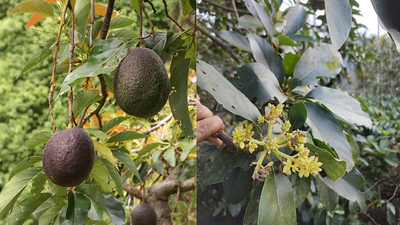
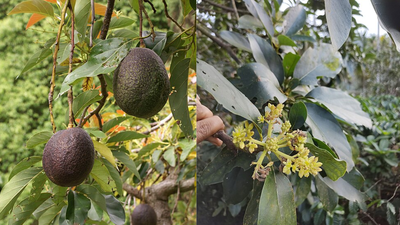
For more than a century, avocado growers have known that not all avocado trees flower in the same way. Some trees produce flowers that function as females in the morning before becoming males the following afternoon, while others follow the opposite schedule. This unusual rhythm has long shaped how orchards are planted, with growers pairing different flowering types to maximise pollination and fruit production. Although the pattern has been carefully documented for generations, the genetic mechanism behind it remained unknown. Now, researchers from the University of California, Davis and the University of California, Riverside have identified a single gene that controls this remarkable flowering cycle, solving one of the oldest mysteries in avocado biology and offering breeders a powerful new tool for developing improved varieties.
Every avocado flower opens twice, first as a female and then as a male
The findings come from the Proceedings of the National Academy of Sciences (PNAS) study ‘Balanced Polymorphism in a Floral Transcription Factor Underlies the Ancient Rhythm of Daily Sex Alternation in Avocado’ by J.S. Groh and colleagues.Unlike most flowering plants, each avocado flower opens twice over two consecutive days. During its first opening, the flower functions only as a female, capable of receiving pollen but not releasing it. It then closes for the night before reopening the following day as a male, releasing pollen after its female phase has ended.This sequence occurs in every flower, but entire trees follow one of two distinct schedules. A-type trees open their flowers as females in the morning and reopen as males the following afternoon. B-type trees do exactly the reverse, beginning their female phase in the afternoon before becoming male the following morning.
A single gene controls a rhythm that growers have observed for generations
To uncover the genetic basis of this unusual flowering pattern, the researchers sequenced the genomes of hundreds of avocado trees representing both flowering types.Their analyses traced the entire difference to a single gene known as SDMYB, a floral transcription factor that switches on a network of other genes responsible for coordinating when flowers open, close and transition between female and male phases.The study found that a dominant version of the gene produces A-type flowering, while a recessive version results in B-type trees. Rather than involving dozens of interacting genes, one genetic difference appears to determine the flowering schedule that growers have relied upon for decades.to Groh and colleagues, this provides a remarkably simple explanation for a biological phenomenon that has puzzled botanists and avocado breeders for around 100 years.
The unusual flowering pattern helps prevent self-pollination
The research also explains why the two flowering types are so important for successful avocado production.If every flower on every tree became female and male at exactly the same time, opportunities for pollen transfer between trees would be greatly reduced. Instead, the alternating schedules ensure that female-phase flowers on one tree overlap with male-phase flowers on another, maintaining a continuous supply of pollen throughout the day.This staggered timing encourages cross-pollination rather than self-fertilisation, increasing the likelihood of successful fruit production. It is also why commercial orchards have traditionally planted both A-type and B-type cultivars together, even before the underlying genetics were understood.
DNA testing could allow breeders to identify flowering types years earlier
One of the most practical outcomes of the discovery concerns avocado breeding. At present, breeders often have to wait several years before a young avocado tree matures and produces its first flowers, allowing its flowering type to be identified through observation.Because the new study links flowering behaviour directly to the SDMYB gene, breeders can now determine whether a seedling will become an A-type or B-type tree using a simple DNA test, long before the plant reaches maturity.The researchers suggest this could significantly accelerate breeding programmes by allowing desirable flowering combinations to be selected much earlier, saving both time and resources.By identifying the genetic switch behind avocado flowering, J.S. Groh and colleagues have solved one of horticulture’s longest-standing puzzles. Their discovery not only explains why avocado flowers change from female to male over two days but also provides growers and breeders with a practical genetic tool that could improve orchard planning and speed the development of future avocado varieties.